
You reach for your partner on an ordinary weeknight. Nothing dramatic, a small thing, a question about the weekend or a hand on the shoulder on your way past the couch, and they don’t look up, or they answer the question you didn’t ask, or they say “fine” in the voice that means it isn’t. And before you’ve had a single thought about it, something in your chest has already dropped, your jaw has already set, and by the time your mind catches up there’s a sentence waiting for it, one you’ve heard a thousand times, the one that says this is what always happens. Your partner sees none of that. What they see is you going quiet, or getting sharp, or picking up your phone. That’s the surface. Everything that produced it happened underneath, in about the time it takes to blink.
I’ve spent most of my working life underneath that surface with couples, and the framework that he’s helped me navigate down there is the NeuroAffective Relational Model, NARM for short, developed by Dr. Laurence Heller. NARM starts from a simple claim that turns out to change almost everything once you take it seriously: every one of us came into the world with a handful of core needs, and the shape of our adult relationships is largely the shape of what happened to those needs before we had any say in it. Heller names five. Connection, the need to feel welcome in the world, connected to our own body and to other people. Attunement, the need to know what we need and to take in what’s offered. Trust, the need to depend on someone and have it hold. Autonomy, the need to set a limit, to say no, and still be loved. And love and sexuality, the need to be loved with an open heart and our desire intact, as we actually are, without shame.
Nobody gets all five met all the way. That’s not a tragedy, it’s a description of being raised by human beings. Where a need went unmet often enough, a child built something around the gap, a strategy, and NARM calls those strategies survival styles. The child who reached and nothing answered learned to disconnect. The child whose needs weren’t treated as real learned to tend everyone else’s. The one whose adults weren’t consistent learned to count on nobody. The one who wasn’t allowed a self of their own learned to comply on the outside and resist on the inside. And the one whose desire was met with shame learned to split love from sex. Every one of those strategies was brilliant at six. The problem is that they’re still running at forty, and they’re running in the one place they were never built for, which is a marriage with someone who isn’t the parent who couldn’t meet us.
What I find so useful about NARM is that it doesn’t stop at the strategy. Heller noticed that each survival style tends to wear two faces, what NARM calls the shame-based identification and the pride-based counter-identification. The person who learned to count on nobody carries a shame face that says “I’m small, I’m weak, I got used,” and a pride face that says “I’m strong, I’m in control, nobody can hurt me.” They look like opposites. They’re the same wound, facing two directions, and most of us spend years mistaking the pride face for strength and the shame face for the truth about who we are.
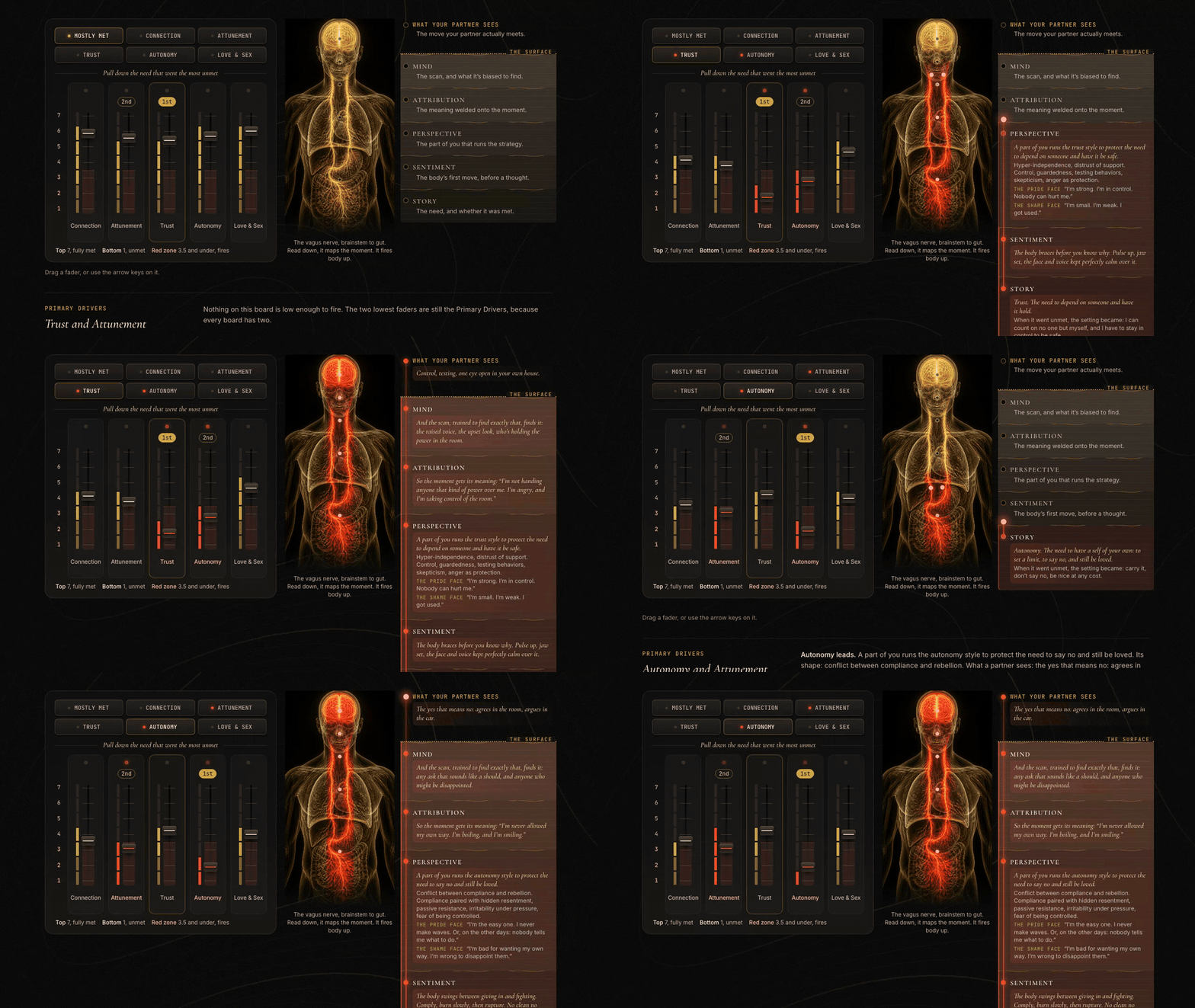
NARM gives us the developmental map. The way I teach it to couples runs that map through five layers I call the MAPSS Analysis™. Read them from the bottom up, because that’s the direction a moment actually travels. Story is the need itself, and whether it was met. Sentiment is the body’s first move, the drop or the brace or the heat in the face, before a single thought arrives. Perspective is the part of you that steps forward to run the strategy it built to protect that need. Attribution is the meaning that gets welded onto the moment, drawn from the body below it and from the oldest story you have about yourself. And Mind, at the top, is the scan, the brain’s search for proof, biased to find exactly what the story predicts, and it always finds it. Only after all five does anything reach the surface where your partner can see it. By the time your head gets there, your body has already decided.
So I built a soundboard. Five channels, one for each core need. A fader at the top is a need that was met. Pull one down far enough and it crosses into the red, and when it does, it fires, up through the five layers and up through the body beside them, gut to brain. And I built it for one reason, which is that I wanted the couples I work with to more deeply understand themselves and each other, and I’ve learned that most people need to see the thing before they can feel their way into it.
Every relationship has a soundboard, and most of the people inside one are unaware of the mix that’s playing and running the dynamics between them. Once you see it, it can be remixed.
We live in a world with more clinical language in it than at any point in history, and we’ve gotten very quick with it. “I’m anxious, he’s avoidant.” “That’s just my attachment style.” “She’s a narcissist.” There’s a belief underneath all of that vocabulary, that if we can just name the thing correctly, something will change. It almost never does. A label pointed at yourself becomes an identity, and an identity excuses repetition. “That’s just how I am” is the pattern defending itself with better words. A label pointed at your partner becomes a verdict, and a verdict requires nothing of you.
What I believe, and what is clinically supported, is that no one should be seen through the lens of their behavior alone. We don’t get to flatten a person into what hurts us, or into what we’d call bad behavior, because no one is just one part of themselves. The map is not the territory.
When we judge someone by only what they did, or by one part of them, we’ve drawn a map of them from the top layer of the board, the thing that comes out last, and often, with a lack of curiosity, we mistake that behavior for the person. And the part that did it was drawing from a map of its own, a very old one, which is why it isn’t bad. It’s doing its job. It just can’t see what the witness can see. Yes, sometimes those parts harden into coping that looks like a personality, and after enough years it can feel like one. But the moment you face yourself and learn that these parts are not destiny, that is how change works. They’re developmental parts. They carry very simple protective beliefs, maps that are keeping us from being free, and the work is bringing your most free self, the witness, to those much younger parts.
This isn’t written for anyone in a relationship where they’re being harmed and talking themselves into staying curious about it. Seeing the whole person doesn’t mean a lack of accountability. It doesn’t mean we can’t be hurt, or that we accept anything anyone does because they were protecting themselves.
True accountability takes tenacity and grit. It resists the easy, lazy way of seeing everything through judgment. Love demands that we see the whole person, in ourselves and in each other. True accountability sees people as they could be, and offers curiosity, tenderness, grace, and forgiveness on the way toward that potential.
If you’re with someone who is willingly on that journey, and the two of you are on it together, it doesn’t mean you won’t get hurt, or that you won’t hold each other to your values and to how you want to live them out. It means you have a deeper, wiser understanding of how to move toward the most free versions of yourselves.
Picture a board where trust is pulled lowest, with autonomy right beside it. Those two are the Primary Drivers, and the two lowest faders on anyone’s board usually run the room. Trust, for this person, went unmet early enough that the setting became count on no one but yourself, stay in control to be safe. Autonomy went unmet too, so closeness started to feel like it cost them themselves. When their partner reaches, what fires first isn’t a thought. It’s a brace in the body, a pulse that climbs while the face stays perfectly calm. Then a part steps forward, a Go-Along that agrees to keep the peace, and right behind it a Quiet Rebel who resents the agreement in private. Then the meaning lands, I’m being controlled, and the scan goes looking for proof, the tone, the look, who holds the power in the room, and finds it. What the partner sees is a yes that means no. Agreeable in the room, arguing in the car.
Now put the partner’s board beside it. Theirs has attunement lowest and trust right above it, a person who learned to track everyone else first and prove their needs were worth it before letting themselves ask. So they reach, and when the reach doesn’t land, a Pursuer presses, and a Scorekeeper starts the tally. One board’s withdrawal is its own wound. The other board’s pursuit is its own. Two boards firing at once, each one’s surface landing as proof on the other’s Mind layer, and neither of them is their behavior. They’re each a part that got scared.
The other thing the board taught me, once I put real people’s mixes on it, is that the Primary Drivers aren’t fixed from one day to the next. The Inner Compass sets the order, but some days the trust part is in front and some days it’s the autonomy part, and you’ll know which one is driving by what your body does and what you’re about to say. So there’s a little switch on the board now, the kind you’d flip on a mixing desk, that says who’s driving. Flip it in a calm moment, and then flip it in a hard one, and you start to know the two of them apart.
A lot of people resist the idea that their younger years are shaping their marriage right now. I understand the resistance. It isn’t up for debate, though, because this is how the brain works. The brain is one long story. Even someone who grew up with a fairly balanced mix was shaped by it, and still has room to grow. And every experience you have is experienced inside that mix. When something acute happens to you, at any age, it lands inside the mix and runs through the lens that’s already there. Sometimes it becomes the new floor, the deepest need on the board. It all works together, and no one is immune, because this is how human development works. A brain primed to survive and sustain itself is going to respond. A brain doing what a brain does is to be expected.
Which is exactly why none of this is a verdict. A mix was set a long time ago by a child doing the smartest thing they could with what they had, and a mix can be remixed. The brain doesn’t record, it predicts, and every time a need gets met in a way the old prediction didn’t expect, it gets a piece of evidence it has to account for. The fader moves a little, and then a little more. It isn’t easy. It takes a lot of intention, self-reflection, and love, for ourselves and for each other, but it can be done.
In the couples work I do, that remix runs in two directions, and I call them the mirror and the mission. The mirror is your own work, and it’s for you. It’s showing up for the parts of you that carry your two drivers. When you catch the old move starting, the press or the file or the silence, the mirror is noticing it, naming it to yourself, “there’s my protector,” and meeting the need underneath it yourself first, so it doesn’t have to come out as pressure on the person across from you. That’s the witness, meeting the younger part.
The mission is about the other person, never about advocating for yourself. It’s the question of what your partner’s two drivers are, and whether you can see giving them those two things as your mission, as a way of loving someone. If their drivers are trust and autonomy, the mission is a reach that doesn’t cost them anything. Space without a tally. A request without an edge. A no they can say and still feel you there. If their drivers are attunement and trust, it’s a steady presence that reaches back on purpose. A small bid returned. A hard moment stayed with for one more minute. Every time they get that from you, their faders move. So do yours.
I’m unique, but I’m not special. Any time I tried to set myself apart, as better than other people or as worse than them, I was separating myself from the one thing all of us share.
That’s the lesson I finally came to clarity about when I was fifty, and it sits under all of this. My suffering is not your suffering, and yours is not mine, but to be human is to suffer. The whole of a life is bookended by birth and death, and in between there will be failures, setbacks, and experiences that are painful, and there will be joy and pleasure and experiences that are ecstatic. Your board is unique to you, and in that respect it’s precious. What you share with every other person who has ever reached for someone and gone quiet when it didn’t hold is more important than what sets you apart, and that’s your humanity. You have dignity and worth, not because you earned them. You have them intrinsically, because every human being does. Your worth isn’t determined by your behavior. Your behavior comes out of your worth.
I keep asking myself what life and death really mean, and the only conclusion I come back to is that what makes a life meaningful is what we share, and the people we deeply love and share it with. That’s what the board is for. It isn’t a type, and it isn’t a sorting hat. It’s a picture of two people’s oldest maps meeting in the same room, drawn so you can stop reacting to each other’s surface and start getting curious about what’s underneath. Ask yourself which of your faders sits lowest right now, and what it would look like to meet that need yourself, before you ask anyone else to.
The NARM Relational Soundboard is a tool I built for exactly this. Pull a fader, load a mix, and watch what climbs, at coupleforward.com/inner-compass. The Inner Compass builds your own board from your own answers and names your two Primary Drivers.
