
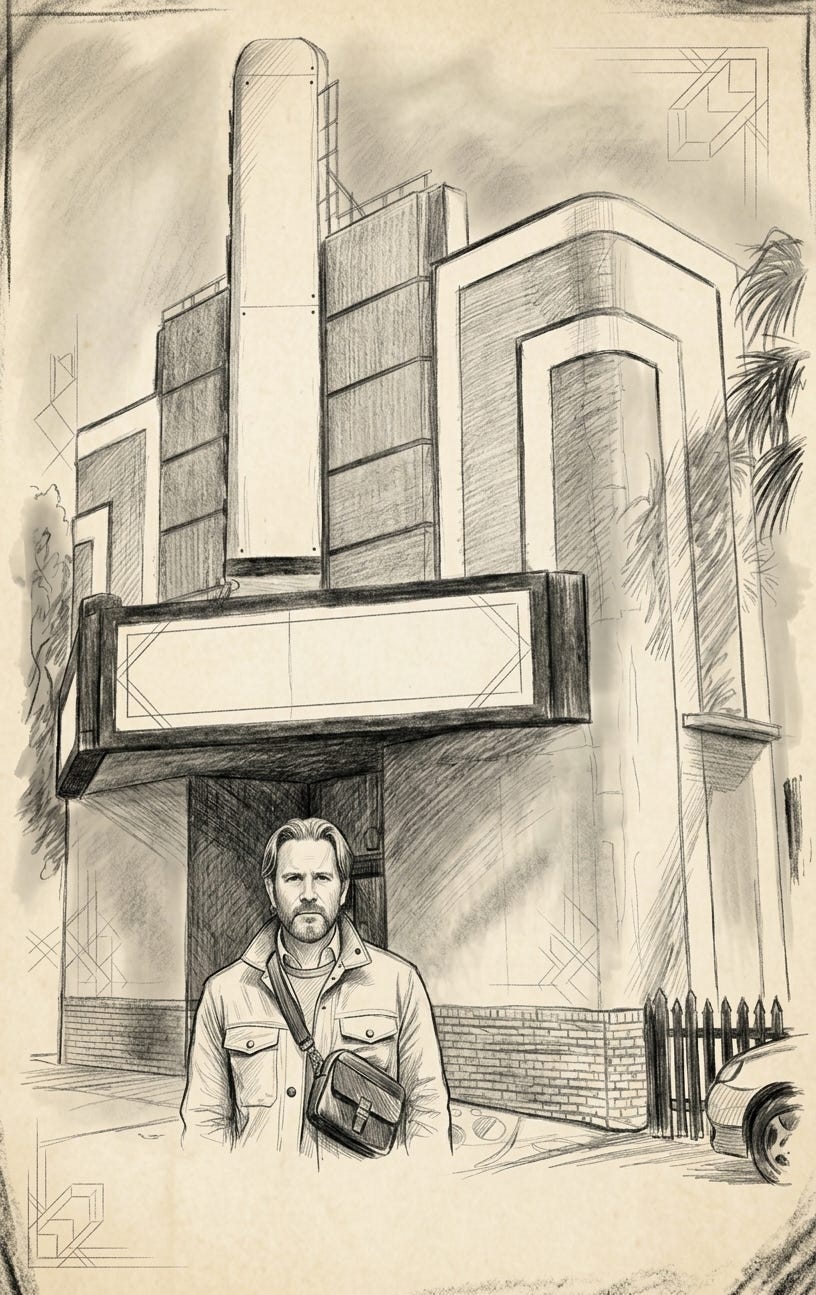
It is a Sunday morning circa 2004, candles, incense and glow. Donuts and coffee abound. The band is bending the room. The giant screen that used to show porn, illuminates the Nicene Creed. One hundred fifty people mill about in what used to be the Springs Theater, a 1938 movie house in Sulphur Springs, Tampa. The seats are torn out. The walls are urban brick. The old projector room has been converted to a sound recording studio console. The same room that sat dark after television killed the matinees in the sixties. The same room a fire gutted in 1966. The same room that ran as an auction house, then a peep-show theater the city raided in 1984 with thirty projectors and crates of film carried out in evidence bags. This room. Handpicked to set a tone. This is the last room. This is the room I left that map.
On stage, microphone in hand. Thirty-something. A guitar slung across my back, my wife and three girls in the second row, a vision for what this church was becoming. I had just done my best performance, channeling some version of Dallas Willard (saint) meets Mark Driscoll (yuck) meets Tim Keller (better) meets Brian D. McLaren (getting better) with the social rebellion of George Carlin (keeper).
The band has brought us to the edge. The last bridge broke people. Tattooed arms are raised in reverence. A couple in the third row reach for each other in a way that means they had been fighting all weekend. Deconstructing Baptists in the back are pretending to be comfortable. Students from a nearby Seminary are hoping they don’t get in trouble for attending. A woman on my right closes her eyes the way someone closes their eyes when the only relief left is to stop seeing the room. A kid up front, maybe sixteen, weeps openly without trying to hide it. The band behind drones underneath, keeping the tone.
This is what I came here to do.
This is what I grew up witnessing and doing.
I believed, with everything I had, that this room was where God’s love came to find people. Where the broken got put back together. Where a love so vast it could not be earned, so personal it knew you before you were born, so unconditional it would never let you go, walked into the space and laid hands on whoever needed laying hands on.
I meant every word.
Afterward, a young woman was waiting in the lobby. Her terminally ill cousin had come the week before. She was asking what to do. I sat with her, with the same warmth still on my hands from the worship, and I told her, gently, that her cousin was now headed for an eternity of conscious torment unless he repented and followed Jesus. I wouldn’t read Rob Bell’s *Love Wins* until 2011, long after my deconversion.
These were the talking points I grew up with.
I did not enjoy saying it.
I did not soften it either.
I held the sentence carefully and put it down in front of her like it was a fact about the weather.
I meant that too.
It was my map at the time.
This is what high-control religion sounds like from the inside. Not a documentary. Not an exposé. Not a meme account. A normal church on a normal Sunday, run by people who genuinely loved the people in the room, delivering a message structured so that the love and the threat arrived together and could not be separated.
I love you. Now go to hell, *unless*…
The *unless* is the entire architecture. The *unless* is what you do not see when you are inside, because the *unless* is invisible to the people for whom it has already been satisfied.
They are loved. They are “in.”
The cousin is not.
The cousin has fallen out of the love by some structural failure of mental assent or behavior or identity, and the love itself is still pure. The love is still good. The system is still good. It is the cousin who has gone wrong.
You believe this. You preach this. You do not yet understand that you are inside the second clause of a sentence whose first clause taught you that you were unconditionally adored, and whose second clause taught you that the adoration could be revoked in an instant by anyone who decided you had drifted.
That is not a belief system. That is an attachment injury wearing a robe, or on that day, jeans and a t-shirt.
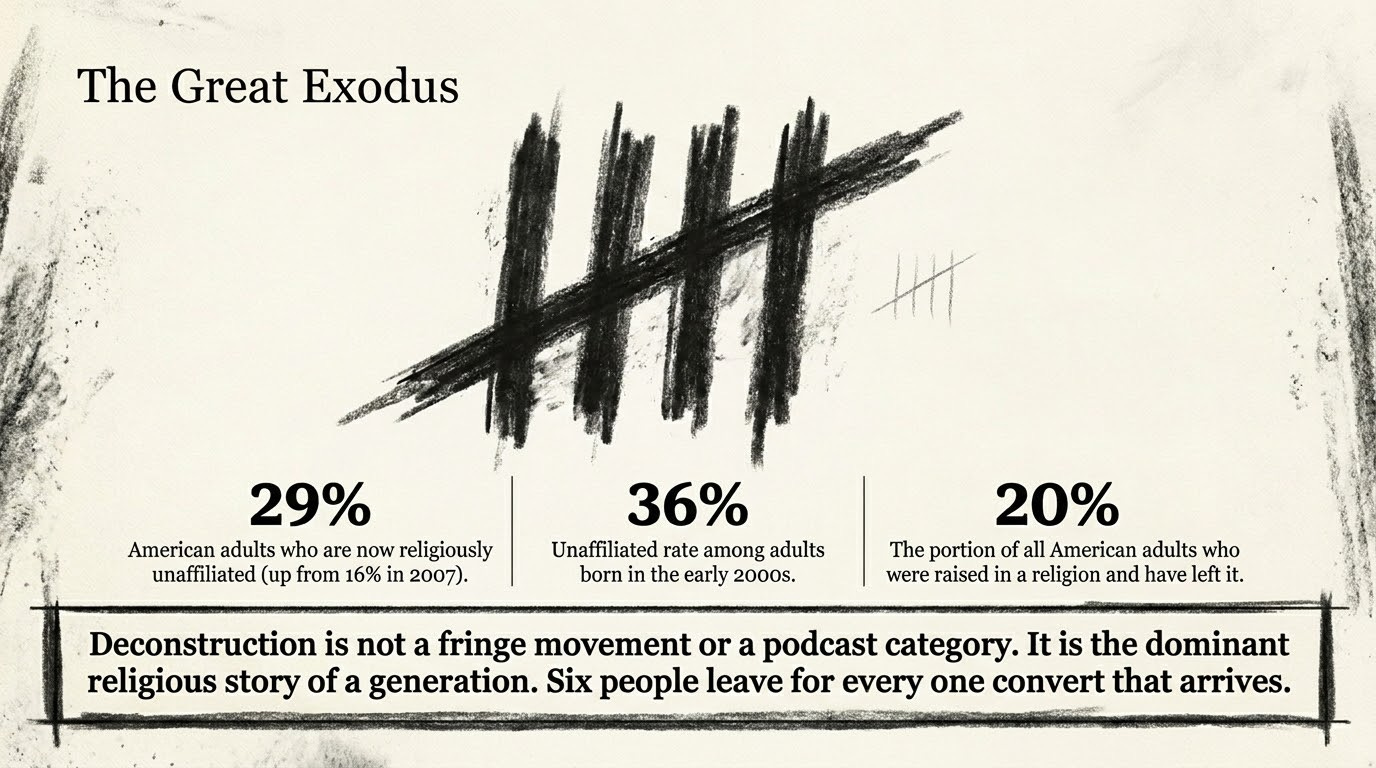
The Pew Research Center 2023-24 Religious Landscape Study reports that 29% of American adults are now religiously unaffiliated, up from 16% in 2007. Twenty percent of all American adults were raised in a religion and have left it. Among those born in the early 2000s, 36% are unaffiliated. The ratio is six former Christians for every convert to Christianity. Six leaving for every one arriving.
I know many of them. I have been part of The Clergy Project since 2014, a network where I sit with the deconverted and with clergy who meet me in secret because they no longer believe what they are saying on Sunday.
The numbers describe a reality the country has not yet metabolized. Deconstruction is no longer a fringe movement, no longer a Twitter hashtag, no longer a category of podcast. It is the dominant religious story of a generation. Millions of people are walking away from what cannot sustain, what does not fit, what falls short.
They are spiritual and not religious.
And even the ones who stayed are enthralled and entangled in the deconstruction. Looking at the website of the church I founded in 2001, this is the theme. They may be coming to some slightly different conclusions, but they’re asking the same questions.
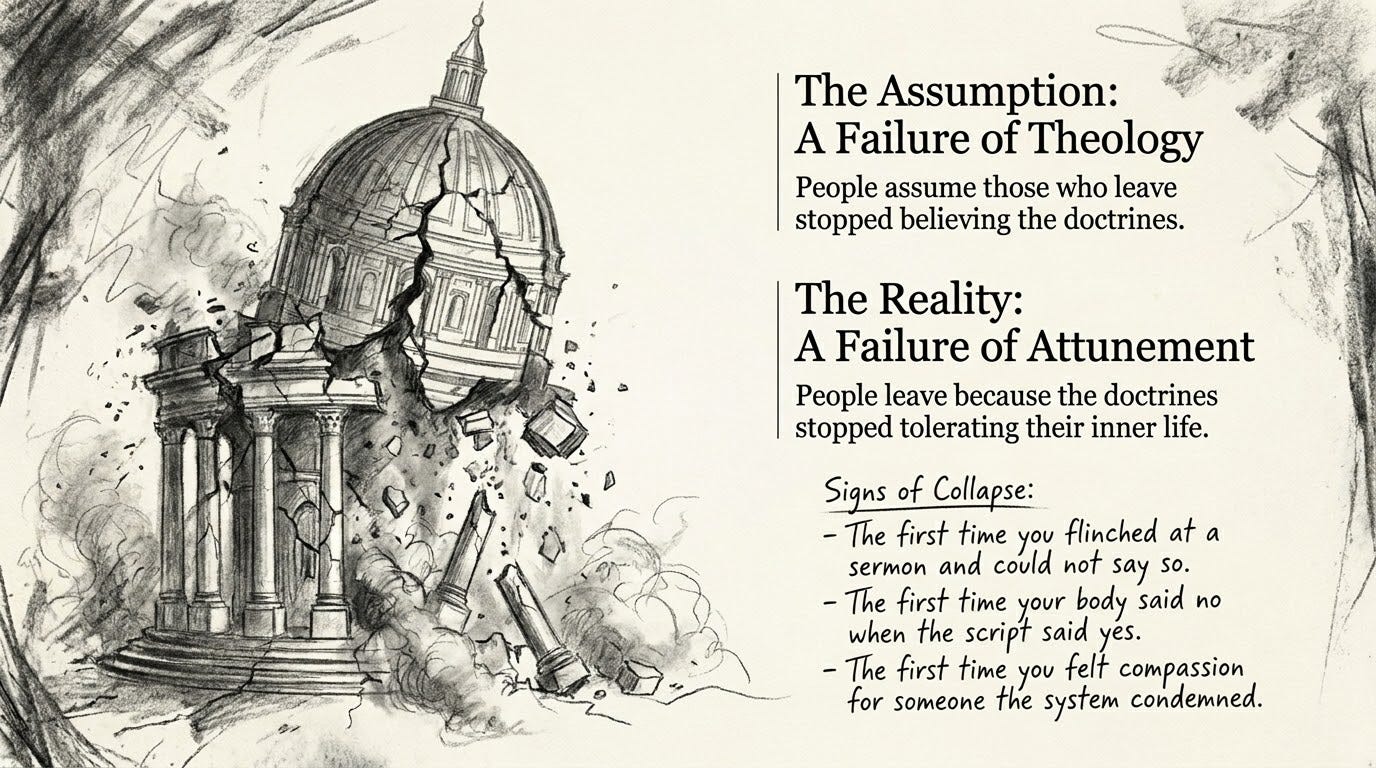
Those who leave do so not because they stopped believing the doctrines. They left because the doctrines stopped tolerating their inner life. They took it seriously and read the book. The first time you flinched at a sermon and could not say so. The first time you felt something for someone the system had condemned and did not know what to do with the feeling. The first time your body said no when the script said yes. That is the moment the architecture starts to fail.
Not at the level of theology.
At the level of attunement.
At the level of human.
A 2023 study published in the journal *Socio-Historical Examination of Religion and Ministry* found that between 27 and 33 percent of American adults report religious trauma at some point in their lives. Between 10 and 15 percent currently meet criteria. The psychologist Marlene Winell, who coined the term Religious Trauma Syndrome in 2011, frames the condition as a hybrid of post-traumatic stress disorder and complex post-traumatic stress disorder, mapped onto the framework Judith Herman built for survivors of prolonged captivity.
The captivity framing is not metaphorical. It is structural. A system that requires the suppression of inner experience as the price of belonging is, by definition, a system that cannot let you out without injury.
You cannot become a self while inside it. Not without cost.
And when you leave, the self you become must be assembled from pieces the system never let you have.
The attachment research goes further. People relate to God the way they relate to their primary caregivers. Securely. Anxiously. Avoidantly. With chaos. The studies, going back to Kirkpatrick and Shaver in the 1990s and continuing through the present, show that the divine attachment figure is not a category of belief. It is a category of relationship. People who left high-control religion did not just lose a worldview. They lost a primary attachment figure who turned out to have been relationally unsafe the entire time.
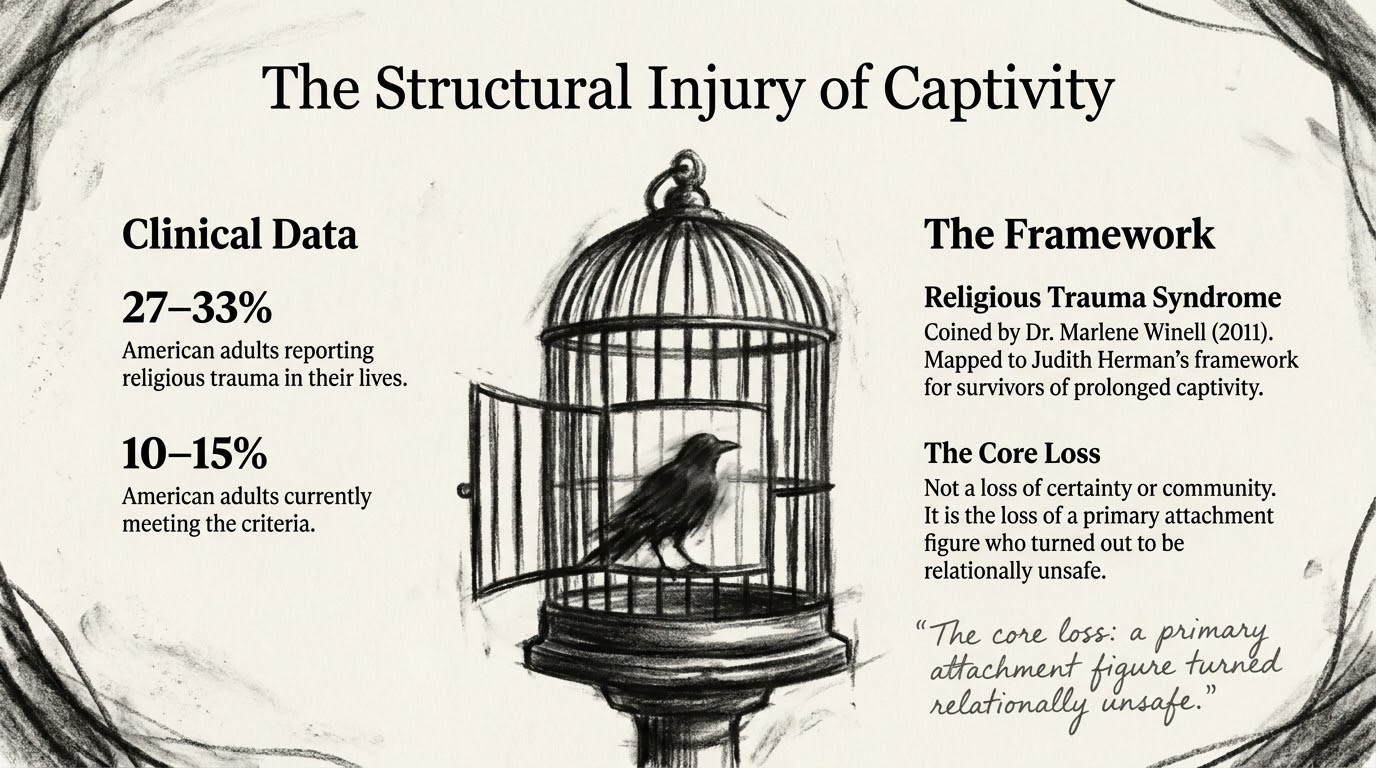
That is the structural injury. Not the loss of community. Not the loss of certainty. The loss of a love that turned out to have a price tag.
When you were inside, both your inner world and your interpersonal life became organized around managing shame, and that did some serious damage to your well-being and your relationships until you became conscious of it.
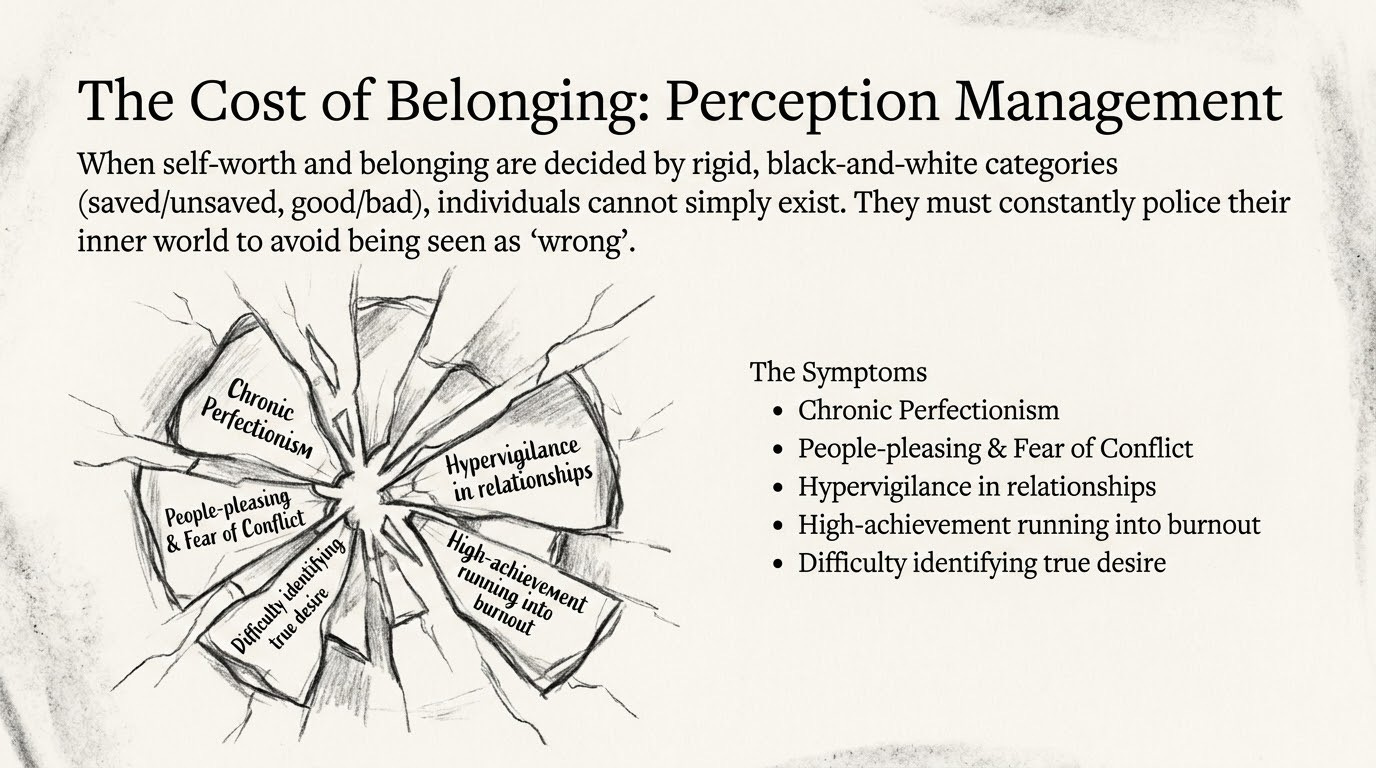
You had to make sure you weren’t wrong or bad inside, and you had to make sure you weren’t seen as wrong or bad, because high-control religion uses black-and-white categories like good versus bad, saved versus unsaved, heaven or hell, godly or sinful.
And when self-worth and belonging are decided by fixed, rigid categories like this, people self-police using them.
So inside of you, you didn’t get to just exist inside of yourself. There was no developing freely and naturally.
You grew up constantly monitoring your inner world, supervising your experience, your intentions, your thoughts. You scanned and policed yourself for that wrongness all the time.
And what did you find? You were not completely “good” inside.
So your personality and, later, your relationship patterns developed around avoiding being seen as wrong. Perception management was as good as you were going to get because there was very little room for the messy, the gray, the beautifully layered, multi-dimensional reality of being human.
This is why, in my work with these clients, I see so much perfectionism. People-pleasing. Hypervigilance. High-achievement that runs straight into burnout. Difficulty identifying desire. Fear of conflict. Anxiety or avoidance in relationships. These are perception management strategies. They make sense for the environment you were raised in. It demanded muted self interest.
The work becomes conscious. You bring it forward. You reckon with what happened. You grieve. And then, slowly, you start to relate from inside yourself instead of from inside the management.
And then you get to live a life that is authentic and aligned with your actual values and needs, not just the projection you had to perform to stay safe.
One lens I work through is NARM, the NeuroAffective Relational Model, a developmental trauma framework that maps five core relational needs every nervous system arrives in the world expecting.
Connection.
Attunement.
Trust.
Autonomy.
Love and sexuality.
When one of those needs goes unmet in development, the nervous system pins that channel down and compensates by pinning the other channels up to manage the deficit. The two channels that high-control religion structurally cannot tolerate are the same two it pins to zero in the people inside it.
Attunement.
Autonomy.
Attunement requires that your inner experience be allowed. The doubt, the question, the feeling that does not match the script. High-control religion cannot allow this because the entire belonging structure depends on the inner life conforming to the doctrine. Doubt is sin. Questioning is rebellion. Diverging feeling is the flesh, the world, the devil, take your pick. The body learns that what is happening inside it must be hidden, suppressed, prayed away, or repented for. There is no version of the inner life that is allowed to be real on its own terms.
Autonomy requires that your no count. That it does not cost you belonging. Your separateness. Your divergent path. High-control religion cannot allow this because the system’s coherence depends on uniformity. Leaving is apostasy. Disagreement is pride. The boundary you draw is the door you walk through on your way to hell. The body learns that there is no exit that does not cost you everything.
Two starved channels. A whole personality built to compensate. A whole life structured around managing the deficit while being told the deficit is love.
You may have built a beautiful life on top of all this. The architecture does not announce itself. It runs underneath. It runs in the moment you flinch at a kindness. It runs in the moment your partner says you matter, and a part of you, twelve years old, still wonders what you must do to make the mattering hold.
When I look back, I was always in deconstruction. Maybe we all are.
The questions started with theology. A garden. A tree. A bite. A sentence to hell, commutable only by mystery. I had been applying an outsider’s lens to every other faith tradition for years. At some point I turned the lens around and looked at my own. The doctrines did not survive the look.
I remember a sermon I once gave in that same room about how the story sounds from the outside.
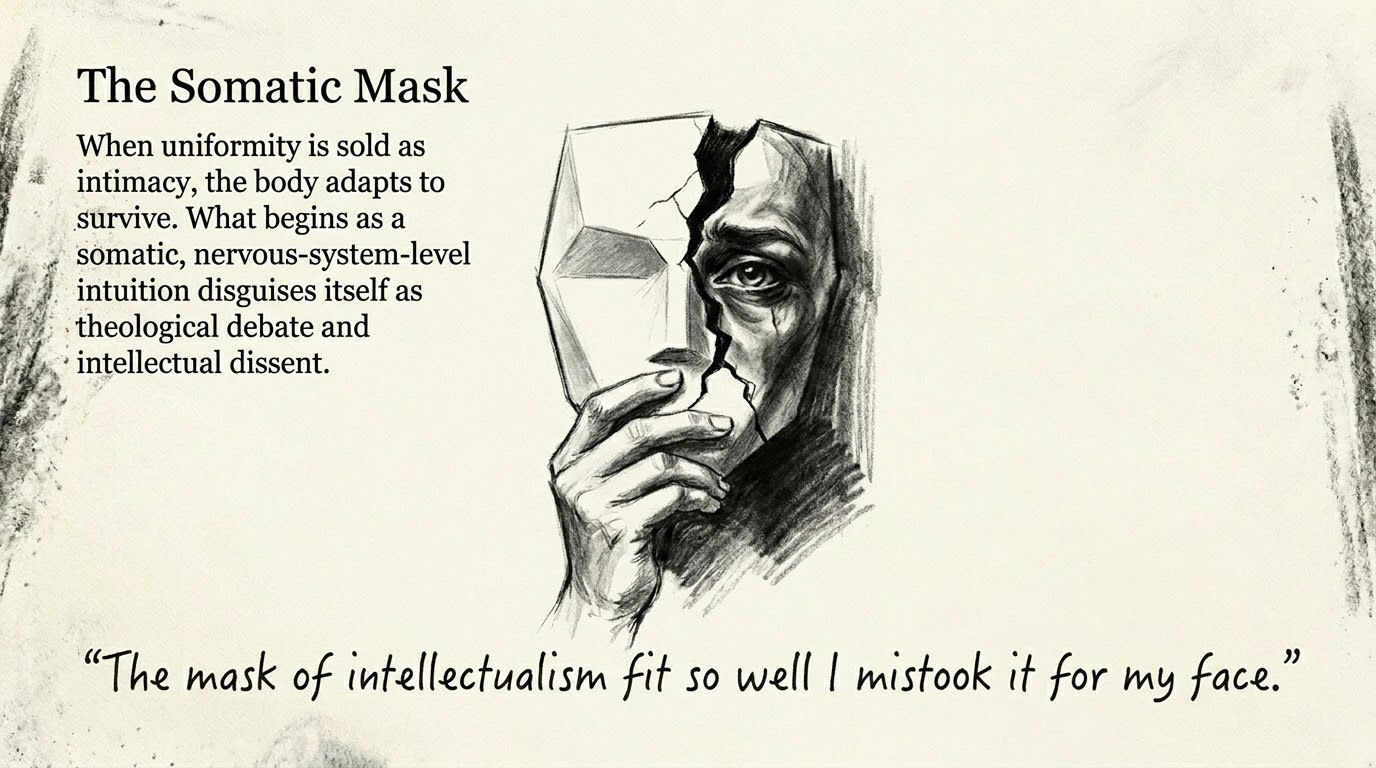
Underneath was a somatic intuition…disguised as theological debate…masked as intellectual dissent. But I wasn’t just thinking. The body has a way to adapt. To attune. To survive. To sense when uniformity is sold as intimacy. To smell when conformity dressed up as connection.
The mask of intellectualism fit so well I mistook it for my face.
Something in me began to refuse, more loudly. Something in me began to attune, against the rules, to the people the system was telling me to condemn. Something in me began to claim an autonomy I had not been allowed to have.
Retribution lost. Condemnation lost. Love gave me the courage to claim attunement over certainty. Authenticity over assimilation.
I confused compensation for character.
I confused certainty for faith.
I confused absence of doubt for the presence of the divine.
I confused.
You may not yet trust that anyone, anywhere, has the capacity to love you without conditions. That is not pessimism. That is data. Your nervous system is recording what it has experienced and updating accordingly. The trust will come back the way trust always comes back.
Slowly.
Through repeated experiences of being received as you are, not as the script wanted you to be. Through people who can hold the whole of you without flinching. Through the discovery that some forms of love do not, in fact, come with a second clause.
Love that requires an *unless* was never love.
It was a system.
You can grieve the system. You can grieve the community. You can grieve the version of yourself who lived inside it. You can grieve all of it without going back.
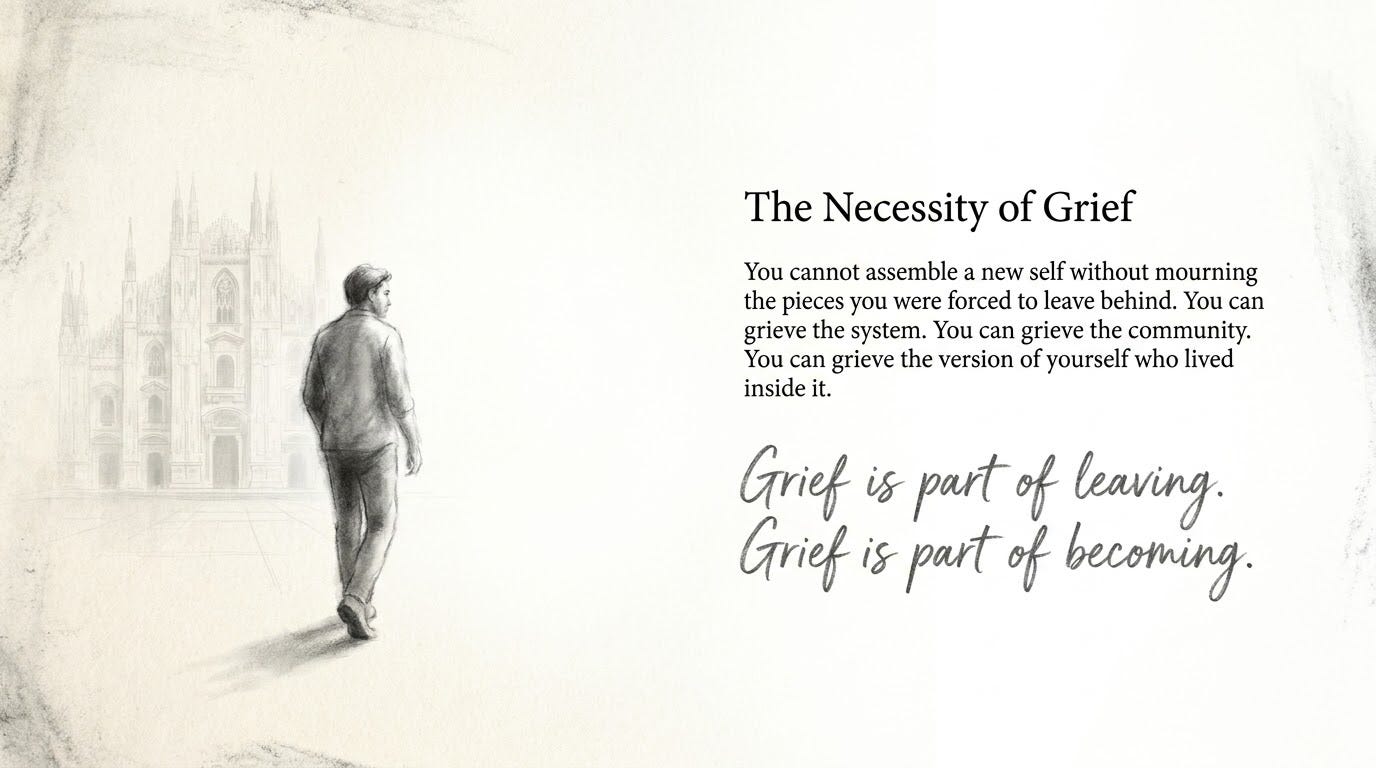
Grief is part of leaving.
Grief is part of becoming.
