

In 1947, in a converted garage behind his house on Curson Avenue in Hollywood, Les Paul was taking apart an Ampex 200 tape recorder. He was trying to do something nobody in the recording industry thought was possible. He wanted to record a guitar part. Then play it back while recording a second part on top of it. Then a third. Then a fourth. All stacked. All preserved separately.
Before Les Paul, a song was a room. Everyone showed up on the same day, at the same hour, and played it together. If the trumpet player cracked a note, the whole take died. If the vocalist was flat, everyone started over. The song was whatever happened in the room that afternoon.
Paul cut a second playback head into the Ampex and wired it so he could listen to what he had already recorded while recording something new against it. He called it soundon-sound. In 1951, his wife Mary Ford, blanket over her head so the neighbors would stop complaining, sang a vocal line into a single RCA Type 44-BX ribbon microphone.
Then sang a harmony against it.
Then another harmony against both.
By the time the record was finished, Paul had stacked something like twenty-four tracks, the same number used in big-budget recording sessions today, done in 1951, in an apartment, by a man and his wife. When the song was released, listeners were hearing a woman singing with herself across weeks of studio time. Three versions of Mary Ford, balanced and stacked, and what came through the radio sounded like one voice in one moment.
But it was a stack.
The song itself was not Paul’s. “How High the Moon” was written in 1940 by Nancy Hamilton and Morgan Lewis for a Broadway revue called Two For The Show. By the time Les Paul got to it, at least seventy-five other artists had already recorded it and none of them had a hit. Benny Goodman cut it first. June Christy had a minor chart entry with it in 1948. It was a jazz standard sitting around waiting for someone to do something different with it.
What Paul invented was the soundboard. Every instrument on its own channel. Every channel with its own fader. Every fader movable in real time. A single song, played on the radio, is the output of dozens of decisions made by someone with their hands on a board the listener will never see.
The musicians play their parts. The producer hears the song. That distinction is the whole thing. The player is inside one channel. The producer is watching all of them at once, seeing how they stack, where they clash, which one is pinned in the red and which one has gone silent without anyone noticing.
Every relationship is a soundboard, and most of the people inside one have never once looked at the board.
There are five channels.
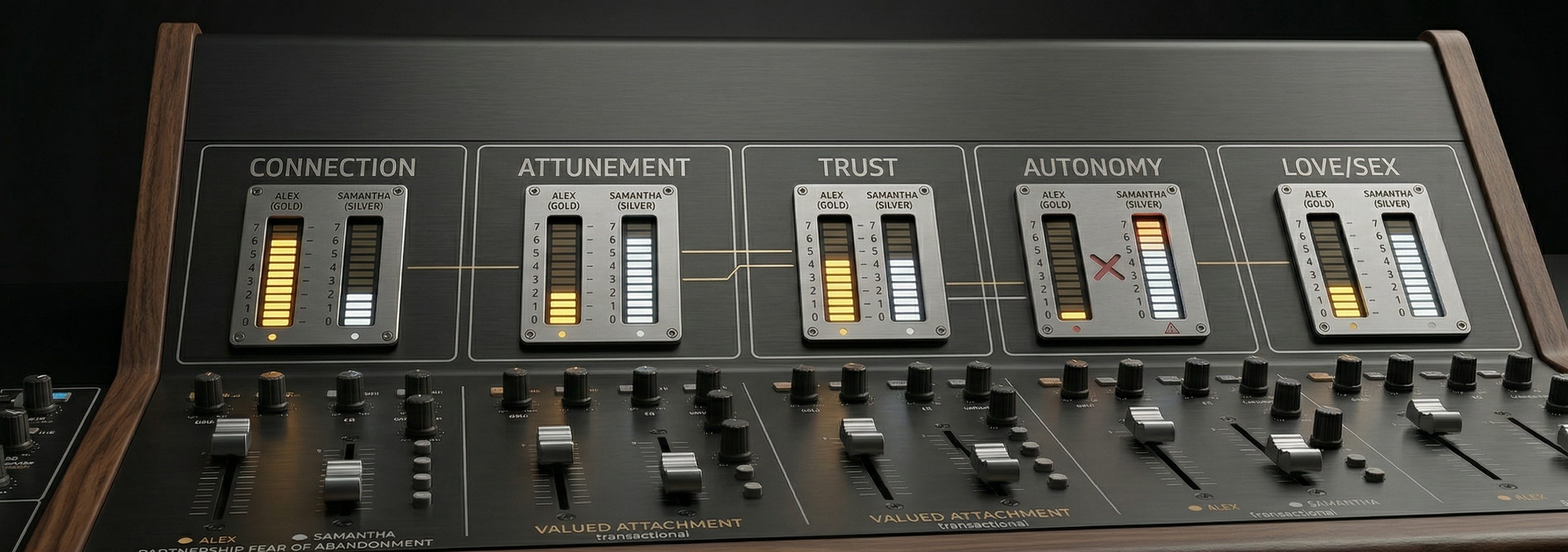
The first is connection. It was calibrated before you had language. When you reached, something answered, or it did not, and whichever happened often enough became the baseline setting of your connection channel. Whether reaching toward another person feels like coming home or like stepping off a cliff got decided in a nursery you do not remember.
The second is attunement. Not, did they love me, but did they see what was actually happening inside me. When you were sad, did a face come close and register sad. When you were frightened, did someone name the fear without dismissing it. Attunement is the channel that records whether your internal state was treated as real.
The third is trust. It was set by whether the adults around you stayed consistent when you needed them. Not perfect. Consistent. A parent who shows up hot on Monday and cold on Thursday and warm on Saturday teaches the nervous system that trust is a prediction problem with no solvable pattern. The channel learns to stay guarded because guarding is cheaper than being wrong.
The fourth is autonomy. When you said no, what happened. When you wanted something different from what the room wanted, was your difference respected or punished. Autonomy is the channel that records whether having a self of your own was safe.
The fifth is love and sexuality. Whether your desire was named as beautiful or treated as shameful. Whether the body you were given got welcomed into the world or shrouded. Whether the first erotic stirrings of adolescence were met with pride or panic. This channel carries more installed contraband than any of the others, because the culture had opinions about it before you were born.
Those are the five baselines.
That is where every human being starts.
But here is the part nobody teaches you. The baseline is not the current setting.
When a channel gets starved in development, the fader does not just sit low. It gets pinned. And the nervous system compensates by pinning other channels all the way up to cover the deficit.
The child whose autonomy was crushed grows up with connection cranked to ten, because connection became the only channel that worked. The child whose attunement went missing grows up with trust pinned at two, because trust was the channel that kept failing. The child whose love channel got shamed grows up with autonomy cranked to ten, because distance became the only safe place to keep desire.
That becomes the mix.
That becomes the personality.
That becomes what other people experience as you.
The fader that got pinned at four years old is the same fader driving the fight you had last night. The channel that never got fed is the channel running hot underneath every argument, every silence, every shutdown, every protest, every time one of you walked out of the room.
The fight is not about the dishes.
The fight is not even about the anger.
The anger is the secondary emotion.
The driver is a channel that got starved decades ago and is currently pinned in the red, asking for something it has never gotten.
Your partner has five channels too. Calibrated in a different childhood. Mixed by a different nervous system.
Two boards.
Two mixes.
One song playing in the kitchen.
The truth is that you are one hundred percent responsible for your own mix. Nobody else can un-pin your faders. Not your partner. Not your therapist. Not your childhood if it ever apologizes. The work of bringing your own board back into balance is inside work, and it belongs to you.
And…..
In partnership, you are responsible to be responsive. Not in the soft generic way that word usually gets used. Responsive specifically to what is running underneath the secondary emotion in the person across from you.
To love someone well is to love them with the same generosity and charity that we love children. With children we always think in 3D. We are instinctively aware that their grumpy tantrum represents something missing, a nap, some food, attention. We often forget this truth when it comes to our partner, who is always seeking their most unmet need in development and life with us.
The work is to listen past the secondary emotion and speak to the driver.
Not to fix it. You cannot fix it.
Not to rescue it. You cannot rescue it.
But to be on a mission to meet the need as a partner. To help balance the mix. This inevitably is a factor in their healing. It gives them a different nervous system experience.
This is the beauty of a healthy relationship brought in by emotional intelligence.
Like music, it’s transcendent.
This is the move that changes relationships at the level they actually run.
If you can hear this mix. The song changes.
Les Paul did not control every channel.
He listened for what the song was missing.
And then he answered it, with grace.
When Capitol Records release the song, it went to number one on the Billboard pop chart and stayed there for nine weeks. It spent twenty-five weeks on the chart total.
The record went into the Grammy Hall of Fame in 1979. Les Paul is the only person ever inducted into both the Rock and Roll Hall of Fame and the National Inventors Hall of Fame.
The song had failed seventy five times before.
Every chance, every moment is a chance to turn everything around.
