
A couple sits three feet apart on the same couch and tells me two different stories about the same Tuesday night. Not two versions of one night. Two different nights. He remembers her voice going flat and the temperature dropping out of the room. She remembers him walking out of the kitchen without saying anything. Both of them are telling me the truth as they experienced it. Both of them were standing right there. And the longer they talk, the more certain each one gets, because certainty is what a body reaches for when it stops feeling safe.
I have watched some version of that a thousand times now, and it has never once been a memory problem.
Daniel Kahneman gave the mechanism a name in Thinking, Fast and Slow, and the name is the entire problem: "What you see is all there is." Your mind builds a whole confident story out of whatever managed to reach it, and it never once flags the parts that never arrived. So you do not experience a partial view of your marriage. You experience the truth, and you experience it with your whole chest.
Somebody sent me a guide called The Hidden Layer. It was written by Travis Mayo, who spends his time pointing at the machinery running under ordinary life, and it is the first thing I have read in a while that made me want to argue with somebody in a good way. He takes five different fields, language and psychology and neuroscience and philosophy and the old contemplative traditions, and he shows that all five of them walked to the same conclusion without ever comparing notes. The sentence he lands it on is this: "What you believe to be fixed is constructed." Which is the whole argument, because a thing that got built once can be built differently.
He built that out of linguists and neuroscientists and a Roman emperor writing notes to himself in a tent. I built my version out of a room with two people in it and a box of tissues on the table between them. We both ended up with five layers. I do not think that is a coincidence, and I do not think it is impressive. I think it is what happens when two people describe the same basement after walking down two different staircases.
The one I use is called MAPSS, and it is a descent. You start at the top with what your attention locked onto, the thing you noticed, the tone shift or the silence or the look. Underneath that is the meaning your brain assigned to it, which shows up welded to a feeling so fast that you cannot tell them apart while it is happening. Underneath that is the stance you took, the version of you that comes out to handle it, the part with a job. Underneath that is the feeling that was actually there before the protector showed up, riding on a nervous system that had already made its decision. And at the bottom is the old story that wrote all of it, usually before you were old enough to have any say in the matter.
Same finding. What feels like the floor is a construction.
His five layers live inside one skull. That is the honest boundary of the project and he never pretends otherwise. Your language, your story, your perception, your self. And every one of those is true. The trouble is that almost nobody suffers alone. They suffer three feet from somebody they love, and the moment there are two of you, the machinery stops being a filter and starts being a circuit.
Your brain runs a forecast of what this person is about to do, based on twelve years of evidence, and then it perceives through the forecast.
Mayo describes this well, but your partner is not a sunset. Your partner is watching you too, running their own forecast, and the two forecasts talk to each other. You brace before he answers. He sees the bracing and hears an accusation that has not been made yet. He answers short. You collect the short answer as evidence. Both of you walk away with your model confirmed, and both of you are right, because you built the evidence together.
That is the part I would add:
In one mind, a prediction is a distortion. Between two people, a prediction is a machine that manufactures its own proof. Two people can each be right about what they saw and still be wrong about what happened, and no amount of private insight fixes that, because the error does not live inside either person. It lives in the space between them, which is a place neither of them can reach alone.
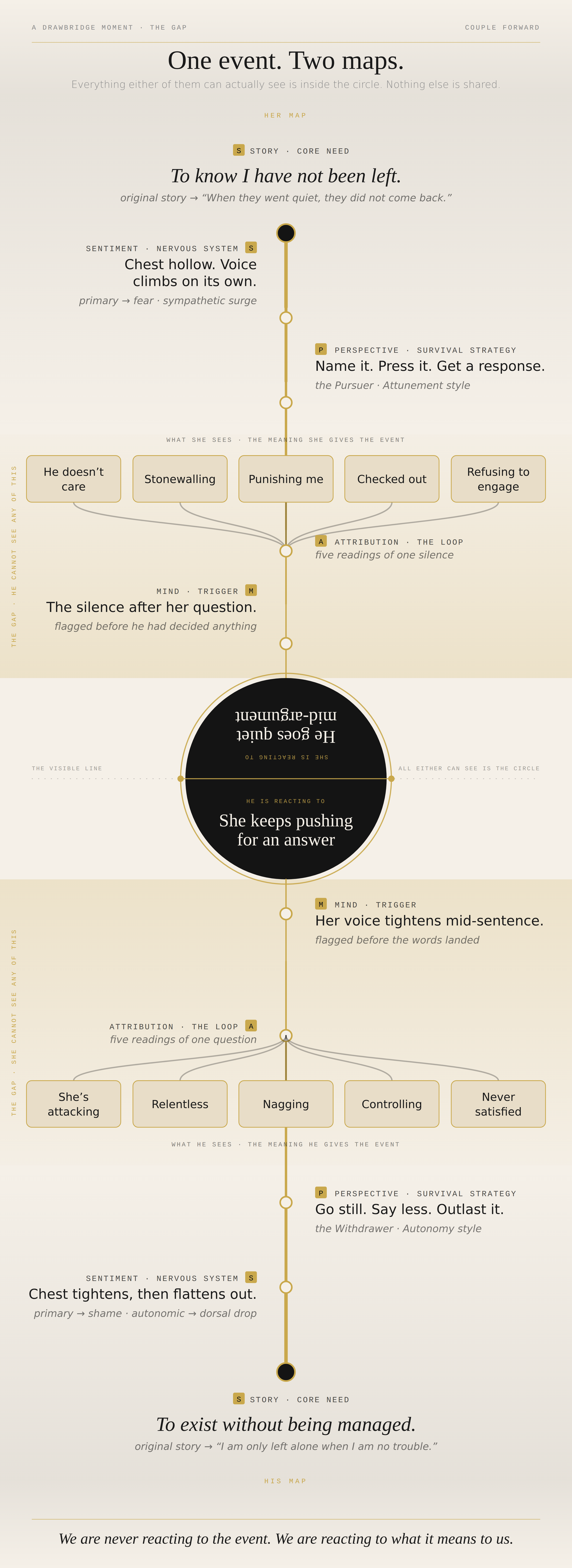
The second thing I would add is about depth, and it is the reason I am fussy about the order of the layers.
Language sits near the top of the stack. So does story. Those are the layers you can work with using more language and more story, which is why they are the layers everybody works with, and why the work feels productive. You can get very good at describing your pattern. I sit with people who describe their own pattern better than I could, and that is not a joke and it is not a failing. It is what happens when a generation gets handed excellent vocabulary and nothing to do with it.
Underneath all of it there is a feeling that showed up first, and underneath that there is a nervous system that made its call before any of the words arrived. That layer does not read. It does not take instruction. It changes its mind about you the only way it ever has, which is by being shown something different, over and over, in a room where nothing bad happens.
Bessel van der Kolk says it about as directly as it can be said in The Body Keeps the Score, that "being able to feel safe with other people is probably the single most important aspect of mental health." Not insight about other people. Safety, with one, repeated until the body believes it. This is why a person can understand exactly what they are doing, watch themselves do it anyway, and then feel a specific kind of shame about it that nobody warned them was coming. It is not a willpower failure. It is the difference between a layer that speaks your language and a layer that does not.
Mayo closes on noticing. His last move is to tell the reader that they can see something now they could not see before they opened the guide, and that this counts for a great deal. And in the chapter on the old traditions he gets nearer to my whole argument than anywhere else in the book, when he points out that those traditions never treated knowing about a pattern as the finish, that they built practices for catching it while it ran.
He is right, and I would push on it harder than he does. Marcus Aurelius was not writing a book when he wrote "our life is what our thoughts make it." He was writing to himself, at night, on a military campaign, because he knew he would have lost the thought by morning. The most quoted Stoic in history did not trust himself to hold his own best insight for twenty-four hours, so he wrote it down again and again for years. That is the part everybody skips. They take the sentence and leave the practice, which is like copying out a musician's favorite chord and never touching the instrument.
We are the most psychologically literate generation that has ever tried to stay married. Everyone can name their attachment style. Everyone's ex has a diagnosis now. Everyone has the vocabulary, and almost nobody has the exit, and the reason is that insight got sold as the finished product when it was only ever the first move. Insight explains the fight after it is over. It is a report filed from a calm room about a war that happened somewhere else. Noticing while it is happening is a different skill entirely, and choosing something else while your chest is tight and your face is hot is a third skill on top of that, and none of the three come free with the other two.
The story people tell themselves here is that they are lazy or broken or not trying hard enough, and it is almost never true. This is the group that tried hardest. They read the books. They did the couples weekend. They came home and had the same fight on Thursday and concluded something was wrong with them personally. What was actually wrong is that they were handed a map and told it was the journey.
A map is worth having. None of this is an argument against understanding yourself, and without a map you are just wandering. But a map that never terminates in an instruction is a souvenir, and a whole industry has gotten rich selling souvenirs to people who were asking for directions.
So. You already know the pattern. You have named it, probably more than once, possibly out loud to your partner in a voice that was not entirely kind. The question is not whether you understand it.
I keep asking myself what it would take to catch one of these things live, on an ordinary night, with somebody I love standing in front of me and my whole body voting for the old move. Not to fix it. Just to see it while it was still happening, and stay there a second longer than usual before I did the thing I always do.
Viktor Frankl called that "the last of the human freedoms," and he found it in a place where every other freedom had already been taken from him. He was not describing a person who understood their situation. In that place understanding changed nothing at all. He was describing what a person does inside a situation they cannot change.
That second is small and it is the entire hinge. Everything I know how to teach lives on the far side of it.
Read Mayo's guide. It is genuinely good and he is doing careful work. Then ask yourself the question his guide opens!
You have the map. What are you going to do on Tuesday?
If you want to look at one of these layers directly, I built a small tool for it. It walks you down one inherited map, the one you did not choose and have never examined, and shows you where it is still running: coupleforward.com/inherited-maps.
Travis Mayo's work is his own and worth going to directly. The Hidden Layer is his; the argument above is what it started in me.
