In 1914, a Polish aristocrat named Alfred Korzybski watched the world come apart.
He was thirty-five years old, serving as an intelligence officer in the Russian army on the Eastern Front. He came from a family of mathematicians and engineers — generations of people who had built their lives on the assumption that if you could think clearly, you could navigate anything. The trenches corrected that assumption with extreme prejudice.
What Korzybski saw during the war was not just violence. He had expected violence. What shook him was the precision of the engineering and the catastrophic stupidity of the reasoning. The same species that had produced calculus, mapped the stars, and split the structure of matter into its elementary pieces was now feeding its children into machine guns because of ideas no one had bothered to examine. National borders. Ethnic narratives. Political identities. Theological certainties. All of it. Every justification for every body in every trench, rested on the absolute conviction that the story someone told about reality was reality itself.
He survived the war. Barely. And when he came out the other side, he carried one question with him for the rest of his life: Why do humans, capable of extraordinary reasoning in science and mathematics, keep producing catastrophic failures in how they relate to each other and the world?
It took him almost twenty years to answer it.
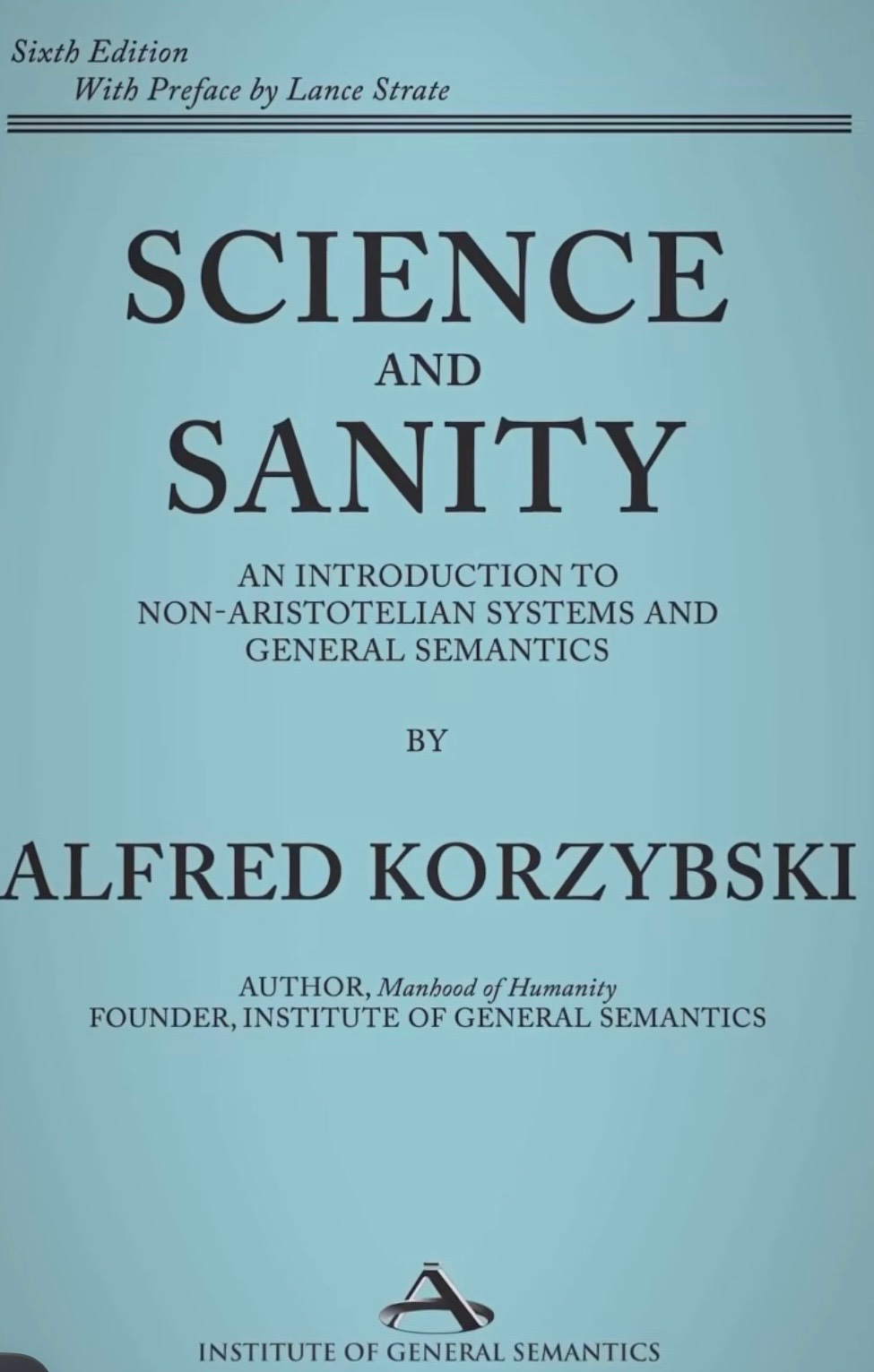
In 1933, Korzybski published a book called Science and Sanity. It ran over eight hundred pages. It drew from mathematics, physics, neurology, psychiatry, and philosophy, sometimes within the same paragraph. It is dense, sometimes maddening, and almost entirely ignored by the academic establishment of its time. It also contained what I believe to be the single most important sentence ever written about why human beings suffer in their relationships, their politics, their families, and their own skin.
“A map is not the territory it represents, but, if correct, it has a similar structure to the territory, which accounts for its usefulness.”
That sentence changed my life.
It is changing my marriage.
It is changing the way I practice therapy.
And if you stay with me through this piece, I want to make the case that it can change the way you see every relationship you’re in — with your partner, your children, your colleagues, your country, and yourself.
Let me cook
Korzybski’s argument is deceptively simple. Humans cannot access reality directly. Everything we experience is filtered, first through the nervous system, then through the languages and symbol systems we’ve inherited. What we call knowledge is always an abstraction. Never the thing itself.
Think about what that means for a moment. Not as philosophy. As physics.
Right now, as you read this, photons are bouncing off a screen and entering your retina. Your retina is converting those photons into electrochemical signals. Those signals are traveling along your optic nerve. Your brain is receiving them, cross-referencing them with stored patterns, filling in gaps, smoothing out inconsistencies, and constructing, the word is constructing, an experience that you call “reading.” What arrives in your consciousness is not the screen. It is your nervous system’s representation of the screen.
A rendering.
A map.
This happens at every level of experience. The sound of your partner’s voice. The memory of your father’s face at the dinner table. The feeling you get when someone says your name in a certain tone. None of it is raw. All of it is processed. Filtered. Abstracted. By the time you “experience” something, your organism has already selected, compressed, and distorted it necessarily, because the full complexity of any moment would overwhelm any biological system. Your brain is not a camera. It is an editor. And editors have a point of view.
Korzybski did not see this as a flaw. Abstraction is how organisms survive. You can’t process every molecule of air to decide whether to breathe. You can’t evaluate every photon to decide whether to step off a curb. The compression is the feature. The map is what allows you to move through a world far too complex to take in whole.
Identification
The problem, the problem that consumed the rest of his life, is what happens when we forget we’re looking at a map.
He had a word for it. Identification. The collapse of the distinction between an abstraction and the thing it abstracts from. When your belief about someone becomes indistinguishable, in your own nervous system, from who they actually are. When your story about what happened becomes, for all functional purposes, what happened. When the label replaces the observation, and you stop being able to tell the difference.
Korzybski argued that the majority of human confusion, conflict, and psychological suffering stems from exactly this error. Not from bad intentions. Not from ignorance in the traditional sense. From a structural confusion that lives so deep in our thinking that we rarely notice it’s there.
We mistake the map for the territory. And then we defend the map as if our survival depends on it. Because, at a nervous system level, it does.
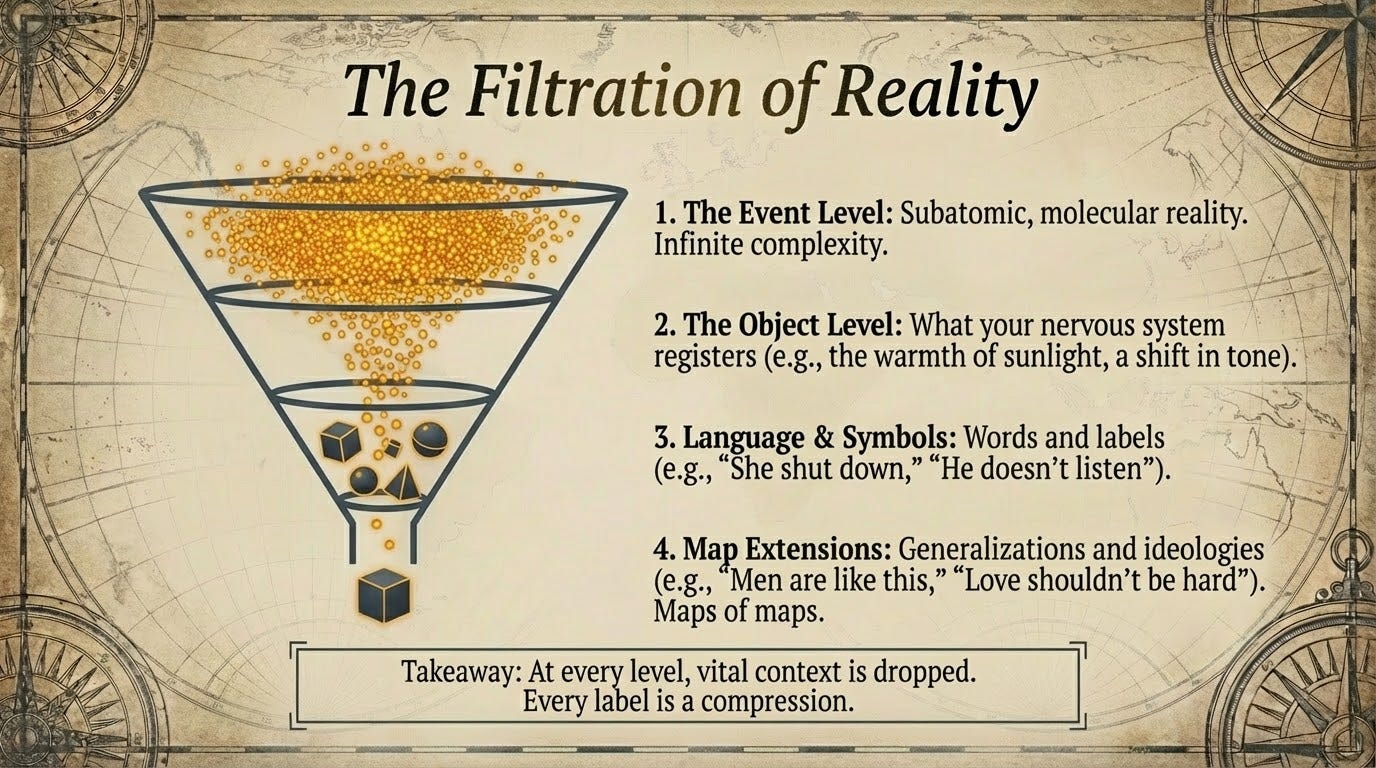
Here are the levels at which this occurs:
The Event Level
Korzybski described human knowing as a layered process. At the bottom sits what he called the “event level”, the actual processes of reality happening at scales no human being perceives directly.
Subatomic.
Molecular.
Electromagnetic.
This is the territory. It exists whether you’re paying attention or not.
The Object Level
Above the event level sits the “object level”, what your nervous system actually registers. The warmth of sunlight on your arm. The sound of a door closing. The pressure in your chest when your partner goes quiet.
This is already an abstraction.
Already a compression.
Your nervous system has taken the infinite complexity of the event level and reduced it to something a biological organism can work with.
Language & Symbols
Above the object level come words.
Labels.
Names.
“She shut down.” “He doesn’t listen.” “They always do this.”
These are higher-order abstractions, further from the territory, more compressed, more likely to leave out exactly the information you need.
Map Extensions
Above words come generalizations.
Theories.
Beliefs.
Ideologies.
“Men are like this.” “Relationships shouldn’t be this hard.” “Love means never having to explain yourself.”
These are maps of maps of maps.
And at every level, something gets left behind.
Structural Differential
Korzybski built a physical teaching model to make this visible, something he called The Structural Differential. A parabolic shape at the bottom represented the infinite complexity of reality. A circular disc above it represented the nervous system’s first cut, what gets through. Rectangular plates stacked above represented each successive layer of verbal abstraction. And hanging between each level, dangling strings, representing the characteristics that get dropped at every step.
The point was visceral, not intellectual. He wanted people to feel the dropping. To feel the loss that happens every time you move from experience to language. Every label you apply is a compression. Every conclusion you draw is a reduction. Every story you tell about another person, including the people you love most, leaves something out.
The question he spent the rest of his life asking was not whether you’re abstracting.
You are.
Always.
The question is whether you know it.
What This Means
Korzybski put it this way: “Whatever you might say the object ‘is,’ well it is not.”
Here is what that essentially means. You cannot collapse the full territory of a thing, or of a person, into a label and call it done. The label is never the thing. The description is never the described. And the moment you fuse them, you stop seeing what’s actually in front of you.
Watch how this works.
John is a person struggling with addiction. The moment you say “John is an addict,” John disappears. The struggle disappears. The person behind the substance: the father, the veteran, the man who hasn’t slept in four days, all of it collapses into a single word. And now you’re not responding to John. You’re responding to a category.
Jesus is a person whose documentation status is unresolved. The moment you say “Jesus is an illegal,” the person is gone. The man who crossed a border with his daughter on his back, who works sixty hours a week, who teaches his children to pray in a language this country refuses to learn, erased. Replaced by a word that makes it easier to look away.
Florida is a state with thirty-three million people living thirty-three million different lives. The moment you say “Florida is a red state,” you’ve flattened it. The Haitian grandmother in Little Haiti. The queer teenager in Orlando. The third-generation rancher in the Panhandle who votes one way and lives another. Gone. Collapsed into a color on a map that someone on television drew for you.
The word “is” does this every time. It takes a map and welds it to the territory. And it does it so smoothly, so naturally, that you don’t notice you’ve just locked something alive inside something fixed.
Korzybski saw this and refused to let it pass as a quirk of grammar. He argued that the structure of a language shapes the thinking of everyone who speaks it.
Not influences. Shapes.
If the verb at the center of your language performs the collapse, fuses evaluation with identity every time you open your mouth, then the thinking will collapse too. The confusion is not a personal failure. It is inherited. Baked into the syntax. You were trained to confuse the map with the territory before you could read.
Now listen to what this sounds like at the kitchen table on a Tuesday night.
“You are selfish.” “She is cold.” “He is just like his father.” “Our marriage is broken.”
Same operation. Same collapse. A moment, a behavior, a pattern, an observation, turned into a permanent identity. The person disappears behind the label. And once the label is locked in place, you stop looking at the person.
You only see the label.
Labels are category designations that are limiting. Sometimes on purpose.
Korzybski called his system “non-Aristotelian,” and the name was not an accident. He was picking a fight.
Aristotelian logic, the framework that has organized Western thinking for over two thousand years, operates in binaries. True or false. Either/or. Is or is not. Something belongs to a category or it doesn’t. Korzybski saw this as an operating system that had passed its expiration date.
So do I.
Not because Aristotle was stupid. Aristotle was a genius. But Aristotle was working with the science available in the fourth century BCE. By the twentieth century, physics had moved on. Einstein had demonstrated that space and time were not fixed. Quantum mechanics had shown that particles could exist in multiple states simultaneously until observed. Non-Euclidean geometry had proven that parallel lines could converge. The hard sciences had already abandoned either/or logic because reality refused to cooperate with it.
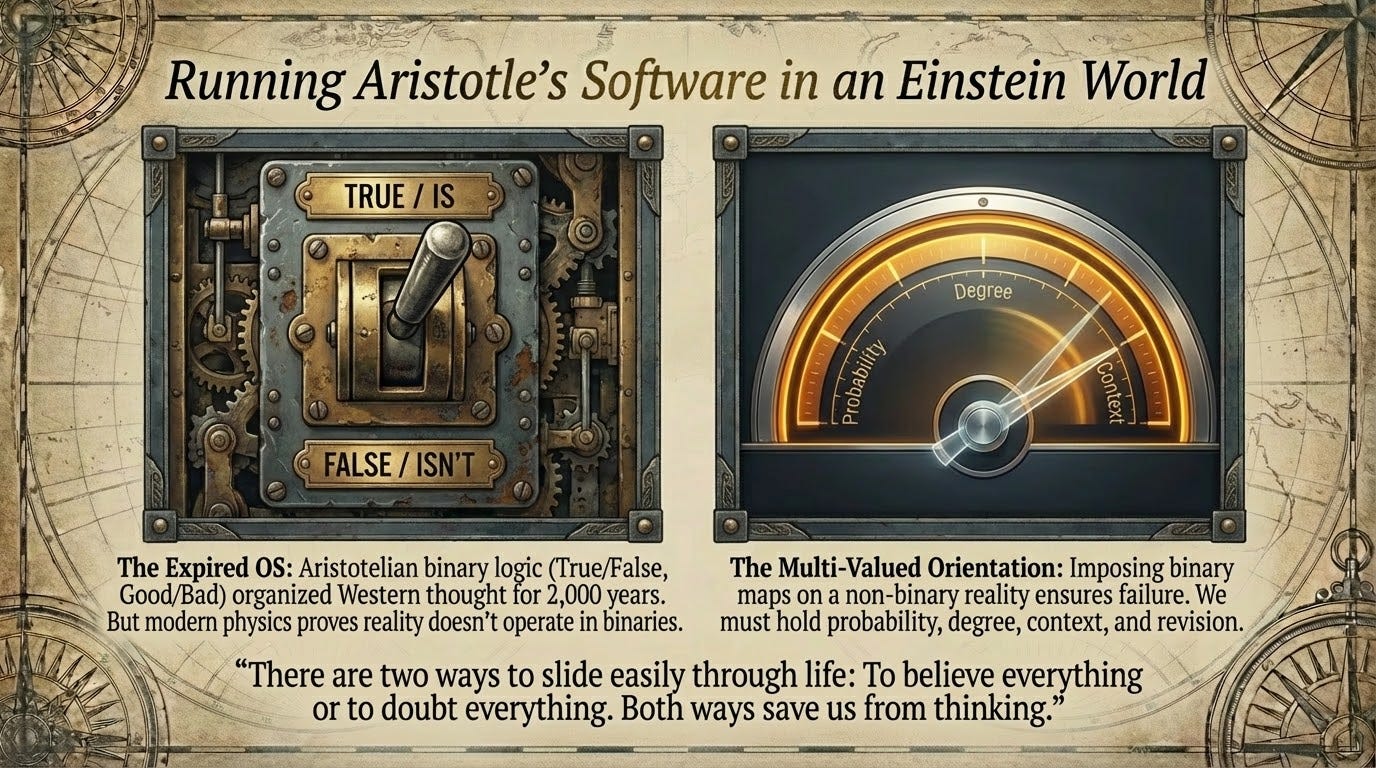
Korzybski’s argument was that human psychology, language, and social systems needed to catch up. We were still running Aristotle’s software in an Einstein world. And the cost was everywhere, in our politics, our institutions, our families, and our nervous systems.
He proposed what he called a “multi-valued orientation.” Instead of two options — true or false, good or bad, right or wrong; he argued for a system that could hold probability, degree, context, and revision. Not as wishy-washy relativism. A structural accuracy. Because the territory, as modern science reveals it, does not operate in binaries. And a map that imposes binaries on a non-binary reality will eventually fail.
“There are two ways to slide easily through life,” he wrote in his earlier work, Manhood of Humanity. “To believe everything or to doubt everything. Both ways save us from thinking.”
He wasn’t advocating the middle. He was advocating the harder thing. Holding complexity without collapsing it. Staying in the space between certainty and nihilism long enough to actually see what’s in front of you.
I think this can be revolutionary.
Semantic Reactions
Now here is where Korzybski lands somewhere most people, including most people who cite him, don’t follow.
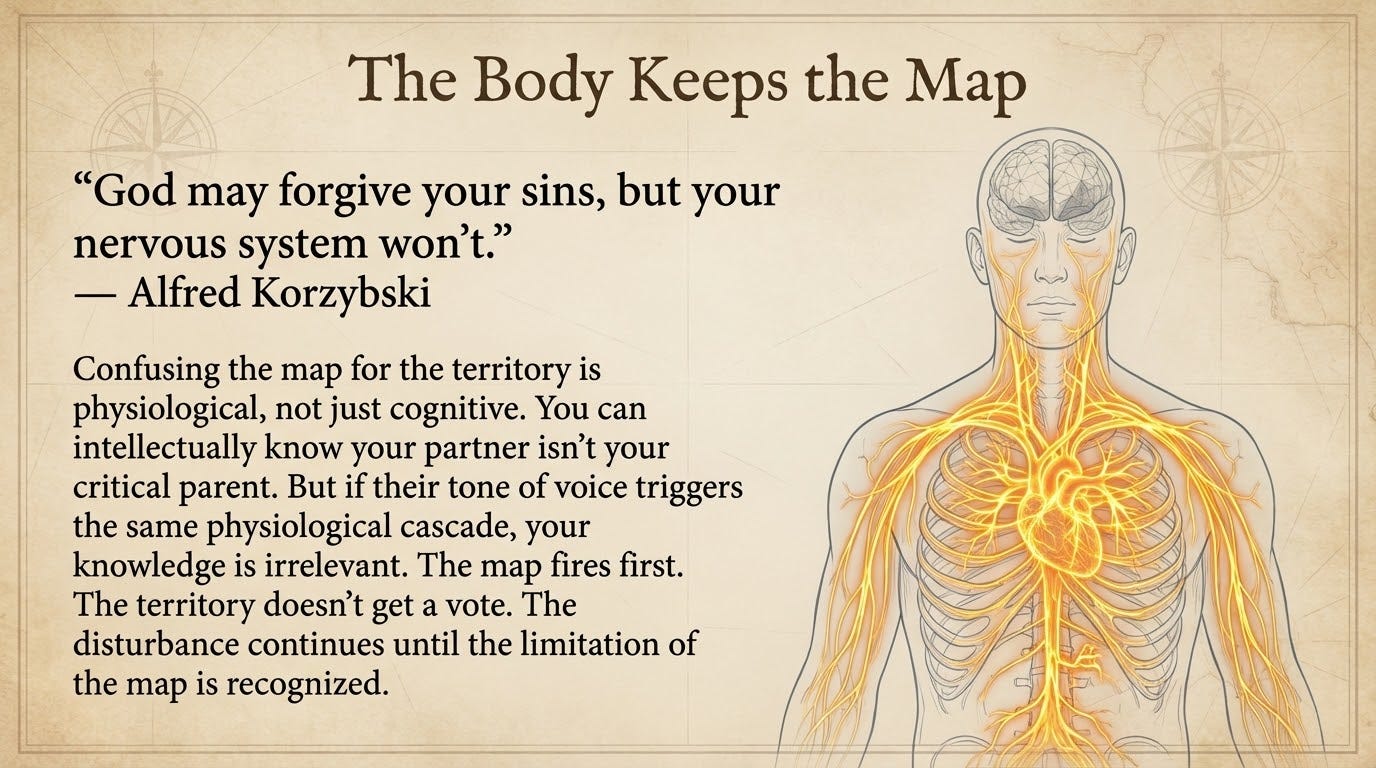
He argued that the confusion between map and territory is not just cognitive. It is physiological. He used the term “semantic reactions” to describe the total organismic response a person has to a word, a symbol, or an event, including the physiological, emotional, and neurological components. This was not about meaning in the abstract. This was about what happens in your body when language activates a map.
A person reacting to words, their own internal narration or words heard from someone else, can shift their attitudes, their nervous system states, and their behaviors in ways that have nothing to do with what is actually happening in front of them.
The map fires first.
The territory doesn’t get a vote.
“Whenever the map is confused with the territory,” he wrote, “a ‘semantic disturbance’ is set up in the organism. The disturbance continues until the limitation of the map is recognized.”
Read that last line again: the disturbance continues until the limitation of the map is recognized. Not until the situation changes. Not until the other person changes. Until you see the map as a map.
“God may forgive your sins, but your nervous system won’t.”, he wrote.
That’s not poetry.
That’s a clinical observation.
The body keeps the map even when the mind has updated. It keeps score. You can intellectually understand that your partner is not your parent. You can know, at the level of concept, that the argument you had last Tuesday is not the same as the argument you had ten years ago. But if your nervous system is still running the old map, if the tone of voice, the pause before the response, the slight shift in facial expression triggers the same cascade it always has, then your knowledge is irrelevant. The map is still firing. And the territory never had a chance.
Consciousness of Abstracting
Korzybski’s solution, his central thesis, the one he says repeatedly is the point of the entire eight hundred pages, was not a technique. It was an orientation. He called it “consciousness of abstracting.”
The goal is not to stop abstracting. That’s impossible. You are a biological organism that runs on abstraction the way an engine runs on combustion. The goal is to know you’re doing it. To catch yourself in the act. To develop the kind of awareness that can watch the map forming in real time and say: that is my rendering, not the thing itself.
He promoted phrases like “I don’t know; let’s see” as practical tools, not as expressions of intellectual humility, but as neurological interventions. A deliberate pause before the map takes over. A gap between stimulus and label wide enough to let the territory through.
I tell my clients, the word “maybe” should be our best friend.
He also developed what he called “extensional devices”, small, practical habits designed to interrupt the automatic fusion of map and territory. Indexing: reminding yourself that “person one is not person two.” Dating: acknowledging that “the situation in 2024 is not the situation in 2020.” The use of “etc.”: reminding yourself that no description is exhaustive, that there is always more you’re not seeing.
These sound small. They are not. They are the difference between living inside a story you’ve mistaken for reality and living in the world as it actually presents itself , complicated, contradictory and relentlessly particular.
Why this Matters:
Because what Korzybski described as a problem of language and logic, I have watched destroy intimacy in real time. In my office. In my marriage. In the mirror.
Every couple I have ever worked with arrives with the same fundamental confusion. They do not know they are fighting about maps. They believe they are fighting about the territory. She thinks the territory is that he doesn’t care. He thinks the territory is that she’s never satisfied. Both of them are fully convinced that their experience of the relationship is the relationship.
That what they feel is what is.
It is not.
What they feel is the map. A map built from every relationship they’ve ever been in. Every nervous system pattern they’ve inherited. Every story their family told them about what love looks like, what safety requires, what abandonment feels like. By the time they sit across from each other in my office, or across from each other at the kitchen table, they are not seeing the person in front of them. They are seeing their rendering of that person.
A compression.
An abstraction.
And they are defending that abstraction with everything they have.
This is Korzybski’s “identification”, the collapse of map and territory, except it’s not happening in a philosophy seminar. It’s happening at the most intimate level of human experience. The place where the stakes are highest and the margins for error are smallest.
I know this because as a fellow human being, I’ve lived it.
The girl who broke my heart in ninth grade and ended my childhood innocence created a map of guardedness. My nervous system decided right there and then, vulnerability wasn’t useful. Girls, and eventually women where not to be trusted. They could become subjects to pursue. But the could not be trusted with authentic love and loyalty. And every time I dared to remap this, it got reinforced. It did not help that this was being experienced in a incubator of extreme religious cultism where uniformity, conformity, and obedience was the way to experience praise and love. Autonomy and attunement wasn’t required or welcome.
This lasted well into adulthood.
Most of what we call “communication problems” in relationships are not communication problems. They are map problems. The couple is not failing to talk. They are failing to see that they are talking about two different realities — each of them fully real to the person experiencing them, neither of them identical to what actually happened.
She says: “You weren’t present last night.” He hears: “You failed.” She meant: “I missed you.” But his map, the one built by decades of evaluative environments, performance pressure, and the quiet algebra of never being enough, rewrites her words before they land. By the time the signal reaches his conscious awareness, the territory is gone. The map has replaced it. And he responds to the map.
She watches his face close. His jaw sets. He pulls away. And her map fires. The one that says: “He doesn’t want to be close.” The one that says: “I am too much.” The one that was installed long before she met him, in a house where needing things made you a burden.
They are now two nervous systems reacting to each other’s maps. The territory, two people who love each other and are both afraid , has left the building.
Korzybski would have called this a semantic disturbance.
I call it a random Tuesday.
But here is what Korzybski gave me that no other framework has. He didn’t just describe the problem. He identified the structural error. And structural errors are fixable.
Not by trying harder. Not by communicating better. Not by reading another book about love languages or attachment styles, though those maps have their uses. The fix is separate from of all of that.
The fix is learning to see the map as a map in real time, while it’s firing.
That is what “consciousness of abstracting” means when you move it out of an eight-hundred-page philosophy text and into the living room at eleven o’clock on a Wednesday night.
It means developing the capacity to watch your own rendering form, to feel the tightening in your chest, hear the story start to narrate itself, notice the label land on the other person. And in that space, that fraction of a second between the trigger and the response, choose something different.
Any therapy or self help that doesn’t help you widen that gap is ineffective and just treating the symptom.
Not suppress the map. Not pretend it isn’t there. Not intellectualize it away. See it. Name it as yours. And then, and only then, look at the person in front of you and ask: what is actually here?
Korzybski called this the extensional orientation. Start with observation. Look first, label second. Let the territory arrive before the map takes over.
I have a simpler name for it. I call it curiosity.
Curiosity is the cure.
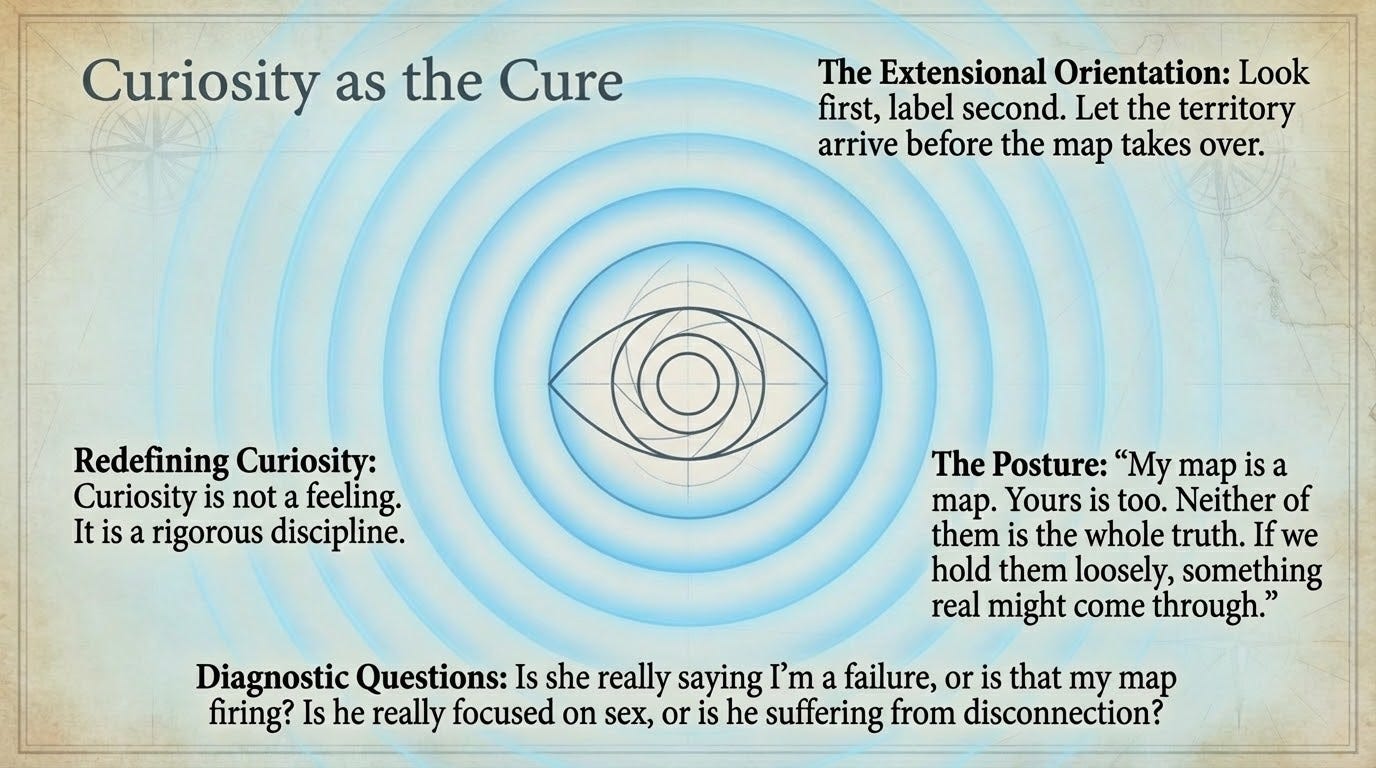
“Is she really saying I’m a failure, is that my map firing?”
“Is he really just focused on sex, or is he suffering from disconnection?”
Not curiosity as a feeling.
As a discipline.
A practiced orientation toward another person’s reality that does not require agreement. Curiosity is the posture that says: my map is a map. Yours is too. And neither one of them is the whole truth. But if we can hold them both loosely enough, something real might come through.
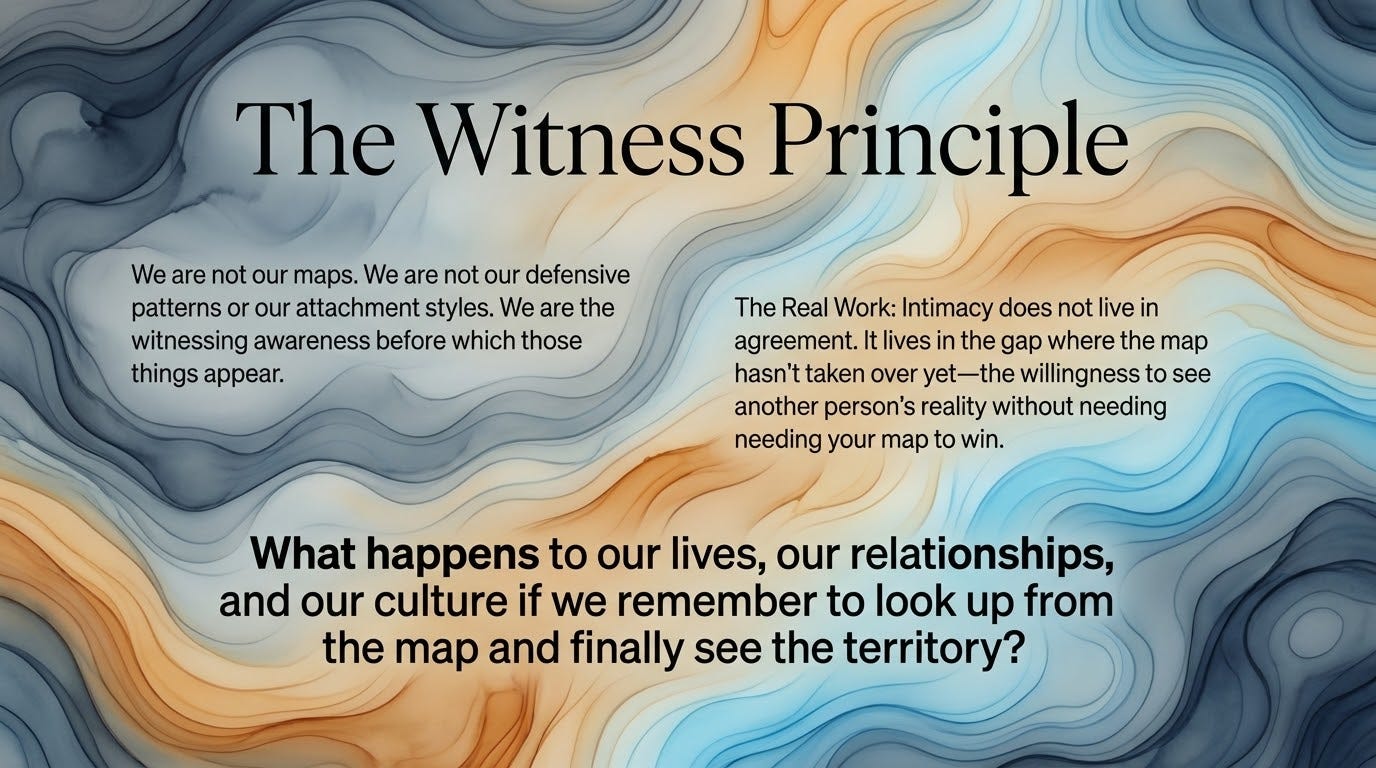
We are not our maps.
We are not our thoughts. We are not our feelings. We are not our stories, our survival strategies, our defensive patterns, or our attachment styles. We are the awareness before which all of those things appear. The witnessing essence that can watch a map form, watch it fire, and choose not to be consumed by it.
This is the work. To know this, experientially.
Korzybski got partway there. His “consciousness of abstracting” points at exactly this capacity — the ability to observe the mapping process while it’s happening. But he stayed in the language of epistemology. He talked about levels of abstraction and structural differentials and extensional devices.
What I’ve learned, in my office, in my marriage, in the long work of becoming someone who can be present to another human being without defending a position, is that the real territory is not “out there.” The real territory is the space between stimulus and response. The gap where the map hasn’t taken over yet. The place where you are not your reaction.
That’s where intimacy lives. Not in agreement. Not in understanding. Not even in empathy, though empathy matters. Intimacy lives in the willingness to see another person’s reality as real for them, without needing your map to win. Korzybski called this the extensional orientation.
I call it the witness principle. It is the same move, aimed at a different scale.
Korzybski’s Impact
I should tell you something about the man’s reach, because it might surprise you.
During World War II, the war after the one that broke him open, the United States Army used Korzybski’s methods to treat soldiers with what they then called “battle fatigue.” The work was supervised by a psychiatrist named Douglas Kelley, who found that training soldiers in consciousness of abstracting, helping them separate their experience from their narration of their experience, produced measurable improvements in their capacity to function.
Kelley went on to become the psychiatrist assigned to evaluate the Nazi war criminals at Nuremberg. He spent months interviewing men who had operated inside certainty systems so total, so identified with their maps of racial superiority and national destiny, that they had lost the capacity to see the human territory standing in front of them.
Korzybski’s work also influenced Albert Ellis, who credited him in the development of what became Rational Emotive Behavior Therapy , one of the first therapeutic systems to argue that it is not events that disturb us, but our interpretations of events (our MAPSS ™-Minds, Attributions, Perspectives, Sentiments and Stories)
The philosopher Alan Watts drew from him. So did the physicist Fritjof Capra. So did Robert Anton Wilson, who spent decades trying to make Korzybski’s ideas accessible to a wider audience.
And yet. Ask most people, ask most therapists, most philosophers, most writers, if they’ve heard of Alfred Korzybski, and you’ll get a blank look. His ideas traveled. His name didn’t.
The map outlived the mapmaker.
This is Personal
You have maps.
About your partner.
About your parents.
About your children.
About yourself.
Those maps were not built arbitrarily. They were built by a nervous system doing its best to keep you safe in a world that, at some point, felt dangerous. They are your survival adaptations. Your compressed renderings of experiences too complex and too threatening to hold in their full form.
Those maps served you. Many of them still do. The problem is not that you have them.
The problem is that you forgot they were maps.
And in forgetting, you started treating your rendering of the people you love as if it were the people themselves. You started reacting to the compression instead of the person. You started defending conclusions you drew years ago as if they were current observations. You started living inside a model of your relationship and calling it your relationship.
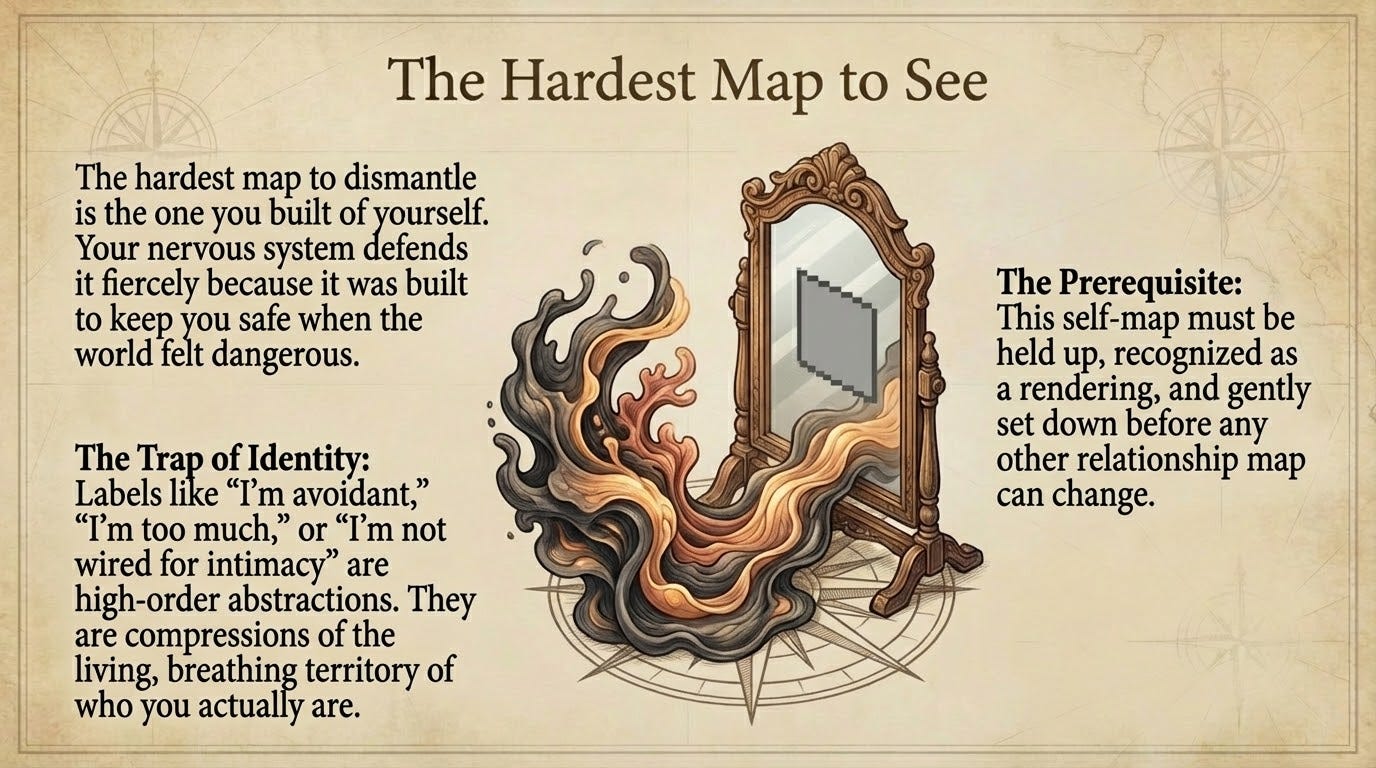
Korzybski would tell you that every map leaves things out. That the person your map describes is not the person standing in front of you. That the description you hold of yourself (“I’m avoidant,” “I’m too much,” “I’m not wired for intimacy”) is a high-order abstraction, several levels removed from the living, breathing, changing territory of who you actually are.
He would tell you that the “is” of identity is a structural trap. That “you *are* selfish” and “you *are* cold” and “we *are* broken” are sentences that perform the same operation as confusing a highway map with the highway. The map may have useful information. But you can’t drive on it.
He would tell you that the disturbance continues until the limitation of the map is recognized. That you don’t need a new partner, a new family, a new identity. You need the awareness to see that you’ve been navigating by a rendering — and the courage to look up from it.
I would tell you the same thing. Except I’d add the part Korzybski didn’t live long enough to say.
The hardest map to see is the one you built of yourself.
It is the one you’ve carried the longest. The one your nervous system defends most fiercely. The one that tells you who you are in a voice so familiar you mistake it for truth. And it is the one that must be seen, held up, examined, and gently set down, before any other map in your life can change.
Not destroyed. Not replaced with a “better” map. Seen. Recognized as a map. And then, in that moment of recognition, you are no longer inside it. You are the awareness looking at it. And from that vantage point, everything changes.
Korzybski died in 1950. He was seventy years old. He had spent the last decade of his life running the Institute of General Semantics in Chicago, training people in the work he believed could prevent the next catastrophe. The world mostly ignored him.
But the idea survived. It moved through disciplines, through decades, through people who recognized in his central claim something so obvious and so overlooked that it needed to be said again and again, in every generation, in every context where human beings confuse their stories with reality.
I am saying it again now.
In the context of love.
In the context of marriage.
In the context of what happens when two people try to build a life together while navigating entirely different renderings of the same shared territory.
The map is not the territory.
Your experience of your partner is not your partner. Your story about your marriage is not your marriage. Your belief about who you are is not who you are.
And the work, the real work, the work I’ve staked everything on, is not to build a better map.
It is to become the kind of person who remembers, in the heat of the moment, that the map is always a map. Who can feel the old rendering fire and choose to look through it rather than from it. Who can turn toward another human being with something closer to curiosity than certainty.
Alfred Korzybski asked the question in a trench in 1914. Why do brilliant people keep destroying each other over ideas they’ve never examined?
I’m asking a smaller version of the same question. Why do otherwise successful high functioning people destroy their relationships without truly understanding the problem?
And what happens to all of culture if they can stop?