
In 1847, women were dying in a Vienna maternity ward at five times the rate of the ward next door.
Same hospital.
Same city.
Same year.
The difference was who was delivering the babies. In the first ward, it was medical students. In the second, midwives. A Hungarian physician named Ignaz Semmelweis noticed the gap, traced it to the students who came straight from autopsies to deliveries without washing their hands, and proposed a solution so simple it should have been obvious.
Wash your hands.
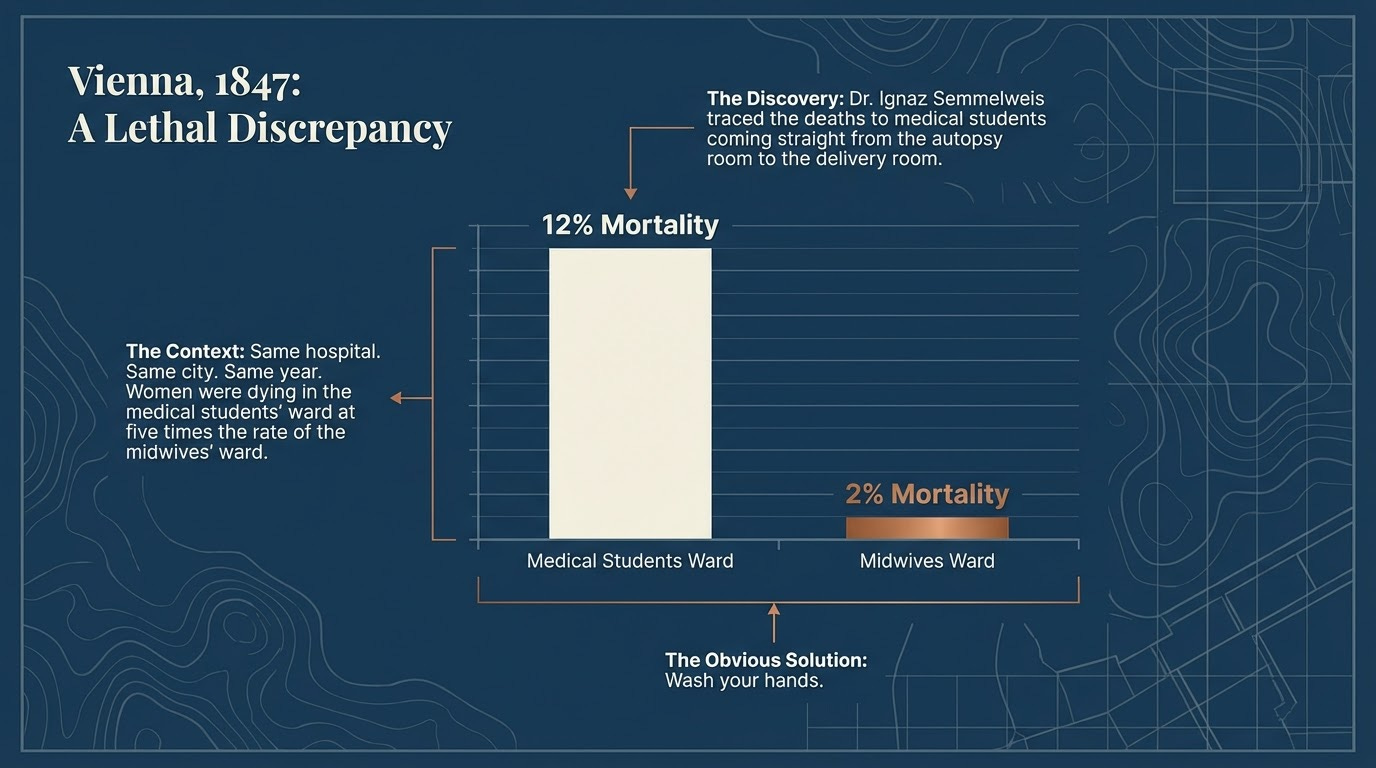
His colleagues refused. Not because the evidence was weak. The mortality rate in his ward dropped from twelve percent to under two percent once hand washing was implemented. They refused because the suggestion implied something unbearable, that they had been the cause of the deaths all along. That their confidence in their own methods had been the infection.
Semmelweis spent the rest of his career being mocked, dismissed, and eventually committed to an asylum, where he died at forty-seven. His colleagues went on delivering babies with unwashed hands. Women kept dying. Not because the doctors didn’t care. Because they were certain they already understood the problem.
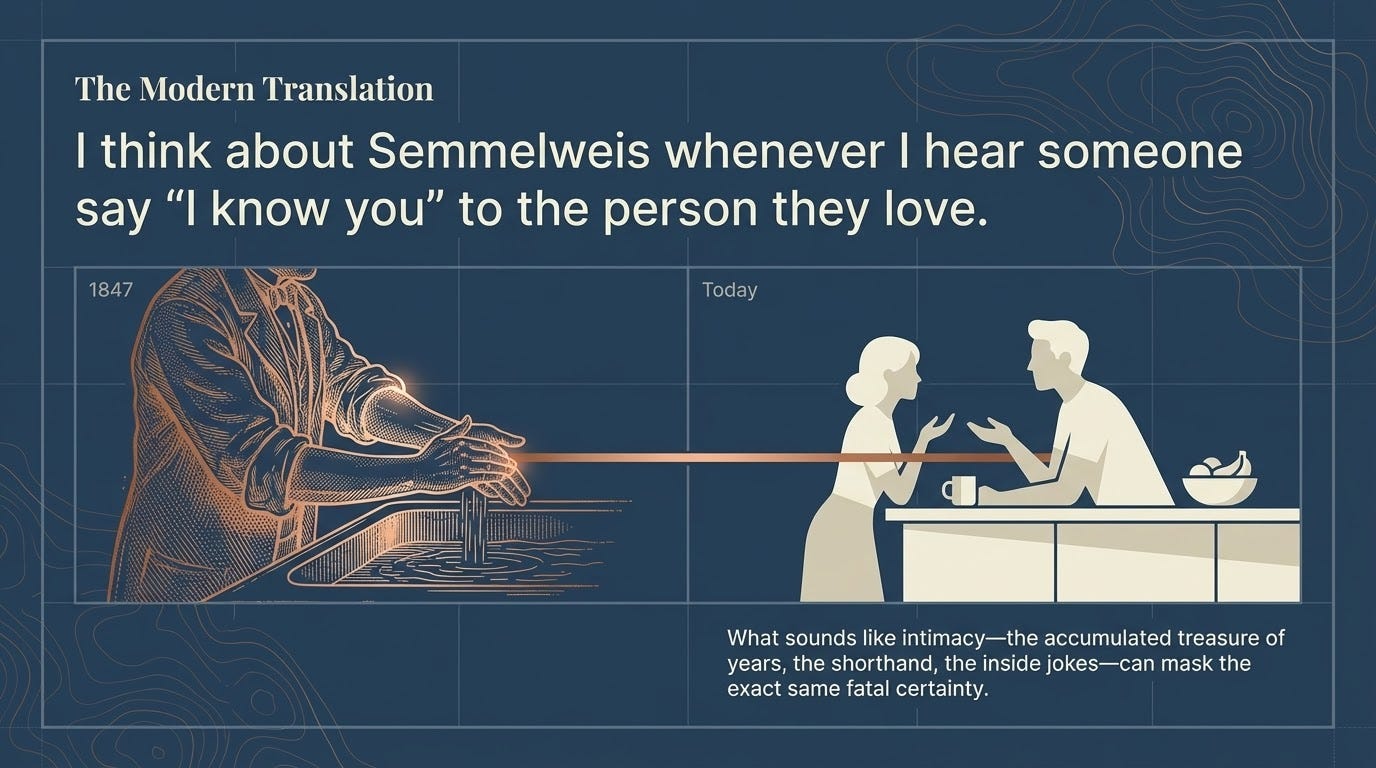
I think about Semmelweis whenever I hear someone say “I know you” to the person they love.
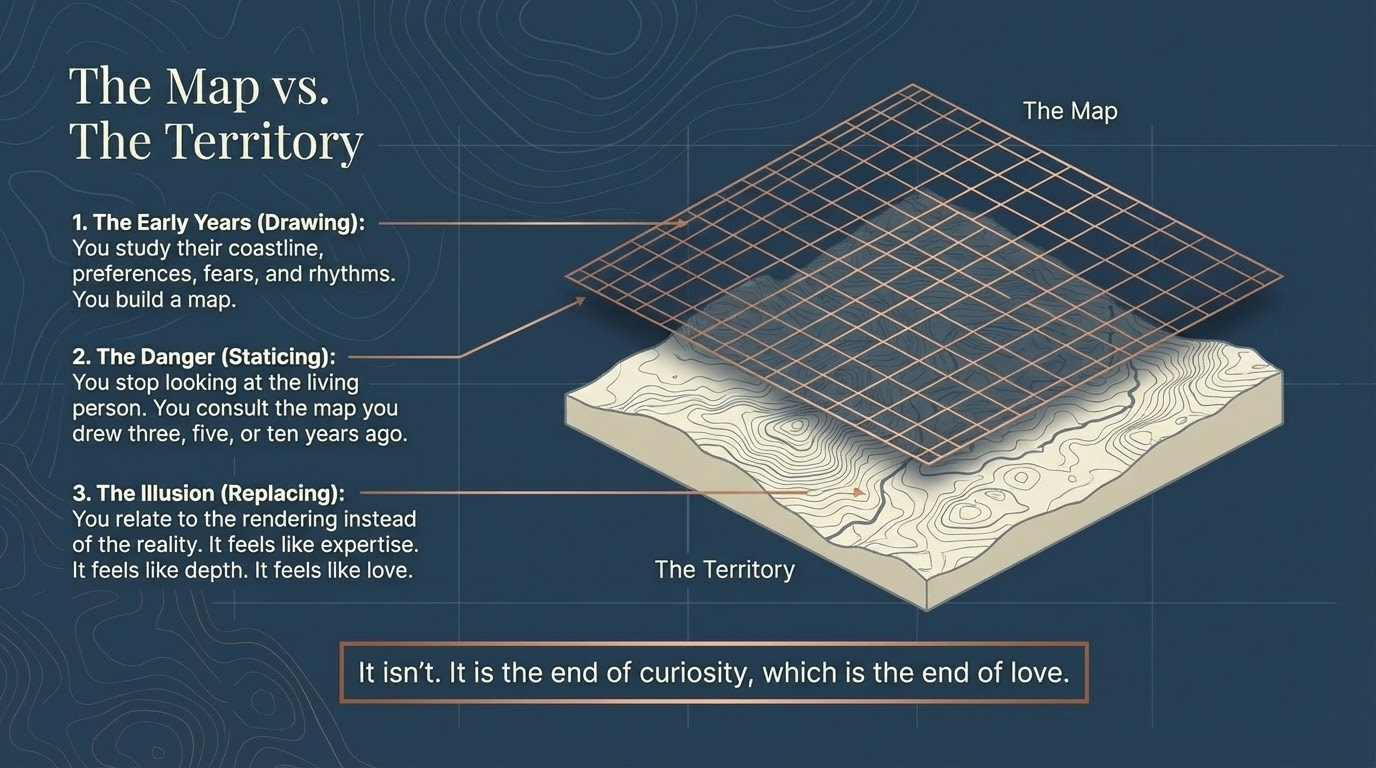
It sounds like intimacy. It sounds like the accumulated treasure of years together, the shorthand, the inside jokes, the ability to finish each other’s sentences. And in the early years, that’s what it is. You’re building a map of this person. Their preferences, their fears, their rhythms. You’re studying them the way a cartographer studies coastline, and the map you’re drawing feels more accurate with every passing year.
But here is where the map becomes the problem.
At some point, and no one can tell you exactly when it happens, you stop updating it. You stop looking at the living person in front of you and start consulting the map you drew of them three years ago. Five years ago. A decade ago. You start relating to the rendering instead of the reality. And the most dangerous part is that it feels like expertise. It feels like depth. It feels like love.
It isn’t. It’s the end of curiosity, which is the end of love.
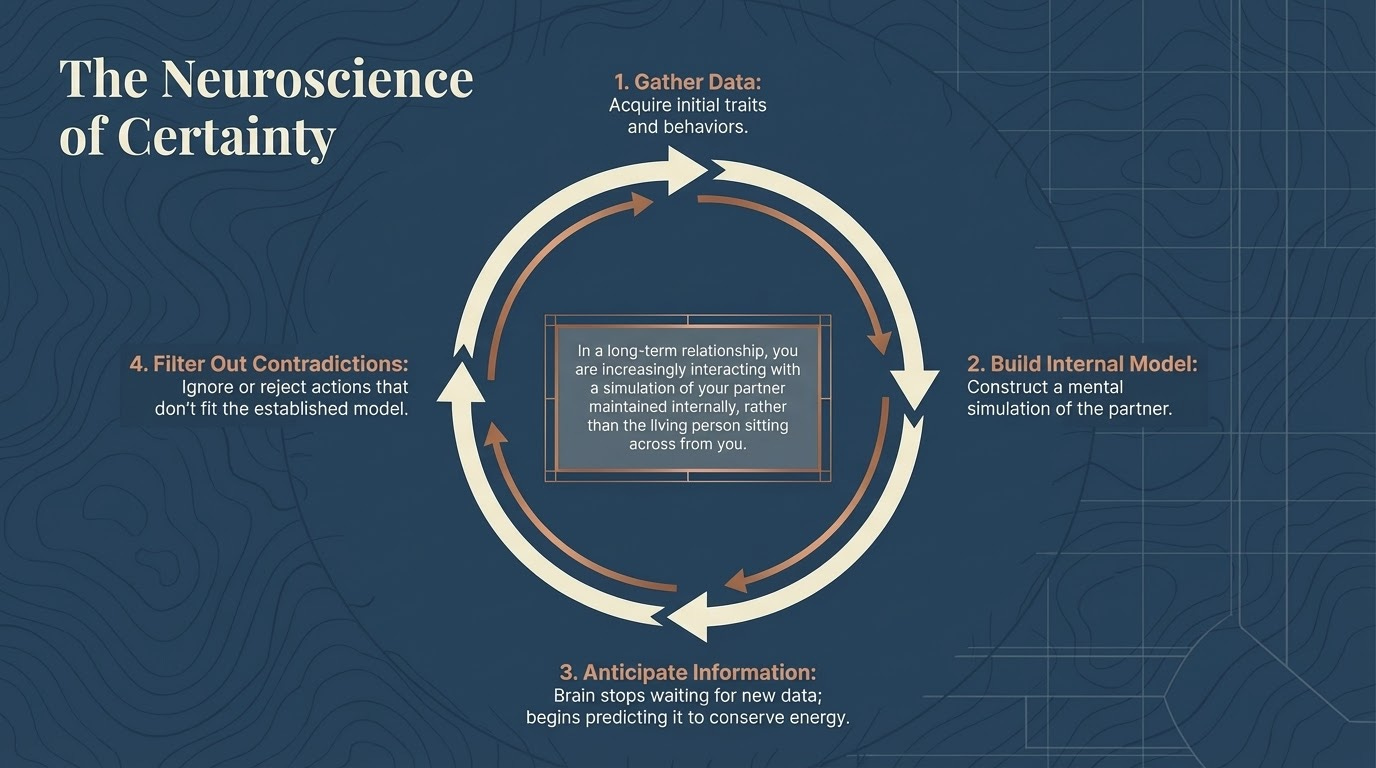
The neuroscience on this is ruthlessly clear. Your brain is a prediction machine. It doesn’t wait for information, it anticipates it. Once it has enough data to build a model of another person, it begins filtering new information through that model rather than updating the model with new information. This is efficient. This is how your brain conserves energy. And in a long-term relationship, it means you are increasingly interacting with a simulation of your partner that your brain maintains internally rather than with the person who is actually sitting across from you.
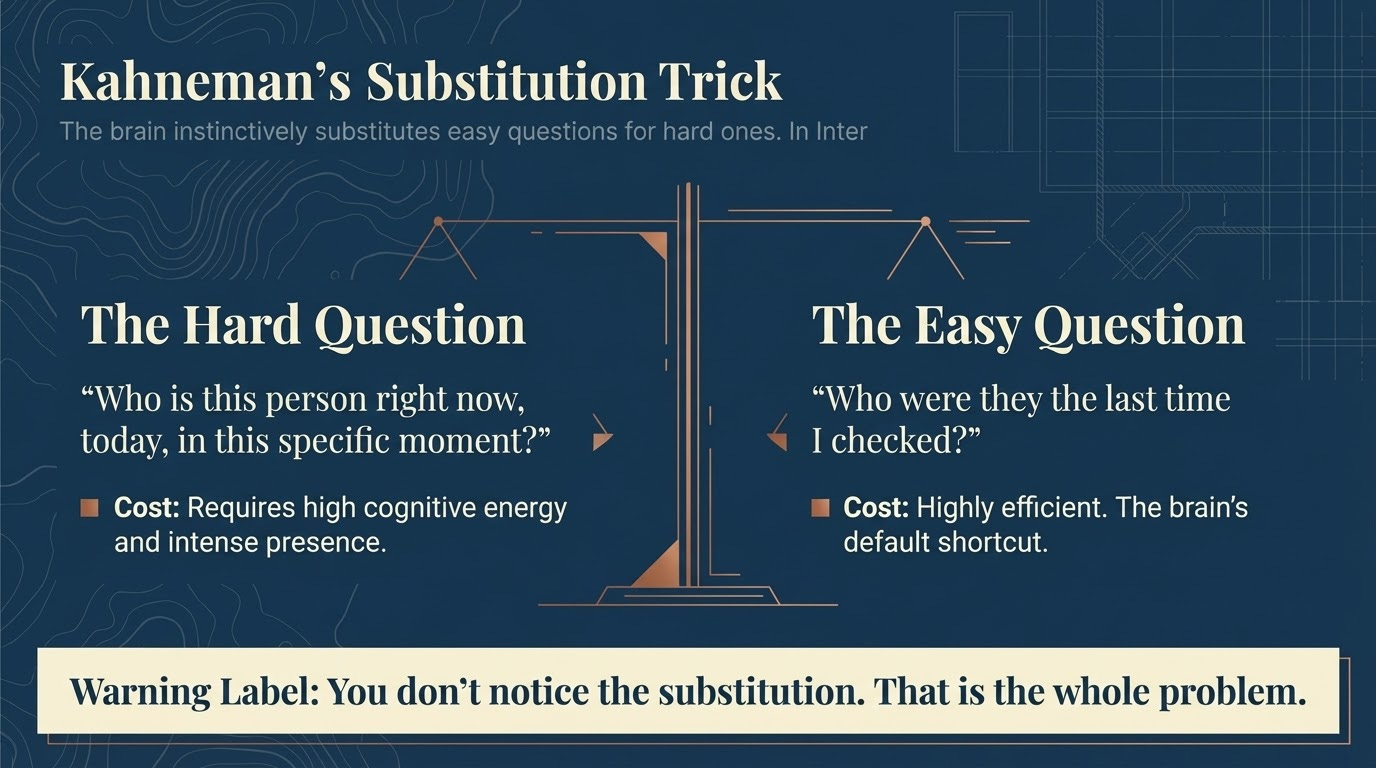
Daniel Kahneman spent a career demonstrating how the brain substitutes easy questions for hard ones. The hard question is: Who is this person right now, today, in this specific moment? The easy question your brain substitutes: Who were they the last time I checked?
You don’t notice the substitution. That’s the whole problem.
This is not a relationship problem. It is a human perception problem that happens to detonate most visibly in relationships.
Your boss does it with your capabilities. Your parents do it with your identity. Your adult children do it with your values. The map someone drew of you at twenty-two is not the territory of who you are at forty-five, but if they never updated the map, they are still addressing the twenty-two-year-old. And you can feel it. You can feel when someone is talking to their idea of you instead of to you.
It produces a very specific kind of loneliness. The loneliness of being seen and unseen simultaneously. Known and unknown in the same breath.
I know this because I did it. For years. I had a map of who I wanted my wife to be and who she was. I defended that map like it was scripture. When she changed, when she grew, when she became someone more complex and more specific than the woman I married, I didn’t update the map. I argued with the territory. I told the living, breathing, evolving person in front of me that she was wrong about herself, because my map said otherwise.
That sentence should horrify me.
It does.
It should also sound familiar to anyone who has been in a relationship longer than five years. Because the arrogance of familiarity doesn’t announce itself as arrogance. It announces itself as love. As knowing. As the special access that years together supposedly earn you.
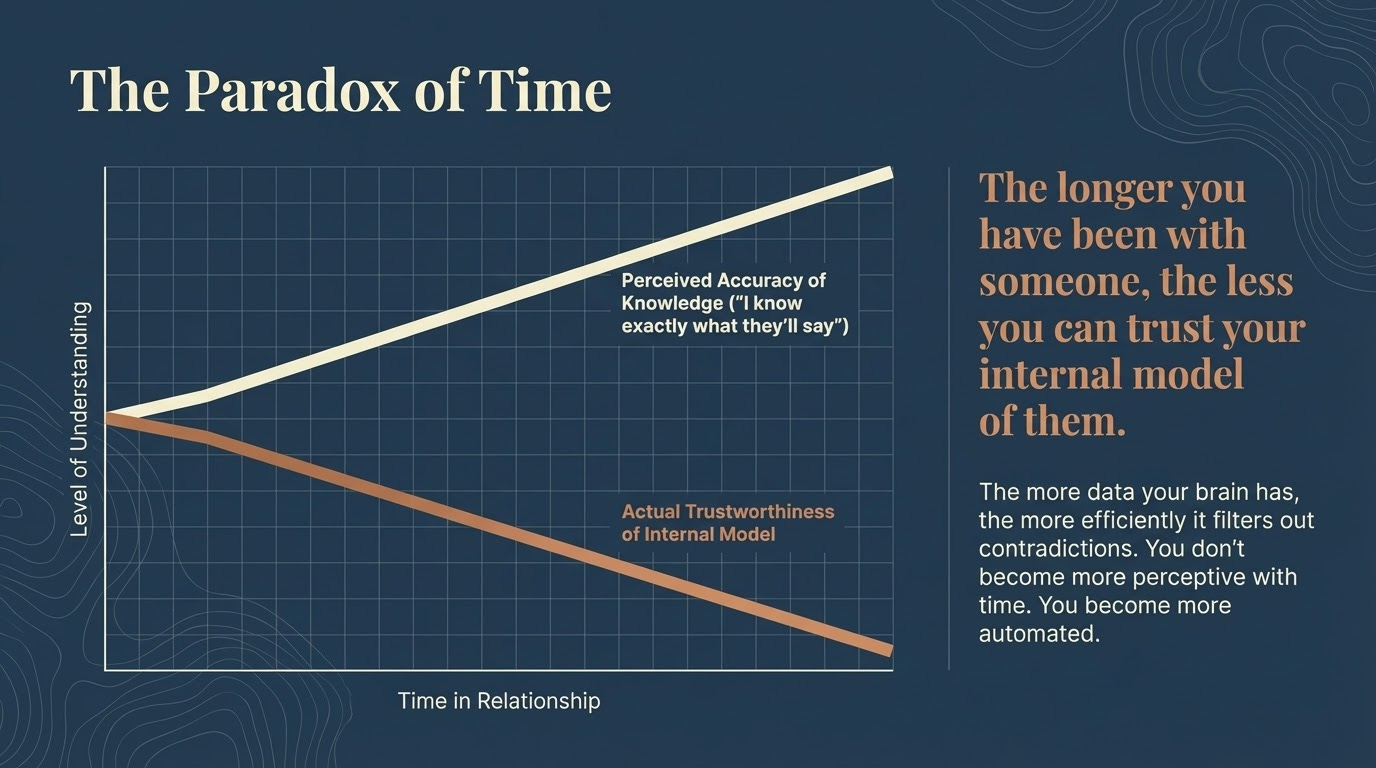
The longer you have been with someone, the less you can trust your internal model of them. Not the more. The less. Because the longer the relationship, the more data your brain has used to build the simulation, and the more efficiently it will filter out information that contradicts the model. You don’t become more perceptive with time. You become more automated. The map gets thicker. The territory gets ignored.
You’ve said it. Probably recently. “I know you, you’re just tired.” “I know you, you don’t really want that.” “I know you, you’ll get over it.” “I know what that face means.”
And in that sentence, you replaced a living person with a file you wrote about them years ago. You didn’t mean to. You weren’t being cruel. You were being efficient. Your brain handed you the shortcut and you took it, because it’s faster to consult the map than to look up and actually see the person standing in your kitchen.
But the person standing in your kitchen is not the person on the map. They haven’t been for a while. And the gap between who they are and who you think they are, that gap is where contempt grows. Not from malice. From the slow, quiet replacement of curiosity with certainty.
The opposite of “I know you” is not “I want to keep getting to know you.”
It’s “Who are you becoming?”
My wife is better at this than I was. She gave me the necklace that never comes off from around my neck. It’s a dog tag with the inscription. “The privilege of a lifetime is to become who you truly are." – Carl Jung
If relationships are mirrors of who we can become, embracing our growth; Then privilege of loving someone is helping them become who they truly are through curiosity. Curiosity is the cure.
That question of who are you becoming cost something. It costs you the comfort of the map. It costs you the efficiency of the shortcut. It means admitting that the person you love is a moving target, that they are not a fixed point you charted once and can return to indefinitely, but a living system that reorganizes itself every single day.
The Viennese doctors couldn’t afford to admit that their hands were dirty. The cost of that admission was too high. It meant everything they thought they knew about medicine was contaminated.
What does it cost you to admit that what you think you know about the person you love might be contaminated too?
Not wrong.
Not useless.
Just incomplete.
Just a map.
Just a rendering that served you for a season and now needs to be redrawn.
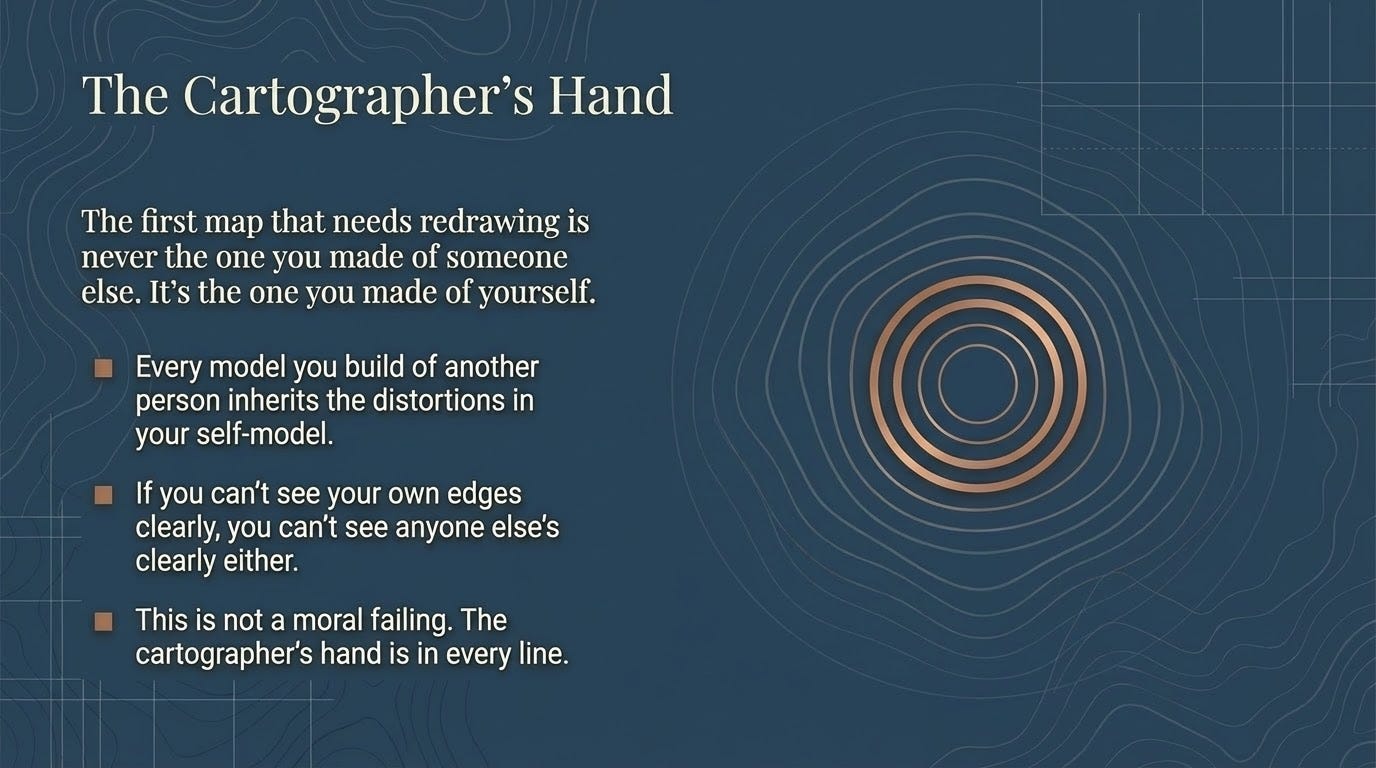
The first map that needs redrawing is never the one you made of someone else. It’s the one you made of yourself. Because every model you build of another person inherits the distortions in your self-model. If you can’t see your own edges clearly, you can’t see anyone else’s clearly either.
That’s not a moral failing.
That’s just how maps work.
The cartographer’s hand is in every line.
