
I have spent years helping couples, but I think I have finally designed the most practical protocol for breaking negative relational scripts that can enact true change.
Most couples are not arguing about the present moment. They are reenacting a script that feels current but was written years ago. The topic shifts. The emotional choreography does not. That repetition is the tell.
When conflict activates, perception narrows. The brain reduces complexity to protect certainty. Each partner becomes convinced they are responding to what is happening, when in reality they are responding to what they expect will happen. Prediction runs the show.
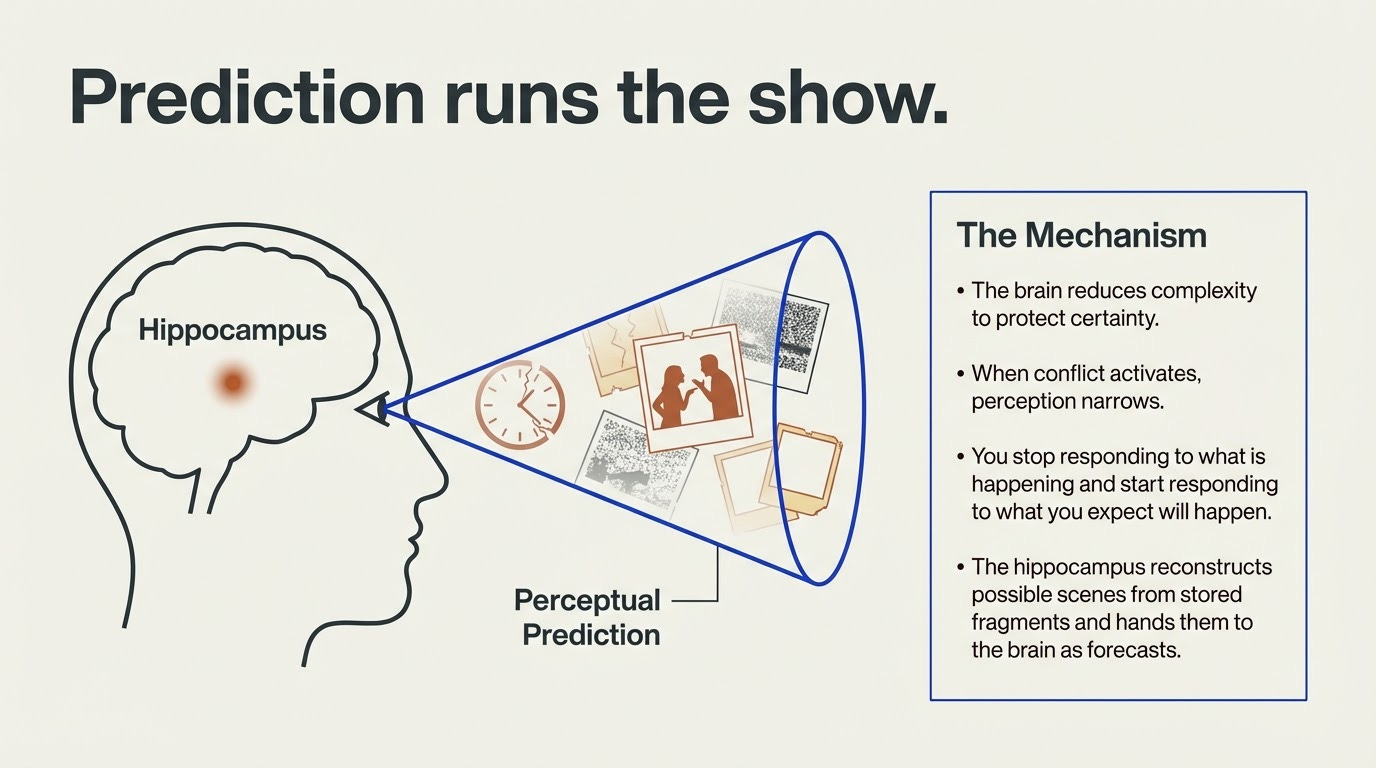
Neuroscience has been clear about this for years. The same memory systems used to recall the past are used to simulate the future. The hippocampus reconstructs possible scenes from stored fragments and hands them to the brain as forecasts. Behavior follows those forecasts more reliably than it follows intention.
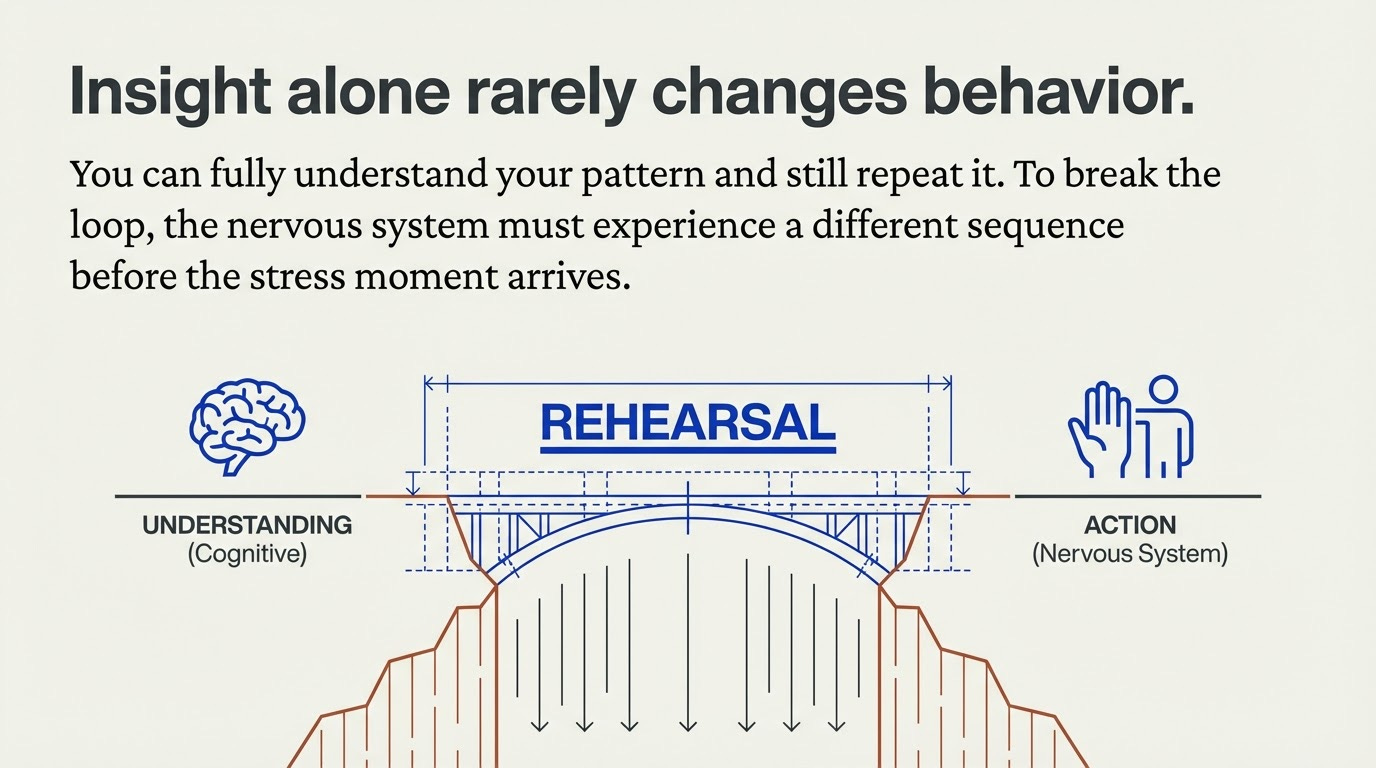
That is why insight alone rarely changes anything. You can understand your pattern and still repeat it. Change requires rehearsal. If you want the loop to break, the nervous system has to experience a different sequence before the moment arrives.
This protocol is built around that idea.
The Protocol
This is not a communication technique. It is rehearsal. It is designed to alter execution under stress.
Set a 20-minute container. The time limit matters. Without it, most people drift into analysis or avoidance.
Step 1: Name the Loop
Choose one recurring relational pattern. Not a global complaint. Not a personality diagnosis. Something concrete and repeatable.
Write it in sequence:
Trigger → internal reaction → protective move → partner reaction → familiar ending.
For example:
“When she says I seem distant, I hear criticism, I defend myself, she escalates, and we both feel misunderstood.”
Or:
“When he withdraws during conflict, I push harder, he shuts down further, and we both feel unsafe.”
Keep it simple. The goal is not depth. The goal is accuracy. You are identifying the script as it actually runs.
Step 2: Adopt the Outsider Witness
Shift perspective. You are not imagining a better version of yourself. You are observing yourself from a future position where this loop no longer controls your behavior.
The stance is straightforward:
“I’m watching myself move through a normal day after this pattern lost its grip.”
This creates distance without disengagement. You are not leaving the relationship. You are stepping outside the script long enough to see it clearly.
Calm distance is the signal that you are in the right posture. If it feels like striving or fantasy, you are still inside the old story.
Step 3: Future Mapping
Write in present tense.
Begin here:
“It’s a regular weekday, six months from now. This pattern no longer runs my relationship. Here’s what today looks like.”
Describe one ordinary day. Not a healed relationship. Not a transformed partner. The same trigger should appear.
For example:
“It’s Tuesday evening. She says we haven’t connected this week. I feel the tightening in my chest. I notice the urge to defend. Instead, I stay quiet for a second. I ask what she’s missing. My voice stays even. The conversation doesn’t escalate.”
Or:
“He goes quiet when I bring up finances. I feel anxiety rising. I notice the impulse to push. I say I’m starting to feel anxious and don’t want to attack. My breathing slows. He stays present.”
Notice the internal sequence. Notice the body. Notice what meaning does not automatically attach. You are rehearsing process, not outcome.
Research on mental rehearsal shows that vividly simulating an action activates overlapping neural circuits with execution. The more specific the rehearsal, the easier it is for the brain to retrieve under pressure. You are training recall of a different move.
Step 4: Decide Who You Will Be
Now collapse the simulation into one clear commitment.
“When ___ happens, I will ___.”
Not a time frame. Not a goal. A stance and a behavior.
Examples:
“When I feel criticized, I will get curious instead of defensive.”
“When I feel the urge to withdraw, I will name one emotion instead of going silent.”
“When I feel panic about connection, I will slow my breathing before speaking.”
This is pre-decision. You are choosing your identity in advance of the trigger. Research on implementation intentions shows that linking a specific cue to a specific response increases follow-through dramatically. You are not hoping you’ll react differently. You are deciding who you are when the cue appears.
Step 5: The Rehearsal
If your partner is willing, this is where the work becomes real.
Take the script you wrote and act it out together.
Not discuss it. Not critique it. Run the scene.
Use the actual trigger line. Let the tone be realistic. Allow the nervous system to feel the edge of discomfort. Then respond using the new script.
It will feel awkward. That is normal. You are interrupting muscle memory.
Run the scene again.
And again.
During rehearsal, you are allowed to break the fourth wall. You can pause and say, “That was the old move. Let me try again.” You can adjust your tone. You can ask your partner what phrasing would land better. You are co-writing the moment in real time.
This step matters because journaling happens in isolation. Conflict happens in relationship. Rehearsal with your partner introduces relational load while safety is still intact. The nervous system learns faster when the stimulus is present.
You are not performing. You are installing.
What Changes
Outsider Witness creates perceptual distance. Future Mapping rehearses a different sequence. Pre-decision clarifies identity. Relational rehearsal fuses it into the body.
Repeated over time, prediction shifts. When the expected move fails to appear, the loop weakens. Timing changes. Escalation stalls. The fight does not complete its usual arc.
Couples do not break cycles by understanding each other better alone. They break cycles when the script stops running automatically.
The map loosens. The territory becomes visible. And for the first time, the moment is actually new.
