
It’s one in the morning and she’s sitting cross-legged on her bed with the blue light of her phone turning her face into something lunar and hollow. She’s twenty-eight. Master’s degree. Good job. Smart friends. And she’s taking an attachment style quiz for the third time this month, tapping through questions she already knows the answers to, because something about seeing the result typed out in a clean sans-serif font makes her feel like she has a handle on the thing that is eating her alive.
Anxious-preoccupied.
She screenshots it. Posts it to her story with a self-deprecating caption. Three friends reply with their own results. They swap them like zodiac signs at brunch, half joking, half dead serious, entirely unchanged.
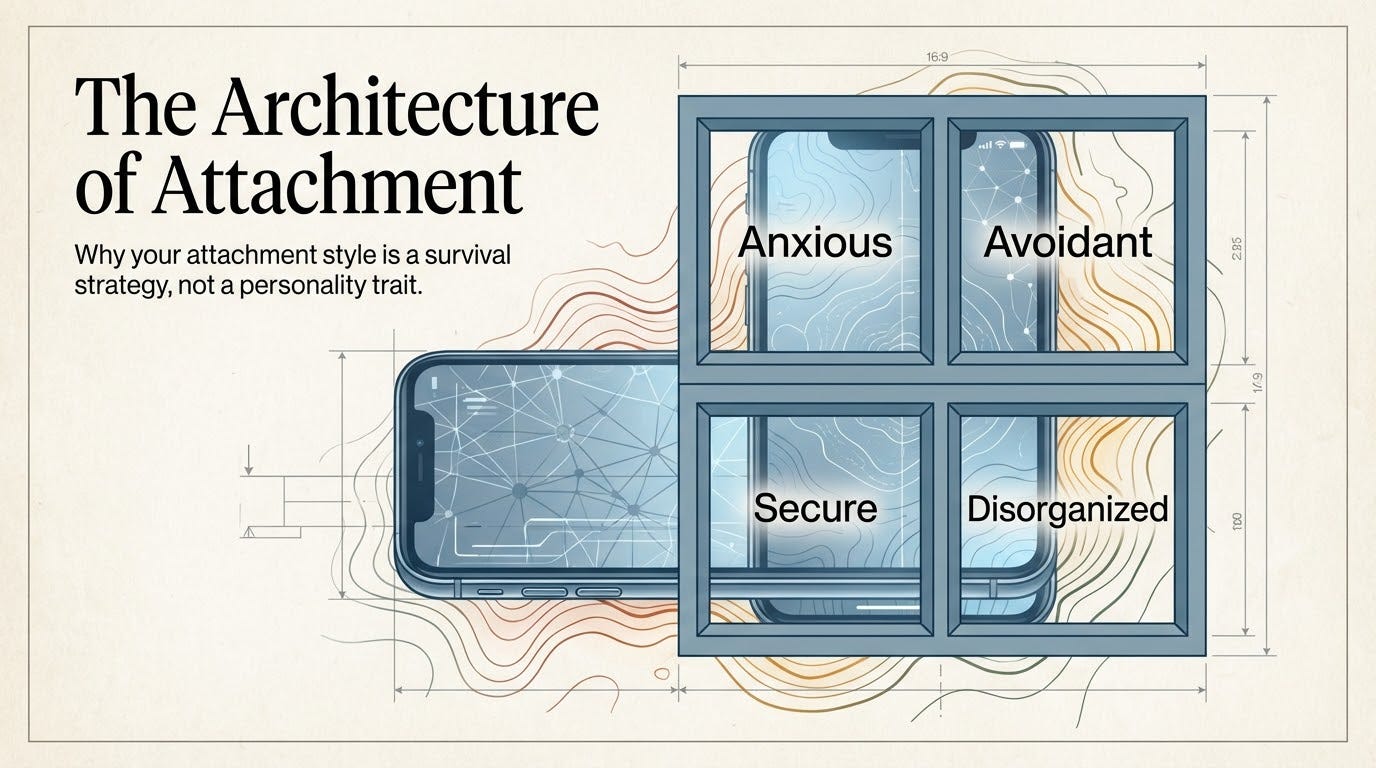
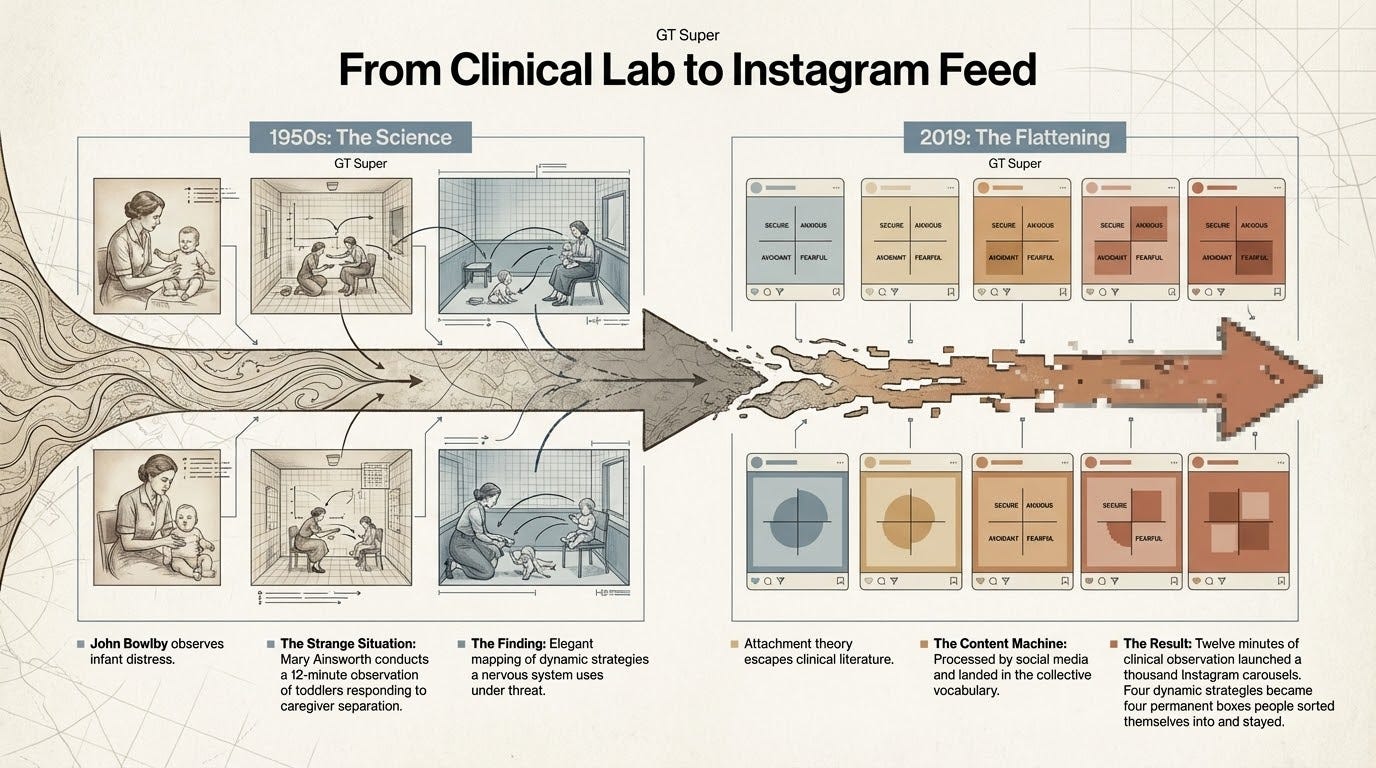
This became a cultural phenomenon somewhere around 2019. Attachment theory, originally developed by John Bowlby in the 1950s to explain infant distress, escaped the clinical literature, passed through pop psychology, got processed by Instagram’s content machine, and landed in the collective vocabulary as a personality category. Anxious. Avoidant. Disorganized. Secure. Four words that were supposed to describe dynamic, context-dependent strategies for managing closeness and distance became four boxes people sorted themselves into and stayed.
The original research was elegant. Bowlby observed that infants, when separated from their caregivers, developed predictable strategies for managing the distress. Some protested loudly. Some went quiet. Some did both, simultaneously, in a way that looked like chaos but was actually a coherent response to an incoherent environment. Mary Ainsworth took this further with the Strange Situation experiment; a twelve-minute observation of how a toddler responds when their caregiver leaves and returns.
Twelve minutes. That’s what launched a thousand Instagram carousels.
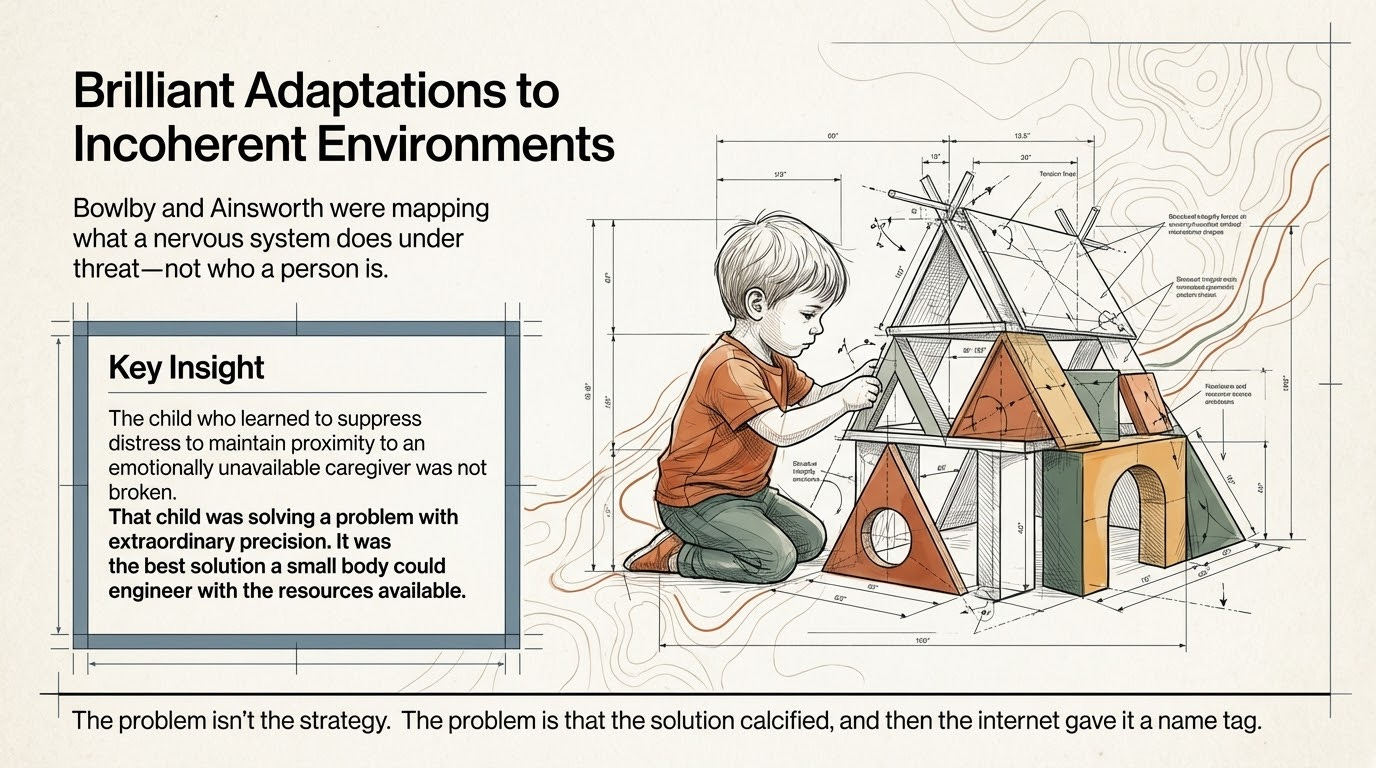
What gets lost in the translation from lab to feed is this: Bowlby and Ainsworth were describing strategies, not identities. They were mapping what a nervous system does under threat, not who a person is. The strategy was adaptive. It was the best solution a small body could engineer with the resources available. It was brilliant, actually, in the way that all survival adaptations are brilliant. The child who learned to suppress distress in order to maintain proximity to an emotionally unavailable caregiver was not broken. That child was solving a problem with extraordinary precision. The problem is that the solution calcified. And then the internet gave it a name tag.
Here is the map that millions of people now carry: I am anxious-attached. This is who I am. This explains why I do what I do in relationships. If I can find someone who is secure, or if I can identify the avoidants early enough to avoid them, I will be okay.
That map is not the territory.
It’s not even close.
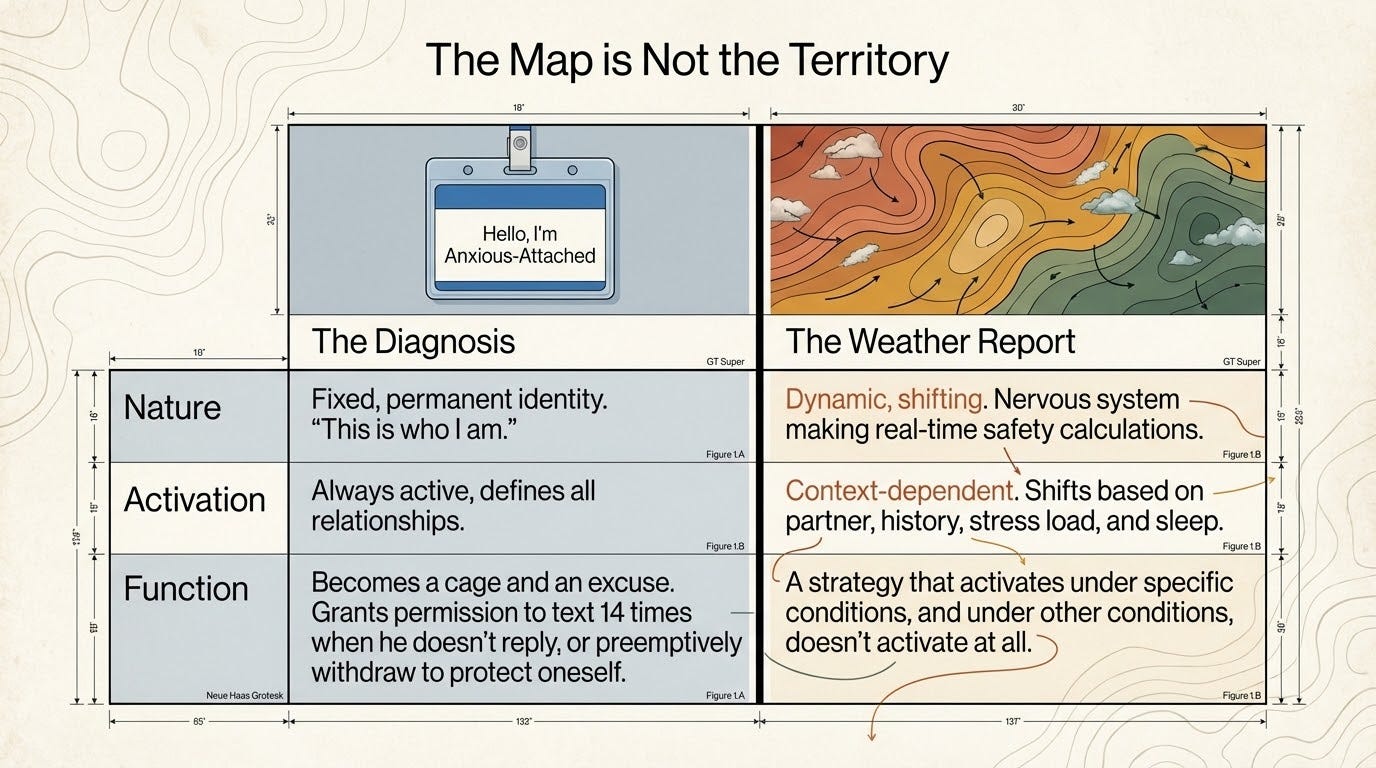
Because the territory is not a fixed style. The territory is a nervous system making real-time calculations about safety and threat, and those calculations shift depending on context, partner, history, stress load, sleep, and a hundred other variables that a four-category system cannot capture. You are not “anxious-attached.” You are a person whose nervous system learned to manage a specific kind of relational threat with a specific strategy, and that strategy activates under specific conditions, and under other conditions it doesn’t activate at all.
That distinction is not academic. It is the difference between a diagnosis and a weather report.
One is permanent.
The other is always changing.
What I see clinically, what I see in my office every week, is people who have turned the label into a cage. We, as a species, have the remarkable ability to turn the brilliant adaptations of our brains and nervous systems into fate.
The woman who says “I’m anxious-attached” and then uses that as an explanation for why she texts fourteen times when he doesn’t reply, as though the label grants permission for the behavior. The man who says “I’m avoidant” and wears it like a disclaimer : a preemptive apology that allows him to keep withdrawing without examining what the withdrawal protects. The person who has correctly identified the pattern and mistaken that identification for the work.
Naming the pattern is not changing the pattern.
This is the oldest trick in the psychological playbook. The insight feels like progress because insight produces a neurochemical reward — a small hit of dopamine for solving the puzzle. Your brain gets the same satisfaction from naming the thing that it would get from actually changing the thing, and it cannot tell the difference.
So you name it.
You post it.
You discuss it at length with your therapist and your friends and the person you’re dating. And the program keeps running, underneath all the language, as automated as it was before you knew what to call it.
I know this from the inside-out. I too thought my avoidance was permanent. I thought my defensiveness was embedded. But then I worked on building awareness. The kind of transcending awareness that helps you see in real time the subject object relationship (more on this in coming articles). I am amazed at how I thought insight was the final stop. But insight is just the first step.
Identification is not integration.
The map of the disease is not the cure.
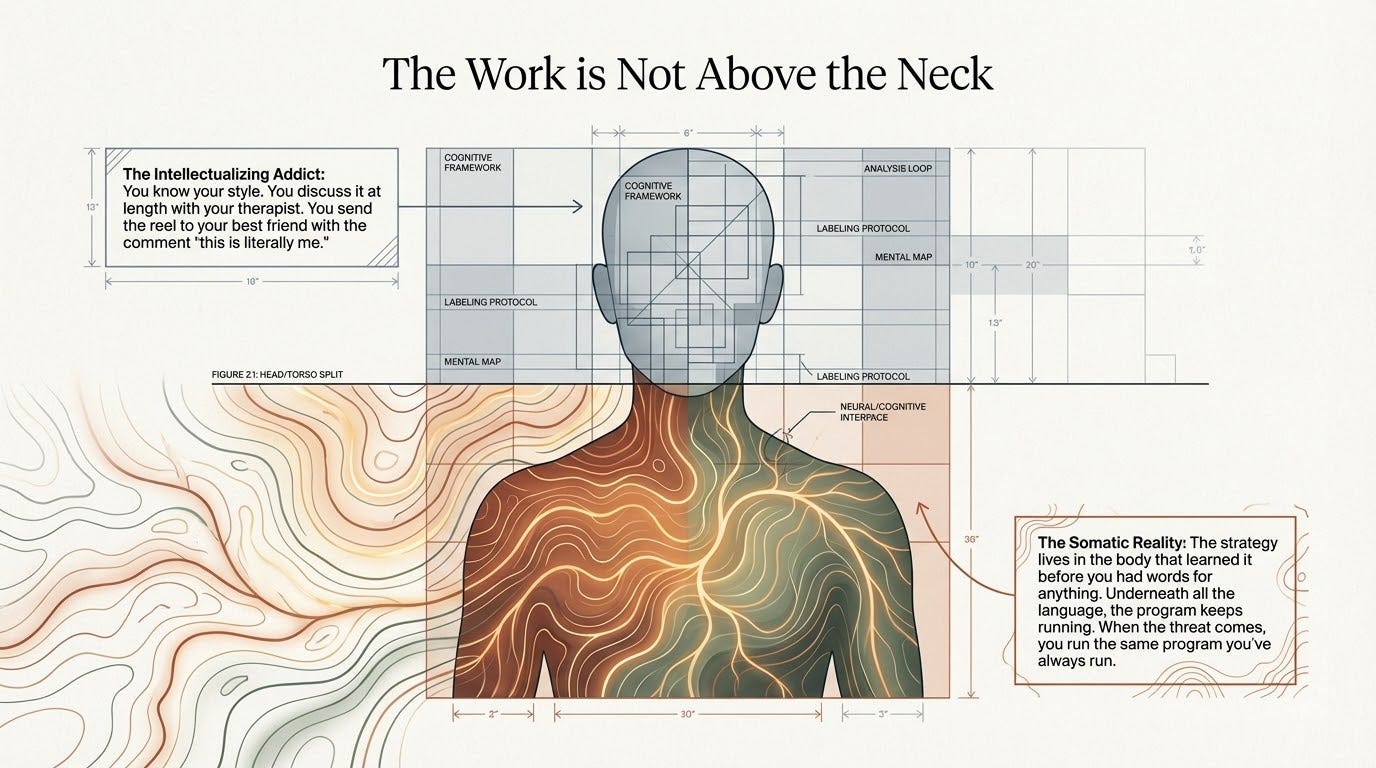
You know your style. You can explain it at a dinner party with clinical precision. You’ve taken the quiz, read the book, sent the reel to your best friend with the comment “this is literally me.”
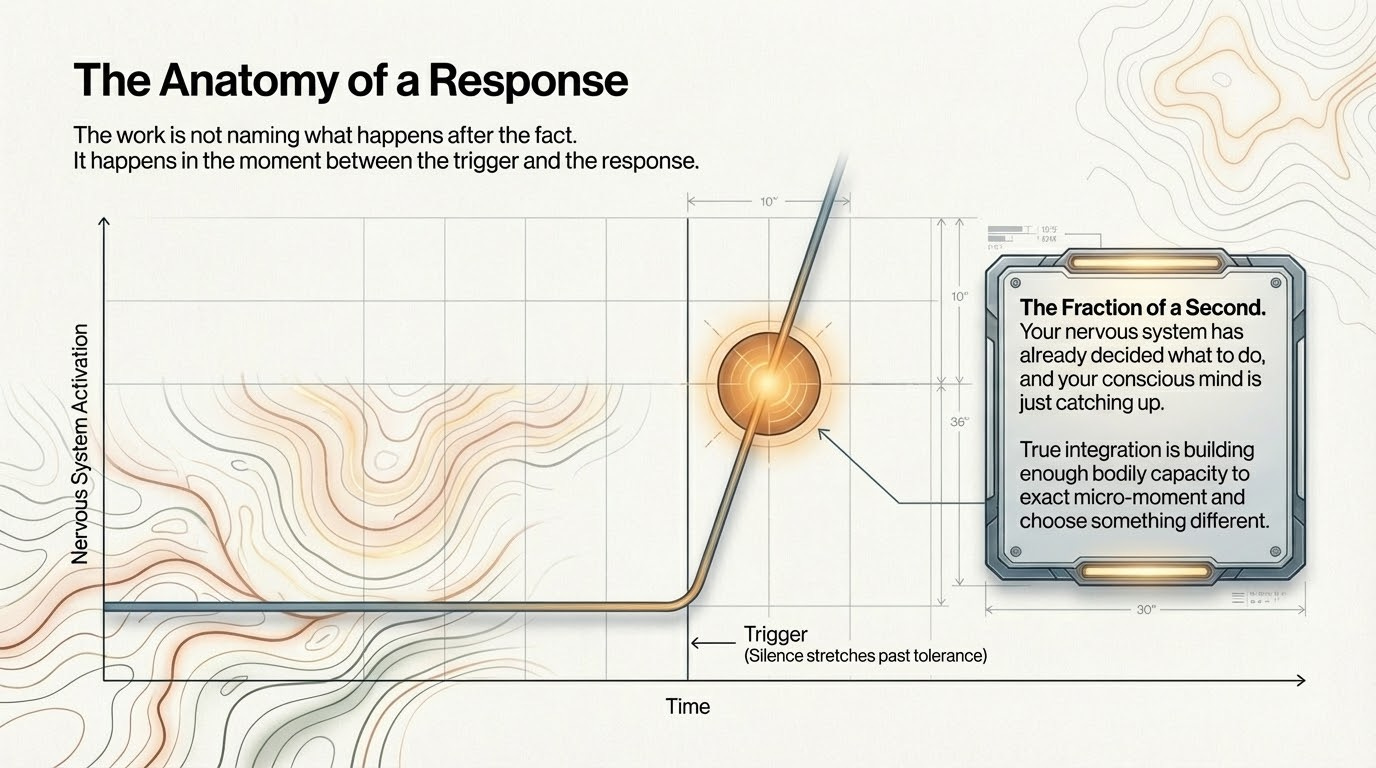
And when the threat comes , when the text doesn’t come back, when the silence stretches past what your nervous system can tolerate, when the person you love turns away and your whole body starts screaming the old scream, you run the same program you’ve always run.
The label didn’t change the loop. It just gave the loop a nicer name. He’s not ignoring you, he a “dismissive avoidant”. She’s not crazy, she’s “anxiously attached”
Case closed.
The real work is not above the neck.
It’s below it.
It’s in the body that learned the strategy before you had words for anything. It’s in the moment between the trigger and the response, that fraction of a second where your nervous system has already decided what to do and your conscious mind is just catching up. The work is not naming what happens in that moment. The work is building enough capacity to pause in that moment and choose something different.
That requires going underneath the label. Past the Instagram carousel and the quiz result and the brunch conversation. Down into the specific memories, the specific adaptations, the specific moments when a small version of you figured out exactly what to do to stay safe.
Not to reject that strategy, it saved you, but to update it. To let the adult body run a different program than the one the child’s body had to engineer.
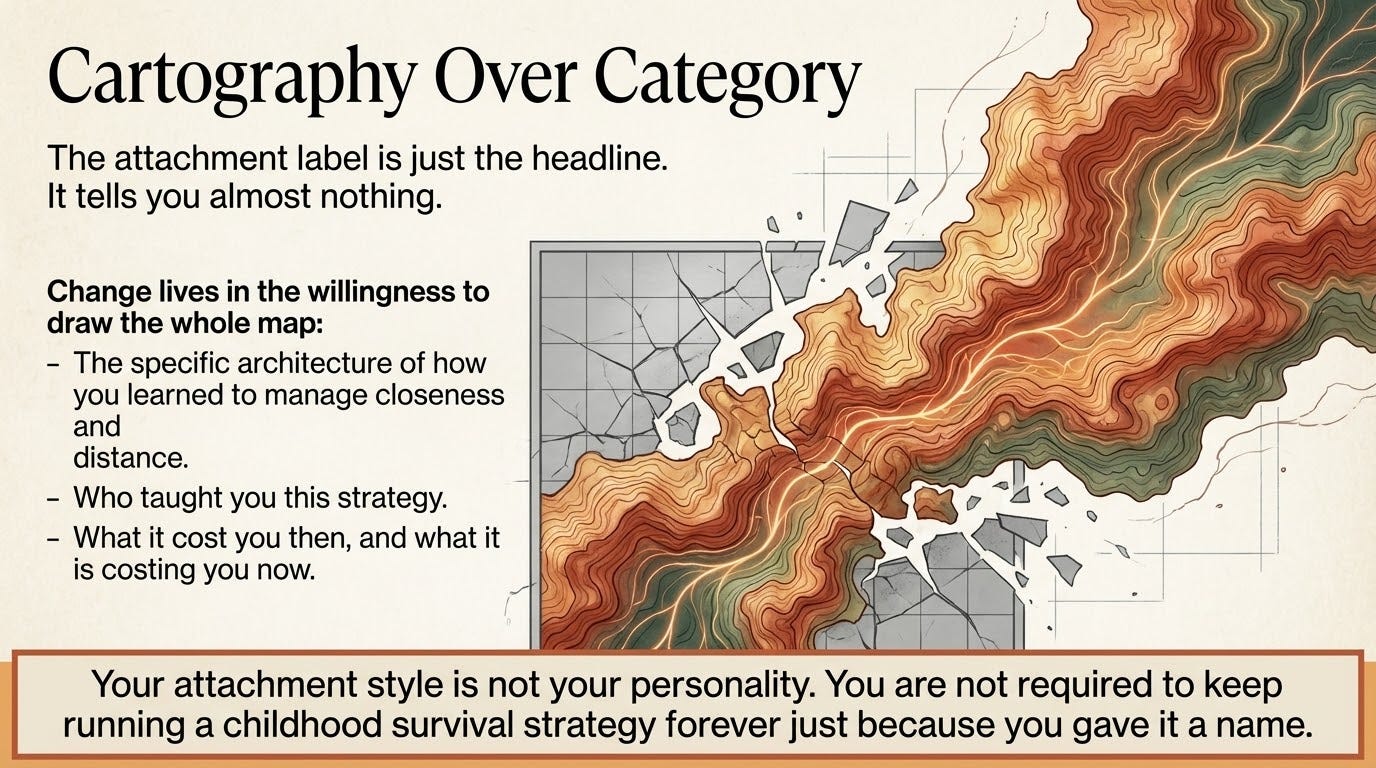
The attachment label is the headline. It tells you almost nothing. The story underneath it, the specific architecture of how you learned to manage closeness and distance, who taught you, what it cost, and what it’s still costing, that’s where change lives.
Not in the category.
In the cartography.
In the willingness to draw the whole map, not just name the continent.
Your attachment style is not your personality. It is a strategy your nervous system invented when you were too young to invent anything else. You are not required to keep running it forever just because you gave it a name.
As a recovering intellectualizing addict myself, it’s worth going beyond the insight game.
