
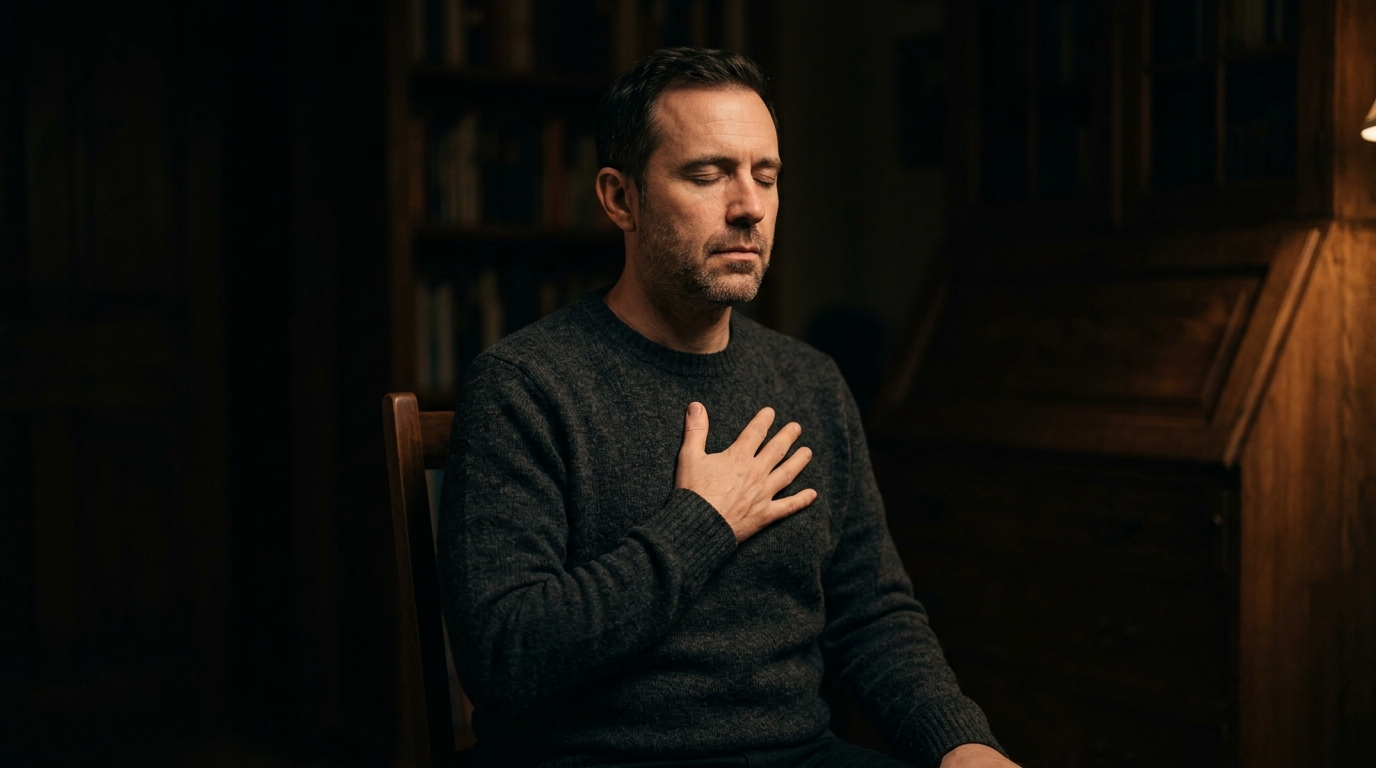
You've talked about it. You've analyzed it. You understand the dynamic intellectually. You can explain to a friend, with clinical precision, exactly why the two of you keep ending up in the same place.
And the next time your partner says the thing, your chest tightens, your jaw locks, and you're right back in the same reactive place you swore you were done with.
That's not a willpower failure. That's your nervous system running a program faster than your conscious mind can override it. The body keeps the conflict alive long after the brain has agreed to move on.
Why Does Your Body React Before Your Brain Catches Up?
The nervous system is not polite. It does not wait for you to think. It scans for threat continuously, and when it detects a match, a tone of voice, a facial expression, a phrase that has historically preceded pain, it launches a response before you've had a chance to evaluate whether the threat is real.
This is called neuroception. Stephen Porges coined the term to describe the nervous system's ability to assess safety and danger without involving conscious awareness. Your body is reading the room before your mind enters it. And the reading it produces is based on history, not the present moment.
This is why a partner's sigh can trigger a cascade of rage or shutdown that seems wildly disproportionate to the event. The sigh was not the trigger. The sigh matched a stored pattern. The nervous system recognized it as the opening note of a sequence that has historically ended in rejection, criticism, or emotional abandonment. And it responded to the full sequence, not just the sigh.
You are not overreacting. Your nervous system is responding accurately to a pattern it has catalogued over years. The problem is that accuracy is based on the past, and the past may no longer be the best predictor of the present.
What Is Your Nervous System "Remembering" in the Middle of a Fight?
The body stores relational experience. Not as narrative memory, the kind you can recall and describe. As procedural memory, the kind that lives in muscle tension, breathing patterns, posture, and the speed of your heartbeat.
When you were a child and your caregiver's mood shifted, your body learned to respond before your mind could interpret what was happening. Maybe you froze. Maybe you became very small and very quiet. Maybe you got louder to be seen. Those responses were encoded in your nervous system as survival programs, and they are still running.
In your adult relationship, those same programs activate. Your partner raises their voice. Your body doesn't hear your partner. It hears the original threat. The one from decades ago. The one your body never fully processed because you were too young, too dependent, too overwhelmed to do anything but survive it.
This is why some fights feel so much bigger than the thing you're fighting about. Because in a very real, physiological sense, you're not fighting about the thing. You're fighting about every version of the thing your body has stored, and the body doesn't differentiate between past and present. It just responds.
Why Talk Therapy Alone Can't Reach the Layer Where Your Patterns Live
Talk therapy is a cognitive and emotional process. It uses language, narrative, and meaning-making to create understanding. It works in the domain of the prefrontal cortex, where insight, reflection, and intentional choice reside.
The relational patterns that keep you stuck live below that domain. They live in the brainstem and limbic system, in autonomic responses that fire before language is available. You cannot talk your way out of a pattern that didn't originate in language. You cannot reason with a nervous system that is operating on a different timeline than your thoughts.
This does not mean talk therapy is useless. It means talk therapy is incomplete if it never addresses the somatic layer.
Couples who do excellent cognitive work, who understand their attachment styles, who can name their triggers, who have developed sophisticated emotional vocabularies, still get hijacked by their bodies in moments of relational stress. The understanding disappears the moment the nervous system takes over. They describe it as "knowing better but not being able to do better." That gap between knowing and doing is the gap between the prefrontal cortex and the autonomic nervous system.
Closing that gap requires working with the body, not just the mind. It requires learning to notice the first somatic signal of activation. Not the thought. Not the emotion. The body sensation. The constriction in the throat. The heat in the face. The sudden impulse to move or the sudden inability to move. That signal is the earliest point of intervention, and it arrives before the fight does.
What Does It Mean to Work With Your Body in Couples Work?
It means paying attention to what your body does before you decide what your body does.
In a session, this might look like a therapist noticing that your shoulders rose the moment your partner started speaking. Or that your breathing shifted. Or that you broke eye contact at the exact moment the conversation moved toward vulnerability. These are not random physical events. They are the body's real-time commentary on what's happening in the relational field.
When you learn to notice those signals, you gain something more valuable than insight. You gain a few seconds of choice. The gap between the trigger and the response widens just enough for a different option to exist.
Those few seconds change everything. Not because they eliminate the pattern. Because they allow you to interrupt the pattern at the point where it was previously automatic. The nervous system that was running a thirty-year-old program encounters something unfamiliar. A pause where there used to be an immediate reaction. And in that pause, a new relational experience becomes possible.
Over time, these new experiences accumulate. The nervous system updates its predictions. The body learns, slowly and through repetition, that this relationship is not the same environment that produced the original survival response. That update doesn't happen through understanding. It happens through lived, embodied experience of something different.
This is what somatic work adds to couples therapy. Not a replacement for conversation. A foundation for it. Because the conversation your relationship needs cannot happen while both nervous systems are in survival mode. The body has to come down before the mind can open up.
Continue reading
→ The Neuroscience of Identity Change
→ Their Defensiveness Isn't About What You Said
→ Why You Keep Having the Same Fight
→ The Brake System You Forgot to Address
→ The Neuroscience section on the 90-Day Rewire
The Inner Compass Assessment includes a nervous system mapping component that identifies where your body holds relational threat, so the work meets you where the pattern actually lives, not just where you can talk about it.
