
There is a diagnosis in the manual called adjustment disorder, and the criteria are roughly these: something happened, you are more upset about it than the committee finds proportionate, and it is interfering with your functioning. If it clears up within six months of the stressor ending, congratulations, you were acute. If not, we call it persistent and bill accordingly.
I have written that code on a lot of forms. F43.22, if you want to look it up. It is the diagnosis you reach for when a person is clearly struggling and clearly not disordered, which describes most of the people who walk through a therapist’s door, and describes every single one of us on a long enough timeline.
Because read the criteria again with your whole life in view. Something happened. You are having a bigger reaction than the situation appears to warrant. It is affecting your functioning.
That is not a disorder. That is Tuesday. That is the human condition with a billing code stapled to it.
I am not making fun of the people who wrote the manual. They had an impossible job and they did it in committee, which is how you end up with a category that means, in effect, this person is having a hard time and we would like to help them without implying anything is permanently wrong. That is a decent impulse dressed up in bureaucratic clothes.
What I am making fun of is the assumption underneath the whole enterprise, which is that there exists a baseline, a normal, an adjusted state, and that the rest of us are experiencing temporary deviations from it.
Show me the adjusted person. I have been doing this for a long time and I have not met them.
Here is what I think is going on. You were issued a nervous system optimized for a world that no longer exists, in a body with a shelf life you are not permitted to discuss at parties, on a rock traveling around a medium-sized star at roughly sixty-seven thousand miles an hour, and you were given no instructions, no guarantor, and no way to verify any of the accounts on offer. And then you were told that struggling with this is a symptom.
Of course you are having an adjustment reaction. You are adjusting to being a temporarily conscious arrangement of matter that knows it is temporary. That is not a six-month process.
Bertrand Russell had a line about this that is funnier than he probably intended. The demand for certainty is one which is natural to man, but is nevertheless an intellectual vice. Natural, and a vice. He is describing an appetite the universe has no intention of satisfying, and then declining to feel sorry for us about it, which I have always admired.
Mark Manson gets at the same thing with less tweed. Nothing is for certain until it has already happened, and even then, it’s still debatable.
Even then. Even after. That is the joke and it is a good one, because most of the fights in most marriages are about a past event that both parties attended.
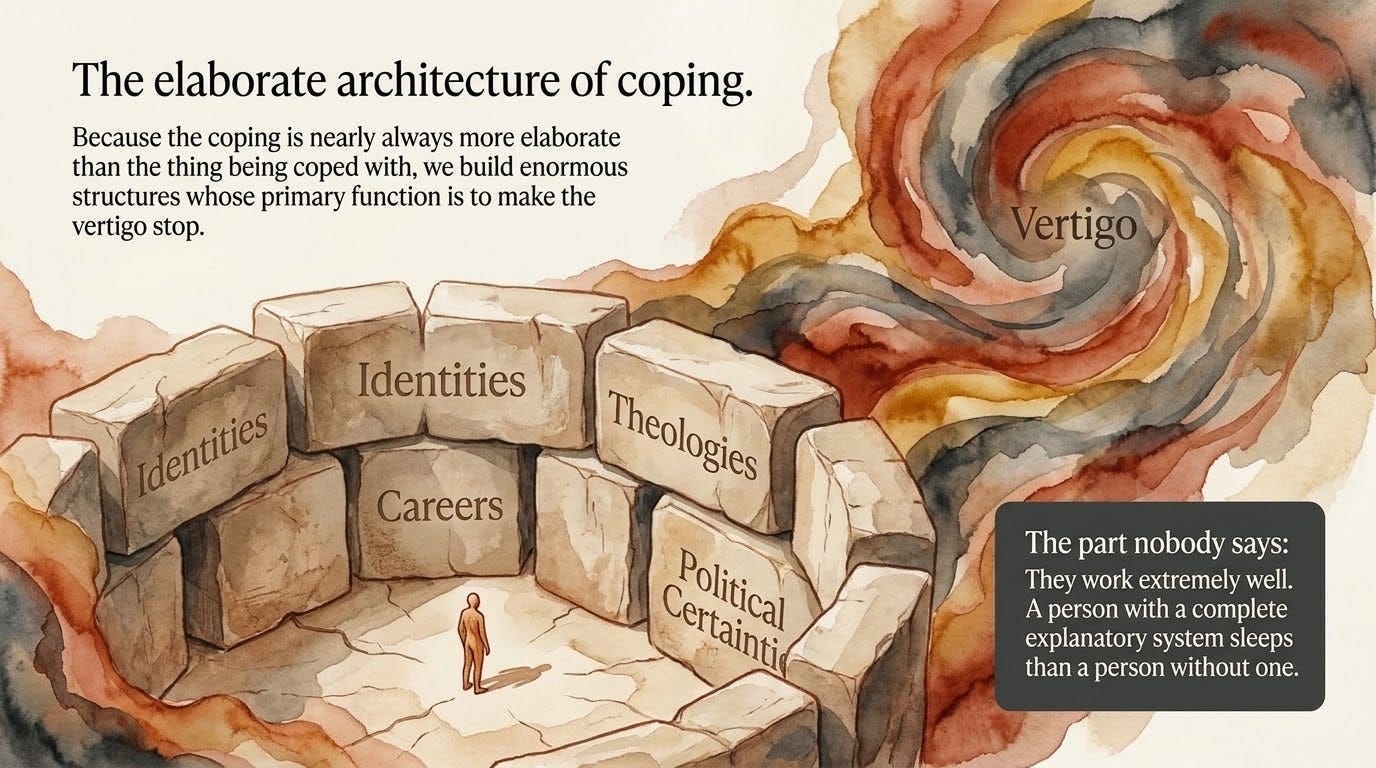
So we cope. And the coping is where it gets interesting, because the coping is nearly always more elaborate than the thing being coped with.
We build enormous structures, whole identities, careers, theologies, political certainties, whose primary function is to make the vertigo stop. And they work. That is the part nobody says. They work extremely well. A person with a complete explanatory system sleeps better than a person without one, and I say that as someone who has slept both ways.
What we do not price in is the bill. The structure that makes the vertigo stop also stops you from meeting anyone. We are addicted to certainty, to the sense of safety. We are drawn toward uniformity and conformity, and uniformity does not require intimacy, because you never have to deal with difference.
That is the trade, stated flatly. Comfort in exchange for company. And most people take it without ever knowing a trade was offered, which is the most efficient possible way to run a con.
The institutions understand this perfectly, by the way, and price accordingly. Every certainty on offer, religious, political, wellness-industrial, has the same business model: your discomfort is a symptom, we have the cure, the cure is agreeing with us, and the ongoing cost of the cure is that you must never seriously entertain the alternative. It is a subscription. The product is the absence of vertigo. The renewal fee is your capacity to be surprised.
I have been a paying customer and I have also, for a while, been on the sales floor. I know exactly how good the pitch feels from both sides.
Ricky Gervais built a television show out of a man refusing this deal, and the best writing in it is not the grief. It is the flat comic honesty around the grief. There is a widow on a bench in a graveyard who says the thing the whole enterprise is built to avoid saying. Good people do things for other people. That’s it. The end.
That’s it. The end. No mechanism, no reward structure, no cosmic accounting. Just: that is the whole content of the good life, it does not require a metaphysics, and we are done here.
And in another scene, about the man she buried: I’d rather live missing him than for him to live missing me. That’s how much I love him.
There is no consolation in that sentence. There is no there-is-a-plan in it. It is somebody standing in the full weight of the loss and finding, inside the weight itself, something that holds. Which is a different operation entirely from being told the weight is not real.
So if life is one long adjustment disorder, and I think it is, then the question is not how to get adjusted. There is nothing to get adjusted to. The question is what you do with the maladjustment, and there are two options.
You can spend it building a structure that makes the feeling stop, which will work, and will cost you the ability to be surprised by another human being, and you will not notice the charge because it comes out in small installments over forty years.
Or you can stop treating the feeling as a symptom.
That second one is not brave and I do not want to make it sound brave. It is mostly just tiring. The tiredness is not from the vertigo. The vertigo is cheap. What costs is the resisting, the low steady expenditure of insisting it should not be there, and you only find out how much you were spending when you resisting. You do not get a settled worldview out of it. What you get is the ability to sit across from someone who has arranged their vertigo differently than you arranged yours and find it interesting rather than threatening, which turns out to be the entire basis of every relationship worth having.
We are the evolutionary products of an indifferent natural process, nothing more, nothing less. But we can and do care for each other. I wrote that in 2013 and I have not found a reason to revise it. The first sentence is the diagnosis. The second one is the treatment, and it is the only one that has ever worked, and it does not come in a six-month course.
Ask yourself what your vertigo has been paying for.
