
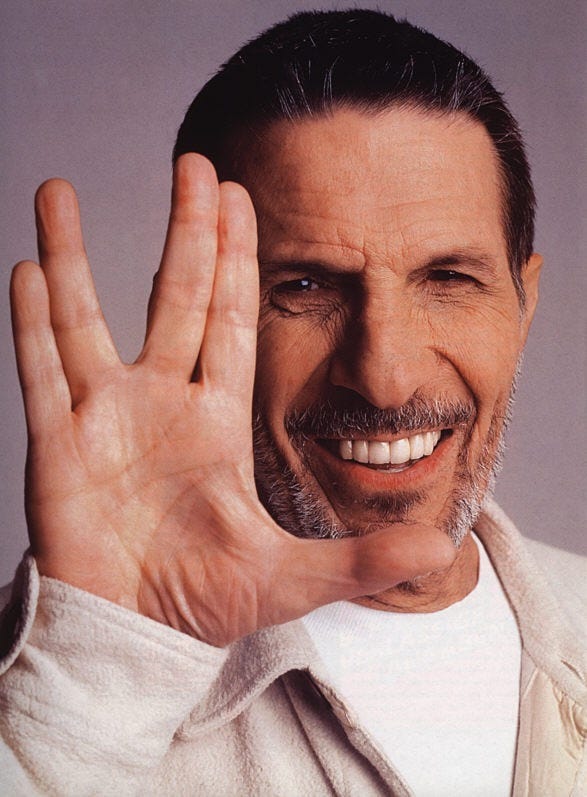
Boston. Late 1930s. An Orthodox synagogue on a holiday morning.
A boy stands in the pews with his father, his grandfather, and his brother. Eight years old, maybe nine. At the front of the room, five or six men rise, pull their prayer shawls up over their heads, and turn to face the congregation. The boy’s father leans down and gives him one instruction. Don’t look.
The men begin to chant. It does not sound like the rest of the service. It sounds like something being called into the room. Under the shawls, hidden, the men stretch their hands toward the people, fingers split down the middle, the shape of the Hebrew letter shin. Shin for Shaddai, the Almighty. Shin for Shekhinah, the presence of God, which tradition says enters through the windows of those fingers, and which is too much for human eyes.
That is the reason for the instruction. You do not look at the presence. You cover your eyes and let it pass over you.
The boy peeked.
He told the story for the rest of his life. Something major is happening here, he remembered thinking. He saw the hands emerging from the shawls, found the whole thing magical, and went home and practiced the gesture until he owned it. His name was Leonard Nimoy.
Thirty years later, on the set of a 1967 television episode called Amok Time, the script had Spock greeting another Vulcan for the first time, and nobody had decided what Vulcans do. Nimoy offered the hand from the synagogue. The director shot it without discussion.
Which means the most famous gesture in science fiction, the emblem of the most relentlessly logical being ever put on screen, is a stolen glance at the presence of God. A boy was told the territory was too much to look at. He looked anyway. Then he spent the rest of his life wearing what he saw.
Remember…
Spock was never logical.
Not in the television years. Not in the films. Not once. What Spock had was not a philosophy. It was armor. And the films spend two decades removing it piece by piece, in public, in order, so that if you watch the arc straight through you can see where the armor came from, what it cost, and what it took to get it off.
Start at the crib. In a flashback we are shown Spock’s birth. His father Sarek, a Vulcan ambassador, looks down at his newborn son, half human through his mother, and says two words. “So human.” Not a greeting. A verdict. The children of Vulcan finished what the verdict started, and every taunt landed on the same half. The boy learned the equation before he could examine it: the feeling part of him was the unacceptable part.
Logic was not something Spock reasoned his way into. Logic is where he fled.
Psychology has a name for this. The clinicians who map the mind’s inner system call it a protector, a part of you that took a job in childhood and never resigned. The intellect gets promoted to management, and its assignment is simple: nothing reaches the surface that once got us punished. I call it the nerve pinch. Spock’s signature move, turned inward. The feeling rises, the hurt or the want or the grief, and a trained hand puts it down gently before it reaches the controls. No violence. No scene. Just a body going quiet.
We know the logic was armor and not philosophy because the films ran the experiment. Twice.
The first test is The Motion Picture, 1979. Spock has left Starfleet for the sands of Gol to complete the Kolinahr, the Vulcan discipline that purges the last residue of emotion. The finished project. Total logic at last. At the final ceremony he senses a vast consciousness crossing space, and he fails. The masters dismiss him. Then he meets the thing he sensed. V’Ger, a machine intelligence carrying knowledge that spans the universe. Perfect logic, actually achieved, floating in front of him. Spock melds with it and comes back shaken. Barren, he says. Cold. No mystery, no beauty. Later, in sickbay, he takes Kirk’s hand, an intimacy no Vulcan performs casually, and says the quiet part aloud. “This simple feeling is beyond V’Ger’s comprehension. No meaning, no hope, and, Jim, no answers.” He says he weeps for the machine as he would for a brother.
He is not weeping for the machine.
V’Ger is what the finished armor looks like. A completed map with no territory left inside it. Spock spent forty years trying to become that thing, met it, and grieved.
The map is not the territory. Spock’s logic was a map, drawn by a shamed child, and mistaken for four decades for the person carrying it.
The second test is harsher. In The Wrath of Khan the armor finally performs the one function armor exists for. Spock walks into a radiation-flooded chamber to save the ship, and dies for it. But watch what he does on the way in. He performs the nerve pinch one last time, on McCoy, the ship’s doctor, the most openly feeling man aboard. Then he presses his fingers to McCoy’s unconscious face in a mind-meld and says one word. “Remember.”
The writers meant it as a hedge, a thread left dangling in case the death needed undoing. What they built was a metaphor so exact it should humble the people who do this deliberately. The logic part, dying, deposits its soul in the feeling part. McCoy spends the next film carrying two men in one body. He breaks into Spock’s quarters and speaks in Spock’s cadence. He gets arrested in a spaceport bar trying to charter an illegal flight to the planet where Spock’s body lies. He carries the soul until Vulcan priests perform an ancient re-fusion and give it back, at real risk to himself, a risk he accepts in three words. “I choose the danger.”
And why is there a next film at all? Because Kirk turns the ship around. He burns his career, destroys the Enterprise, and loses his son to retrieve one man. Spock’s father meets him afterward with the accountant’s question: your ship, your son, at what cost. Kirk answers, “If I hadn’t tried, the cost would have been my soul.” When the reborn Spock asks why they came, Kirk hands him the reversal of the most famous line in the franchise. “Because the needs of the one outweighed the needs of the many.” In the next film Spock’s human mother, Amanda, has to repeat it to him slowly, like a lesson: the good of the one outweighed the good of the many. He can barely compute it. It is the arithmetic his armor was built to prevent.
Now watch who comes back from Genesis. Not a computer. In the final film of the arc, an older Spock stands in his quarters with a protégée, a young Vulcan who worships logic exactly the way he once did, and he says the sentence the entire series had been walking toward for twenty-five years. “Logic is the beginning of wisdom, Valeris, not the end.” He keeps a painting of the expulsion from Eden on his wall, he tells her, as a reminder that all things end. He tells her to have faith.
Faith. From Spock. Crazy.
The philosophers who study this arc have concluded the same thing from the other direction. The early Spock, they argue, was never a Stoic at all, just a suppressor doing an impression of one, a stiff upper lip mistaken for a philosophy. The late Spock is what the real thing looks like. Not the absence of feeling. Freedom from being ruled by it. He died with the armor on and came back able to hold both halves at once, and the man who returned talks like someone who has been somewhere. Because he has.
The day Nimoy died, a comedy writer posted eleven words that traveled the world faster than the obituaries. “None of us were ever Kirk. All of us were Spock.”
So now the question turns to you.
You, the reasonable one. The one who does not escalate, who stays measured while the other person gets loud, who can win the argument without raising your voice and often does. Some of your calm is regulation, earned and real. But some of it is a nerve pinch. The feeling rises, the hurt or the want or the grief, and a trained hand puts it down gently before it reaches the controls. You call this maturity. The people who live with you experience it as distance. They keep meeting the uniform and wondering where you went.
And the project has an endpoint. You have already seen it. Knowledge that spans the universe. Barren, cold, no mystery, no beauty. Nobody argues with V’Ger.
Nobody stays, either.
I should say how I know. I watched these films as a boy and never once wanted to be Kirk. Kirk was obvious. I wanted to be the one nobody could crack, the one whose calm was a fortress, and I grew up and built exactly that. I found my own Vulcan, a church that rewarded certainty and punished doubt, and I rose inside it. I learned to answer feelings, my wife’s and my own, with frameworks. It took decades, a deconstruction, and very nearly a thirty-year marriage to see what the films had been showing me since childhood. The calm was a pinch. The logic was a map drawn by a boy who needed one. I still catch my hand moving toward the meld.
Nimoy needed twenty years to run the same arc in public. In 1975 he published a memoir titled I Am Not Spock. In 1995 he published another titled I Am Spock. The distance between those two titles is the entire work. Not the killing of a part. Its integration. The book that could finally say I am was written by a man who had stopped needing the armor to be the whole story.
Which brings it back to the synagogue, remember?
The instruction was reasonable. The presence was dangerous. Every adult in the room covered their eyes, and the tradition had its reasons, and the boy who looked anyway did not become a cautionary tale. He became the face of an era, and the thing he saw under the shawls became a blessing thrown across a galaxy.
Live long and prosper.
There is something in you that you were told not to look at.
Peek.
