
I like conversations. Even the hard ones. Especially the hard ones. And I have been having a lot of them lately about AI and the revolution it is supposedly bringing.
Many of them take the same shape. Not the conclusions people reach about AI, but the way they arrive. They are reasoning from something they heard in 2023, and that is where the investigation stopped.
I think I have identified three maps in circulation. Each one is held with confidence, and like all maps, keeps them from seeing the territory.
The Resistant.
They range from people with real environmental concerns to people who simply do not like it.
I share the environmental concerns. I do not share the pessimism that we cannot solve what this thing has brought us. The International Energy Agency puts global data center electricity at roughly 485 terawatt hours in 2025, doubling to around 950 by 2030. AI facilities grew fifty percent in a single year. Data center demand is climbing more than four times faster than every other sector combined. Google disclosed 10.9 billion gallons of water in 2025, up thirty four percent. None of that comes from activists. It comes from corporate filings and the most conservative energy body on earth.
The problem is local and it is temporal. Peak daily draw at one facility runs six to thirty times its annual average. UC Riverside and Caltech estimate American water systems need ten to fifty eight billion dollars in new capacity by 2030 to absorb it, and that bill lands on ratepayers who never voted on any of it.
That is a real fight. Zoning, utility commissions, disclosure.
It is also being won.
Microsoft has run closed loop cooling in every new data center design since August 2024. Filled once at construction, circulating between servers and chillers forever. No evaporation. No fresh water draw. Each facility saves more than 125 million liters a year, roughly thirty three million gallons, and their fleet water efficiency has already dropped thirty nine percent since 2021. The Phoenix and Mount Pleasant pilots come online in late 2027. At Build in June, Nadella said the new generation of AI data centers uses about as much water a year as a restaurant.
Google committed in June to replenishing a hundred and twenty percent of what its American data centers consume by 2030. Seven billion gallons replenished in 2025 across a hundred and sixty five projects in ninety seven watersheds, air cooling in at risk watersheds, treated wastewater instead of drinking water in Douglas County, site level numbers published. Amazon runs 0.12 liters per kilowatt hour, the best disclosed figure in the industry. Direct to chip and immersion cooling cut water use by seventy to ninety percent.
None of that is corporate propaganda. It is research any curious person can find. But resistance comes in all forms and probably in every revolution. They love resistance, not curiosity.
One of my favorite things to do is zoom out, because our memories are short and we have seen this movie before.
Between 2010 and 2018, computing done in the world’s data centers grew five hundred and fifty percent. Traffic went up tenfold. Storage went up twenty five times. Energy consumption rose six percent. Energy per unit of compute fell about twenty percent a year, faster than any efficiency gain in aviation or heavy industry. Data centers finished 2018 on one percent of the world’s electricity, the same share as 2010.
The curve broke around 2020 when AI arrived and demand outran efficiency. But an industry that absorbed a five hundred and fifty percent workload increase on six percent more energy is not an industry with no idea what to do. It is one that has done this before and got caught flat footed by the size of the next wave.
In other words, have some fucking optimism.
Sam Altman puts the average ChatGPT query at 0.34 watt hours. The IEA puts an hour of Netflix at 0.12 to 0.24 kilowatt hours. One prompt costs you five to ten seconds of streaming. Five minutes in a microwave is worth about three hundred and fifty prompts.
This next one blew me away, because I had never thought about it until I did the research. Standby power, the electricity your devices burn while switched off, runs five to ten percent of residential consumption according to the Department of Energy. The NRDC once put total idle load in the average American home at twenty three percent. Twenty three percent. A quarter of your power bill for machines doing nothing. The NRDC also calculated that people who bought a smart TV in 2021 and left the wake feature on would add seven hundred and fifty million dollars to American utility bills over seven years, and three million tons of carbon.
There was no movement. There were no think pieces. Nobody quit watching television.
So if you are watching another round of Love Island while scrolling Instagram, you probably should shut the fuck up about the energy AI is taking and maybe help come up with a solution. Although sure, if you are living in a yurt, writing on paper by candlelight, killing only what you and your family can eat, respect. I respect anyone who is consistent.
I recently had a conversation with a Resistant who told me that AI was only being trained on history written by white men. I asked if they had ever heard of Howard Zinn, who wrote A People’s History of the United States. Ironically, they hadn’t, because they could have easily said, yeah, he’s a white man too. So I asked whether they knew there was a whole library of histories written from the Indigenous perspective, by people who had not won.
Books like Michel-Rolph Trouillot’s Silencing the Past, on how absences get manufactured in an archive. Vine Deloria Jr.’s Custer Died for Your Sins. Ned Blackhawk’s The Rediscovery of America, five hundred years of this country with Native people at the center, National Book Award, 2023. Walter Rodney’s How Europe Underdeveloped Africa. C.L.R. James’s The Black Jacobins on Haiti. Ranajit Guha and the Subaltern Studies collective, reading peasant insurgency out of colonial police records since 1982.
Out of respect, I let it go. But I thought about it for weeks, because the person was not stupid. They were not even wrong about the thing underneath their worry. They were wrong about the machine, and ironically, the machine could have corrected them.
What the Resistant do not get is that their instincts are better than their information. The suspicion about whose knowledge is represented is directionally sound. They are not paranoid. They are undersampled.
There is a version of their worry that is truer than the one they said out loud. What I found when I went looking is that there are real holes in what these systems have read. Three of them, with three different causes, and almost everyone collapses them into one accusation.
The first is on purpose, by the people who own the material.
A great deal of Indigenous knowledge is not in these systems because it was never released. The CARE principles for Indigenous data governance add collective benefit, authority to control, responsibility and ethics to the open science standards. The First Nations principles of ownership, control, access and possession date to the nineties. Traditional Knowledge Labels let a community attach its own permissions to a record. Attribution required. Non commercial only. Family use only. Ceremonial use only. A growing number of museums and archives now honor them. Mukurtu runs tiered access so a story can be preserved for the community without being published to the world. In late 2024 the Cherokee Nation, four hundred and fifty thousand citizens, convened its own task force on AI and data sovereignty and wrote a report grounded in Cherokee values.
So the accurate version of that conversation is not that the machine only read white men. It is that some of what would most correct the record is being deliberately withheld by people with excellent reasons, who are not asking permission.
That is not a defect in the training data. That is not the fault of any company. That is sovereignty working, and anyone who wants to fix it is volunteering to repeat the thing that made it necessary.
The second hole is sediment. In the corpora these systems learn from, more than forty languages account for less than a hundredth of one percent of the data, and roughly a hundred sit under a tenth of a percent. Nobody chose that. It is what happens when the internet fills up in the languages of whoever got online first. Whatever lives only in those languages is absent, for the same reason it was absent from the card catalogue.
That one is being filled right now, by people whose names never come up in these arguments.
Masakhane is a pan African collective whose name means we build together in isiZulu. They have published translation tools for more than forty eight African languages. Lelapa AI in South Africa built InkubaLM for Swahili, Yoruba, isiXhosa, Hausa and isiZulu, named after the dung beetle because it moves heavy loads at small scale. Google released WAXAL in February, an open dataset across twenty one African languages. Cohere partnered with HausaNLP for its Aya models. Meta’s translation work now covers more than two hundred languages, curated by hand, aimed at the ones nobody else bothered with.
Africa has more than a billion people and over two thousand languages. Everyone doing this work will tell you it is the tip of the iceberg. They will also tell you they are doing it, which is more than the person across the table from me could say. Curiosity was never on the agenda.
The third hole is on the companies, and it is disappointing.
Somebody has to label all of it. Somebody has to mark which shape is a pedestrian and which is a palm tree, and read the violence and the abuse material so the model learns to refuse it. That work went to the cheapest available hands. Informal government estimates put more than two million Filipinos doing this crowdwork. Labelers in Venezuela earn ninety cents to two dollars an hour for work that pays ten to twenty five in the United States. When one platform expanded into India and Venezuela, Filipino freelancers watched some task rates fall from ten dollars to under a cent. TIME documented OpenAI paying its Kenyan outsourcing firm up to twelve dollars an hour per worker while the workers took home between one dollar thirty two and two. A 2025 survey of seventy six workers across Colombia, Ghana and Kenya recorded sixty separate incidents of psychological harm. Oxford’s Fairwork project surveyed more than seven hundred platform workers and found not one of fifteen platforms scored above bare minimum on pay, conditions, contracts, management or representation.
But hey, you’re a capitalist, right?
Kenyan workers have since formed a Data Labelers Association. Three hundred and thirty nine joined in the first week.
Then there is Karya, a nonprofit out of Bengaluru that hires rural Indians to record their own languages, pays around five dollars an hour into villages where that is transformative money, and hands workers ownership of the data so they collect royalties every time it is resold. Thirty five thousand workers. Twenty four states. Thirty five million tasks. They have opened pilots in Kenya and Ethiopia.
Same work. Same clients. Same industry. Opposite economics.
The exploitation was never a technical requirement. It was a pricing decision, and somebody made it.
So there are holes. One is a boundary being held and should be respected. One is being filled by people who did not wait to be asked. One is a choice that could be reversed tomorrow by the companies that made it.
None of which the person across from me could tell me, because they had decided the honest thing to do was refuse to look. And refusing to look is the one position that guarantees their map never changes.
The other thing the Resistant believe is that AI is making us stupid. Again, these people have Google. They just don’t seem to know how to use it. The evidence I found is better than that, and stranger, in both directions.
The World Bank ran a randomized controlled trial in Benin City, Nigeria. Eight hundred senior secondary students, nine public schools, six weeks of after school sessions with GPT-4. The result was 0.31 standard deviations across the assessment, 0.23 on English, the primary outcome. Researchers put that at a year and a half to two years of ordinary schooling, compressed into six weeks, at forty eight dollars a student. Against every education intervention ever randomized in the developing world, it beat eighty percent of them, including structured pedagogy, the field’s gold standard. The largest gains went to girls!
Harvard ran a crossover trial in its largest introductory physics course. A hundred and ninety four students, each experiencing both conditions. They learned more than twice as much, in less time, with a purpose built tutor instead of an active learning classroom and a human instructor. Published in Scientific Reports. The control was not a bad lecture. It was the best evidenced classroom method in the field.
Stanford put an AI assistant in the hands of nine hundred live tutors working with eighteen hundred children in Title I schools. Students were four percentage points more likely to master the topic. Students with the lowest rated tutors gained nine. The tool cost twenty dollars per tutor per year, and half a million messages of analysis showed those tutors asked more guiding questions and gave away fewer answers.
The meta analyses agree. Thirty seven studies at an effect size of 0.577. Twenty two at 0.573. Thirty five studies and four thousand participants at 0.670. In education research 0.4 is large, and most interventions that survive replication sit between 0.2 and 0.4.
But it is not all good news. Like most complex things, it is contextual.
Researchers put nearly a thousand Turkish high schoolers through four math sessions with two tools. One was plain ChatGPT. The other was the same model wrapped in prompts designed to make the student work. During practice, performance jumped forty eight percent with the plain version and a hundred and twenty seven percent with the tutored one.
Then they took it away and ran an unassisted exam.
The plain ChatGPT students scored seventeen percent worse than students who never had access at all. The tutored group was indistinguishable from the control.
Same model. Same curriculum. Same kids. One group got a few sentences telling the machine to withhold the answer, and that was the whole difference between a seventeen percent loss and no loss at all.
We have run this experiment before, and we already published the answer.
In 1986, two researchers named Hembree and Dessart pooled seventy nine studies on hand held calculators in precollege math and ran the meta analysis. This was the middle of a genuine national panic. Parents were certain the machines would destroy arithmetic. Teachers were split. States were writing policy.
At every grade except fourth, students who used calculators alongside traditional instruction got better at paper and pencil math. Not the same. Better. Their computation improved, their problem solving improved, and they liked math more. Ellington replicated it in 2003 across fifty four studies and found the same thing.
Now look at the two exceptions, because they are the whole story.
Sustained calculator use in fourth grade hindered basic skills in the average student. Too early, before the underlying operation was built, and the tool became a substitute instead of a support.
And students who practiced with a calculator but were then tested without one showed minimal gains. No harm, but no benefit either. Students who used it in both contexts improved consistently across computation, concepts and problem solving.
Forty years apart. Different technology. Identical conditional structure.
The finding was never that the tool helps or hurts. The finding was that it depends on when you hand it over and whether the practice matches the test, and we have known that since Reagan’s first term.
In other words, fucking adapt. Yes, there are issues, but that is not where the story ends. We make the obstacle the way.
So the conclusion is not that AI makes you dumber, and not that it makes you smarter. AI reliably improves your performance while you are holding it. Whether that performance becomes capacity depends on whether the thing was built to make you struggle first.
Which is everything anyone has ever known about learning. Desirable difficulty. Retrieval practice. The struggle is the mechanism. Remove it and you remove the learning. Preserve it while removing the wasted flailing and you get two years of gains in six weeks for forty eight dollars.
The Casuals.
About half of American adults now use an AI chatbot. Pew has it at forty nine percent, up from a third in 2024, with twenty four percent using one daily and four percent describing their use as almost constant. Forty four percent have used ChatGPT specifically. Sixty three percent think the whole thing is moving too fast and seventy one percent expect it to make their personal information less safe.
Ask what they use it for and the answer is search and work email.
Line up the whole species by how far they have actually gone with this and the shape is almost vertical.
ChatGPT crossed a billion active users this year, up from nine hundred million in February. Gemini runs somewhere between six hundred and fifty and seven hundred and fifty million monthly. Against those numbers, OpenAI reports just over fifty million paying consumer subscribers and another nine million paying business users. Add every other vendor and the global paying population is somewhere around a hundred million people.
Roughly five percent of ChatGPT’s users pay for the better version. One in twenty.
Now put that against eight billion humans.
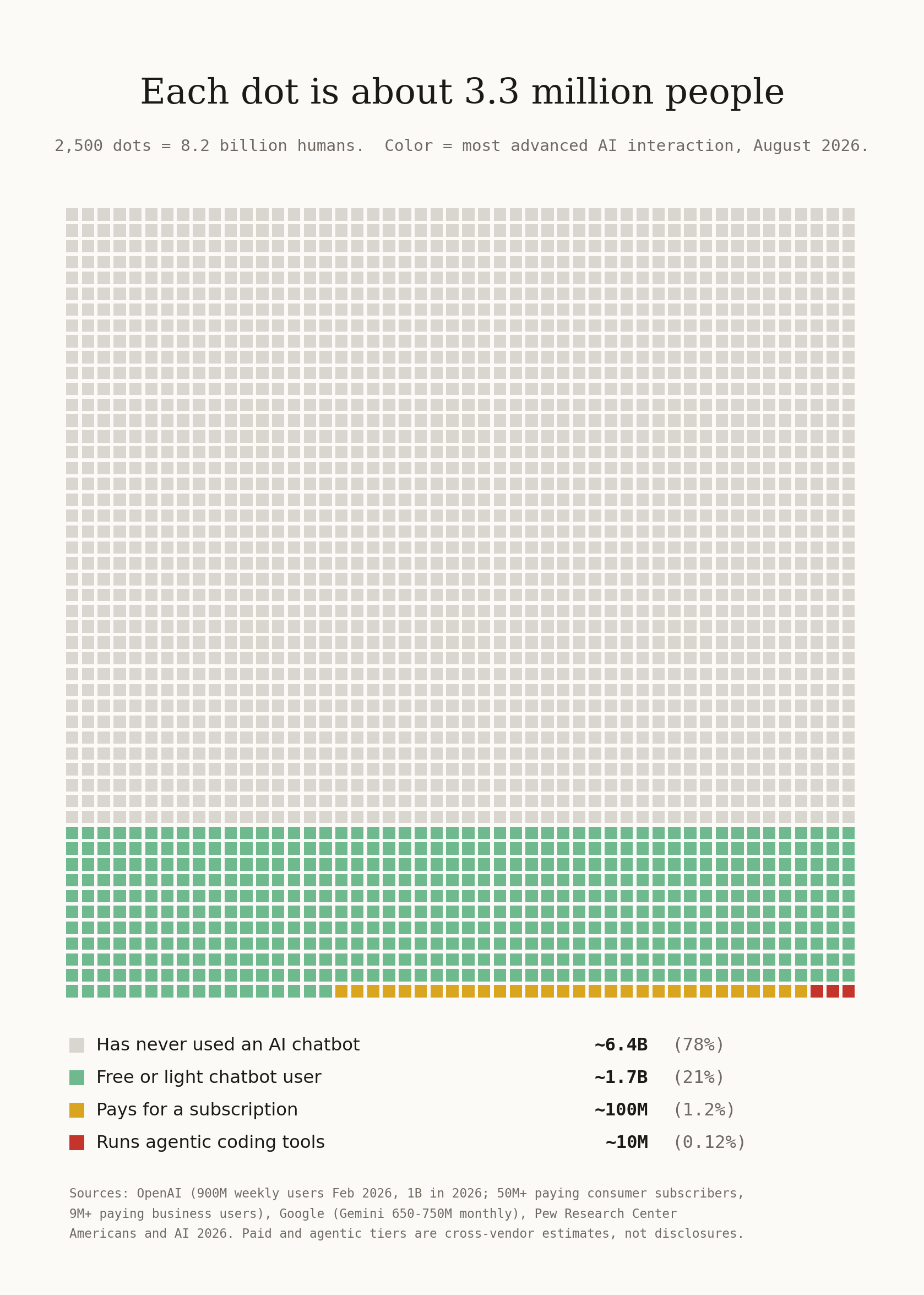
Every dot is about three point three million people. The grey field is everyone who has never touched it, close to six and a half billion. The green band is the free tier, about one point seven billion. The gold streak is everyone on earth paying twenty dollars a month, roughly one percent of us. And in the bottom right corner, there are three red squares. Ten million people, give or take, running agentic coding tools.
I am in the red. I have never been in the red on anything. Except my bank account.
Ninety five percent of the people using the most consequential tool of their lifetime are using the free tier, and inside that ninety five percent, the tasks cluster around haikus, sports scores, and what to feed people at a party.
The Casuals also carry the deepfake worry. The fear is that we will not be able to tell whether a photograph is real. Some blend of that is not really me at that party and everything is fake news now.
What they lack in optimism they make up for in being ill informed.
The Coalition for Content Provenance and Authenticity has passed six thousand members and affiliates, including Adobe, Microsoft, Google, Meta, OpenAI, Sony, Nikon, and Leica. Camera manufacturers are signing images in firmware with keys that cannot be extracted. The European labeling requirement lands this month. The NSA and CISA have recommended content credentials for critical infrastructure. Deepfake incidents went from roughly five hundred thousand to over eight million between 2023 and 2025, and the projected American fraud loss reaches forty billion dollars a year by 2027. Against that, an entire immune system is being built in public.
It is also not sufficient, and the reason is almost funny. Every major social platform strips the provenance metadata during recompression. A screenshot destroys it entirely.
Which brings up the danger that is actually coming, and it is not that you will believe a fake. It is that a real thing will be dismissed as a fake. Researchers call it the liar’s dividend. Once everyone knows synthetic media exists, every inconvenient recording becomes deniable, and the loss is not credulity. It is the category of evidence itself.
Kind of like how using an em dash now gets you accused of being a chatbot.
What the Casuals do not get is that their position feels neutral and is not. Roughly forty percent of companies have licensed an AI tool. Something close to ninety percent of employees are already using one, on personal accounts, without telling anyone.
The Casuals are not standing outside the transition. They are inside it, unsupervised, with no idea what they have agreed to.
Waiting is a decision. It just does not feel like one.
The Pioneers.
The Pioneers are not winning because they were early.
In 2025 a research nonprofit called METR ran the most rigorous test anyone had attempted. Sixteen experienced open source developers, working in codebases they knew intimately, two hundred and forty six real tasks, half with AI assistance and half without.
The developers predicted AI would make them twenty four percent faster.
They were nineteen percent slower.
After finishing, having lived through the slowdown, they estimated that AI had sped them up by twenty percent. Thirty nine points of daylight between what the clock said and what the body felt.
METR then complicated their own result. By early 2026 they reported that the developers most helped by AI were declining to participate in the no AI condition, which poisons the comparison, and their revised position moved closer to we do not know. That is a more honest place to stand than either side of this argument usually occupies.
MIT’s NANDA project reviewed three hundred deployments and reported that ninety five percent produced no measurable impact on the books. That number is now stapled to every skeptic’s slide deck and it is being read wrong. The failure was almost never the model. Nobody defined an outcome, nobody baselined the workflow, and nobody could therefore prove anything in either direction. Ninety five percent did not fail. Ninety five percent did not measure. The study rests on fifty two executive interviews and has not been peer reviewed, which is worth knowing before you quote it at anyone.
And then the finding that reorganizes the whole picture.
Anthropic tracked its own users by tenure and expected the sophisticated ones to be delegating more, handing over whole tasks, getting out of the way. The opposite is true. The longest tenured users iterate more and delegate less. They argue with it. They push back, redirect, reject, revise. Controlling for the task, the model, the language, and the country, they succeed at a measurably higher rate than newer users doing identical work.
The tasks that mark the newest users are haikus and sports scores. The tasks that mark the oldest are research, revising manuscripts, version control, raising money.
Facility is a skill. It compounds. It is learned by doing and it looks like judgment, not speed.
So what does that facility actually buy?
More than speed, and the numbers stopped being ambiguous a while ago.
Four hundred and fifty three college educated professionals were given real writing tasks from their own occupations, half with ChatGPT and half without. Published in Science. The assisted group finished forty percent faster and produced work rated eighteen percent higher. Then the finding nobody quotes. Inequality between the workers went down. The weakest writers gained the most.
Five thousand one hundred and seventy two customer support agents at a Fortune 500 company. Fourteen percent more issues resolved per hour on average. Thirty four percent for the newest agents.
Seven hundred and fifty eight consultants at Boston Consulting Group, seven percent of their entire consulting force, running eighteen realistic tasks. Twelve percent more work completed, twenty five percent faster, forty percent higher quality. The consultants in the bottom half of prior performance improved forty three percent. The ones in the top half improved seventeen.
A randomized trial on GitHub Copilot found developers finishing tasks fifty six percent faster.
Look at what those four studies have in common. The floor rises faster than the ceiling. Every single time.
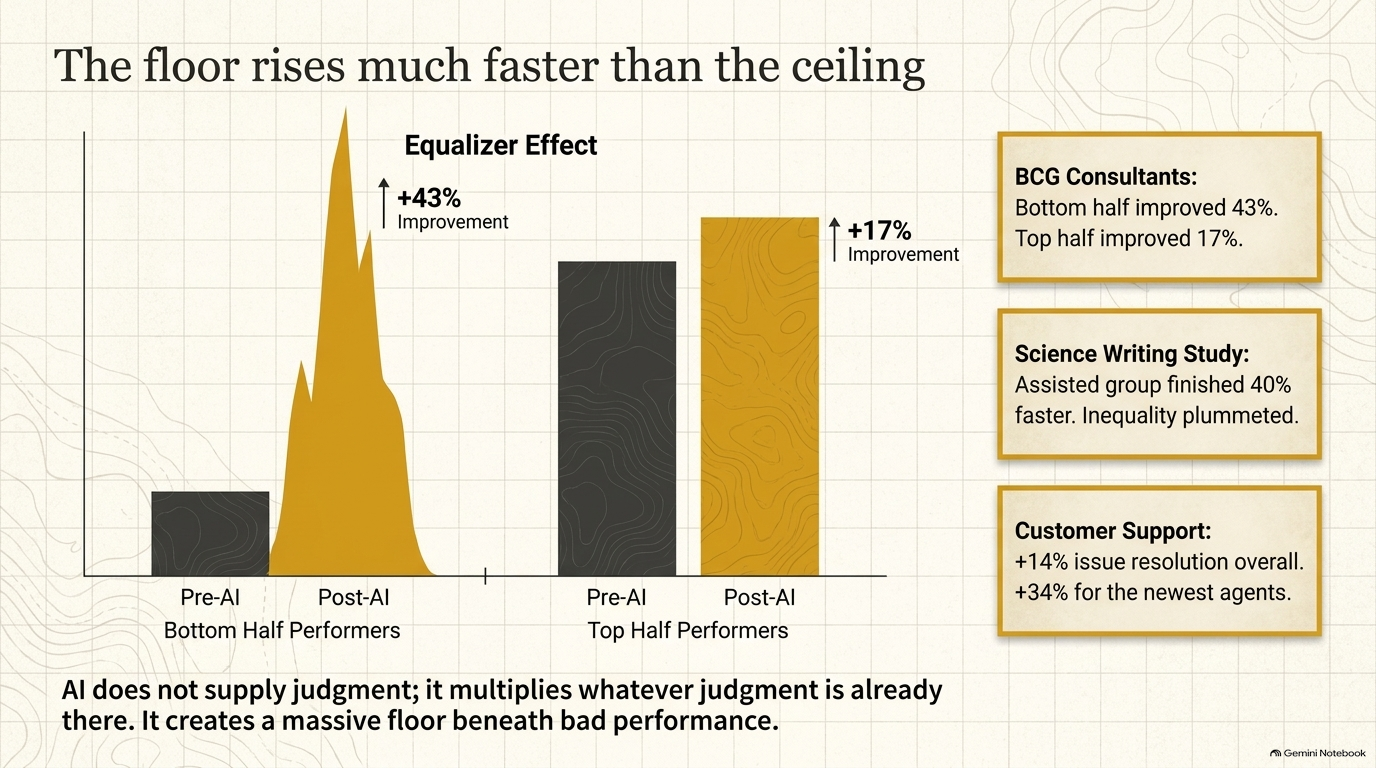
That is the opposite of what everyone predicts about this technology, including me, and it is the most replicated finding in the entire literature.
Then there is the structural thing, which is bigger than any individual study.
The Census Bureau counted a hundred and seventeen thousand American businesses with zero employees that cleared a million dollars in revenue in 2023. Roughly double the 2021 figure. Nearly eighty two percent of all US small businesses now have no employees at all. Twenty nine point eight million solo operators, one point seven trillion dollars, close to seven percent of the economy.
Stripe’s data team tracked the acceleration. The number of solopreneurs earning a million dollars has more than doubled since 2023. Businesses formed in 2025 reached a million in cumulative revenue about thirty percent faster than the 2023 cohort and roughly three times faster than the class of 2019. Solo founders made up sixty three percent of the corporations formed through Stripe Atlas in the second quarter of this year, an all time high. Their head of data calls it the nanocorp boom. And Census survey data shows solo business applications rising fastest in exactly the sectors with the highest AI adoption.
At the venture end, solo founded startups went from under a quarter of new companies in 2019 to more than a third by last year.
One person is now doing what a department used to do. Not metaphorically. In the incorporation filings. That’s why the slogan for one of my new solo startups is “multiplication, not subtraction.”
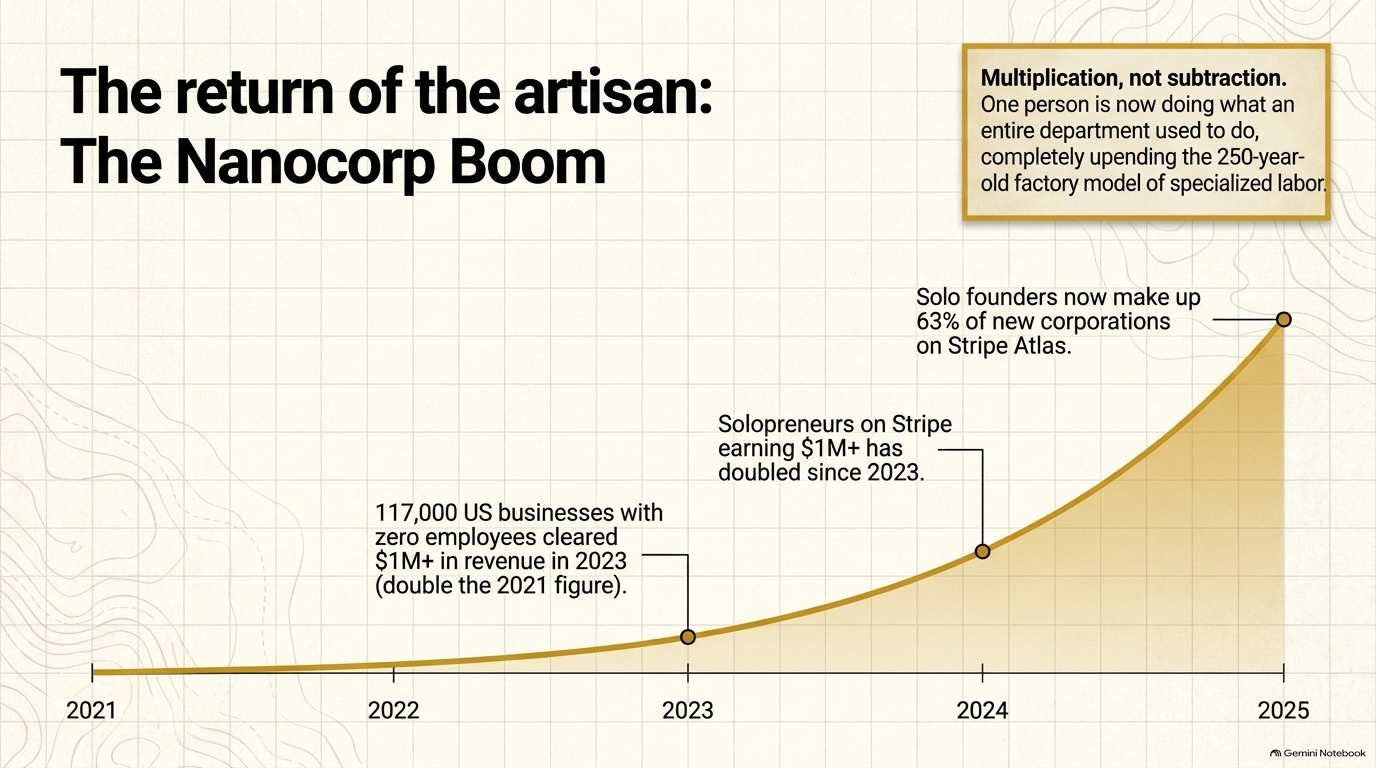
There is a writer I read who argues we are living through a second renaissance, where proof of work replaces the resume, an audience replaces the employer, and taste replaces credentials. That the modern job is only about two hundred and fifty years old, and that before the factory the ideal was a free person who ran an entire operation rather than one station on a line. The artisan. The farmer. The person who was both the thinker and the maker.
I think he is right, and I think the filings prove it faster than the argument does.
Every one of those studies measured people who already knew what good looked like. The BCG consultants could tell when the model was wrong. The support agents knew the product. The bottom half improved most because they had a floor to be raised toward, and somebody else had built that floor.
The leverage does not supply the judgment. It multiplies whatever judgment is already there, which means it will scale a bad offer, a wrong market, and busywork dressed as progress with exactly the same efficiency it scales a good idea. Which is why the person who wins here is not the one who adopted first.
Mark Twain is my favorite example, and not for the reason people expect.
Twain was not a Resistant. He had set type by hand as a young man and he understood exactly what mechanizing it would be worth. So when he saw James Paige’s compositor, a machine that set type by imitating the motions of a human hand across eighteen thousand moving parts, he called Paige the Shakespeare of mechanical invention and started writing checks. Over the years he put in somewhere between a hundred and eighty and three hundred thousand dollars, depending on which biographer is counting. Millions in today’s money. Some of it his wife’s inheritance.
Ottmar Mergenthaler built the Linotype instead. Fewer parts, cheaper, and it never tried to copy a hand at all. It just did the job differently. By the end of 1892 there were five hundred Linotypes running in newspaper pressrooms. In 1894 the Chicago Herald tried the Paige machine for sixty days, the type kept breaking, and it turned out only Paige himself knew how to fix it. Orders went from four thousand to zero.
Twain declared bankruptcy that year. Two Paige compositors were ever built. One sits in the basement of his house in Hartford.
He was not wrong that the revolution was coming. He was wrong about which machine was carrying it, and he was wrong because he fell in love with the one that most resembled a person.
Then he did the thing that makes him worth citing. He went on a lecture tour around the world, at fifty nine years old, and paid back every creditor he was no longer legally obligated to pay.
He updated the map. He kept moving.
So what the Pioneers do not get is that the thing separating them was never courage. It was that they never took their hands off the wheel. The moment a pioneer stops arguing with the output, they stop being a pioneer and become the thing they were certain they would never be, which is a person who believes whatever appears on the screen.
There is also a cost my group is not pricing. These gains are skill biased. They accrue fastest to people who already had the underlying expertise, which means this technology, left alone, widens the distance between people rather than closing it. Anthropic’s own researchers name it in their discussion section. Being early is not a virtue. It is an advantage, and advantages compound quietly into inequality unless somebody says so out loud.
Which cuts against the most hopeful thing in my own map, and both are true at once. AI tutoring compresses the access gap, because a floor under bad instruction now costs twenty dollars a year. It simultaneously widens the facility gap, because knowing how to use it well is itself an acquired advantage. The Stanford tutors who helped their students most were the worst rated ones. The Nigerian students who gained most were also the ones with the strongest baselines.
Like all things, it is complicated.
Stanford’s Digital Economy Lab has been watching payroll records from ADP, millions of workers, and they revised their findings again this month.
There is no broad AI jobs collapse. That story is not in the data.
What is in the data is this : Workers aged twenty two to twenty five in the most AI exposed occupations are now roughly nineteen percent below where they would be if their employment had tracked their less exposed peers. In absolute terms, employment for that age group in the most exposed occupations fell about eleven percent since late 2022 while their less exposed peers grew about ten. Experienced workers in the same occupations show no comparable gap. It concentrates where AI automates rather than augments. And it is not layoffs. It is hiring that never happened.
The researchers named the project after the birds miners carried underground. The canary never saved anyone. It told you the clock was running.
So the young people are absorbing this first, silently, in the form of jobs that were never posted, while three groups of adults argue about whether the technology is good.
Nobody in that argument is wrong about everything. The Resistant are right that there is a real cost, a real skew, and a real risk of atrophy. The Casuals are right that we adapt, and the proof is already stacking up in standards bodies and camera firmware. The Pioneers are right that something enormous is available to anyone willing to learn it.
Every one of them is holding a map. Every map is woefully incomplete.
There is a line everyone attributes to Mark Twain. It ain’t what you don’t know that gets you into trouble, it’s what you know for sure that just ain’t so.
Twain never said it. Scholars at the Center for Mark Twain Studies have looked and found nothing. It probably belongs to Josh Billings, who wrote in 1874 that it is better to know nothing than to know what ain’t so, and it has been hung on Twain since at least 1899. It opened The Big Short. It appeared in An Inconvenient Truth. Mondale used a version of it against Reagan and credited Will Rogers.
A quote about believing things that are not true has been believed by everyone for a hundred and twenty five years, and it is not true.
I could not have written a better ending if I tried.
The only difference that has ever mattered between people navigating unfamiliar country is not which map they started with.
It is whether they were willing to correct it while moving.
I do this work with couples. Two people, two maps, both certain, both partial, each convinced the other is the problem. The work is never getting them to agree. The work is getting them to hold the map loosely enough to notice where it stopped matching the ground.
Same skill. Bigger territory.
Progress will not wait for you to get comfortable. It never has, and it never will.
The question is not which of the three you are.
The question is whether you are willing to be curious and update your map.
Sources
Energy. International Energy Agency, Energy and AI and Key Questions on Energy and AI. Data center electricity ~485 TWh in 2025, projected ~950 TWh by 2030, growing more than four times faster than other sectors. iea.org
Netflix and query energy. IEA (George Kamiya, 2020) for streaming at 0.12–0.24 kWh per hour; Sam Altman’s public estimate of 0.34 Wh per ChatGPT query, June 2025. Both are contested figures from interested or dated sources.
Standby power. US Department of Energy, 5–10% of residential consumption. Natural Resources Defense Council idle load study, 23% of the average American home, and the smart TV wake feature analysis. nrdc.org
Water. Google 2026 Environmental Report, 10.9 billion gallons in 2025. UC Riverside and Caltech on peak demand and the $10–58 billion infrastructure estimate, via Forbes. Microsoft closed loop cooling: Microsoft Cloud Blog. Google’s water stewardship commitments, June 2026: blog.google.
The efficiency precedent. Masanet, Shehabi, Lei, Smith and Koomey, “Recalibrating global data center energy-use estimates,” Science, 2020. science.org
Training data and sovereignty. Common Crawl language distribution, arXiv:2411.14343. CARE Principles, Global Indigenous Data Alliance. OCAP, First Nations Information Governance Centre. Traditional Knowledge Labels and Mukurtu, Local Contexts. Cherokee Nation AI and data sovereignty task force, UBC CTLT.
Language inclusion. Masakhane. Lelapa AI’s InkubaLM, Princeton Africa World. Google WAXAL and the Cohere HausaNLP partnership, African Business.
Data labor. Washington Post investigation on Remotasks in the Philippines, via Business and Human Rights Resource Centre. Venezuelan wage data, The Conversation. TIME investigation into Sama and OpenAI, corroborated by CBS News. Equidem survey and Oxford Fairwork findings, via Brookings. Karya: karya.in and TIME.
Nigeria. De Simone, Tiberti, Barron Rodriguez, Manolio, Mosuro and Dikoru, From Chalkboards to Chatbots, World Bank Policy Research Working Paper 11125, 2025. openknowledge.worldbank.org
Harvard. Kestin, Miller, Klales, Milbourne and Ponti, “AI tutoring outperforms in-class active learning,” Scientific Reports 15:17458, 2025. nature.com
Stanford tutoring. Wang et al., Tutor CoPilot, arXiv:2410.03017. arxiv.org The study found no statistically significant improvement in end-of-year math scores, which the authors state directly.
Meta-analyses. Liu, Zuo and Lu, Journal of Computer Assisted Learning, 2025 (g = 0.577). Doo and Park, IRRODL 27(1), 2026 (g = 0.573). Humanities and Social Sciences Communications 13:684, 2026 (g = 0.670).
Turkish study. Bastani, Bastani, Sungu, Ge, Kabakcı and Mariman, “Generative AI Can Harm Learning,” Stanford SCALE / SSRN 4895486. scale.stanford.edu
Calculators. Hembree and Dessart, “Effects of Hand-Held Calculators in Precollege Mathematics Education: A Meta-Analysis,” Journal for Research in Mathematics Education 17(2), 1986. pubs.nctm.org Replicated by Ellington across 54 studies in 2003.
Adoption. Pew Research Center, Americans and AI 2026, n=5,119, February 2026. pewresearch.org OpenAI and Google user and subscriber disclosures via TechCrunch and Reuters. The paid and agentic tiers in the chart are cross-vendor estimates, not company disclosures.
Provenance. C2PA membership and limitations, truescreen.io and Pebblous.
METR. “Measuring the Impact of Early-2025 AI on Experienced Open-Source Developer Productivity,” July 2025, and the February 2026 revision. metr.org
MIT NANDA. The GenAI Divide: State of AI in Business 2025, MIT Project NANDA, 2025.
Anthropic. Anthropic Economic Index: Learning curves, March 2026. anthropic.com
Productivity studies. Noy and Zhang, “Experimental evidence on the productivity effects of generative artificial intelligence,” Science, 2023. science.org Brynjolfsson, Li and Raymond on 5,172 support agents. Dell’Acqua et al., “Navigating the Jagged Technological Frontier,” 758 BCG consultants. oneusefulthing.org Peng et al. on GitHub Copilot.
Solo business data. US Census Bureau Nonemployer Statistics. Stripe data presented by Emily Sands at Stripe Sessions 2026. Carta via Bloomberg on solo-founded startups. aidailybrief.ai
Labor market. Brynjolfsson, Chandar and Chen, Canaries in the Coal Mine?, Stanford Digital Economy Lab, revised August 2026. digitaleconomy.stanford.edu The authors describe these as descriptive indicators rather than causal estimates.
Twain. On the Paige Compositor: Wikipedia, Codex99, and the Mark Twain House, Hartford. On the misattributed quote: Quote Investigator, citing the Center for Mark Twain Studies at Elmira College.
