
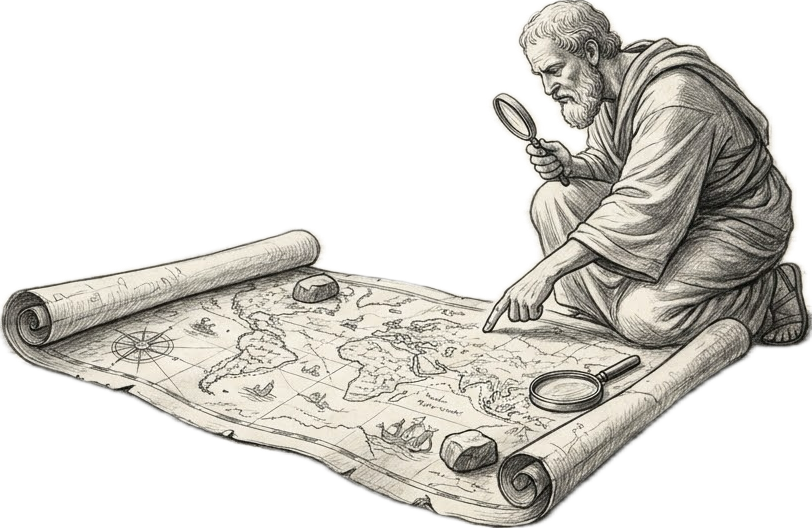
Johannes Kepler arrived in Prague in February 1600 to work as an assistant to Tycho Brahe.
Brahe was the most precise observational astronomer in Europe. For thirty years he had measured the positions of stars and planets to an accuracy nobody else had achieved. He had spent a fortune building instruments. He had filled volumes with data. And he had a perspective.
He was certain, but he was wrong.
Brahe believed the Earth sat at the center, the moon and sun orbited the Earth, and the other planets orbited the sun. It was a hybrid system. He had inherited part of it from Aristotle and Ptolemy. Part of it he had built himself.
He had given decades to defending it.
A year and a half after Kepler arrived, Brahe died. The data passed to Kepler.
Kepler had his own inherited assumption. He believed the planets moved in perfect circles. The circles were Plato's. The circles were Copernicus's. The circles were everyone's. They had been the orthodoxy for almost two thousand years.
He spent eight years fighting Mars.
The data refused. The circles refused. Kepler kept calculating, kept trying to bend the orbit into a clean curve, kept failing. He documented every failure. He filled notebooks. Six hundred pages of arithmetic for one planet. Eight years.
Eventually he did something radical. He threw out the circles. He kept the data.
The orbit was an ellipse.
The idea had been wrong for two millennia. The reality had been there the whole time.
Most of us, when something we inherited starts cracking, do one of two things.
We defend. We mistake our map for the territory. We tell ourselves that giving it up means giving up the thing it was reaching for. The marriage. The faith. The career. The loyalty. The story of what kind of person we are. We hold on because letting go feels like losing the ground, or worse our self identity.
Or we burn it. We torch the whole structure. We tell ourselves what is gone is gone, the territory was a fiction, we were fools to believe any of it. We feel free for a while. Then we notice we have no relationship to the thing it was reaching for. The thing did not stop existing because we set fire to the picture of it.
Kepler did neither.
He saved the data and let the inherited map die.
This is the move Korzybski named in 1933. We do not see reality directly. We see compressions, simplifications, renderings. But the rendering always points at something. When the rendering stops working, the something is still there.
Examining and burning look similar from the outside. They are opposite moves.
Burning takes the territory down with the rendering.
Examining separates them.
We all inherited ideas:
About what love is. About what marriage is supposed to look like. About what counts as success. About what a man owes his father. About what a woman is supposed to want. About what happens to people who leave the church. About what your family expects of you. About what counts as wasted time.
Some of those are cracking right now.
That is why you are here.
The temptation in both directions is strong. Defend the structure until it becomes a cage and you become its captive. Or torch the whole thing and call it liberation while quietly losing access to the real thing underneath.
There is a third way. Examine.
Examination is structured. It has to be. If we stare at a cracking framework and ask whether we still believe it, we get nowhere. Belief is not the question. The map is not asking to be believed. It is asking to be made visible.
So I have developed the MAPSS Check.
The MAPSS Check is the tool. Five layers, descended one at a time.
Trigger. What turns it on. The map does not run at full volume. Something fires it.
Attribution. Where it points the finger. Every model reaches for a default explanation first.
Survival function. What the script protected. The script was not stupid. It worked once. The descent finds what it worked for.
Body state. What it produces in your nervous system. Inherited models are not just thoughts. They are grooves in the body that fire before language arrives.
Core need. What real need the construction was meeting. The need is not the problem. The construction was the delivery system.
Then the test. The most important move in the descent. The map pointed at something. What was that something? Not the map. The thing it was reaching for.
That is the Kepler move. Throw out the circles. Keep the data.
Then a four-part inventory. What stays. What goes. What gets re-mapped. What stays loose because you are not yet ready to decide. Held loosely is a valid resting place. Some maps stay partial. That is fine.
Then one action. Specific. Doable inside seven days. Something the old script would have prevented.
Then a card with all of it on one page.
This prompt does not tell you what your new map should be. I designed it to let that work be yours. The MAPSS Check is examination, not installation. If you wanted a tool that handed you a replacement, you would join a cult and abandon critical thinking. But that is how we arrived here.
The work is not no maps. The work is more honest mapping.
The prompt itself is gated behind a short email capture on the Inherited Maps page. Drop your email there and it lands in your inbox. Run it in Claude. The free version is fine. ChatGPT will not run this correctly. Run it on one map. Whichever one is loudest right now.
Religious belief. Family-of-origin script. Professional identity. Gender expectation. Marriage model. Definition of success. Pick one.
Kepler took eight years to let the circles go.
You probably do not have eight years to spare.
Continue reading
→ The Map Is Not the Territory: Where the Idea Came From
→ Knowing Your Attachment Style Is Not the Same as Changing Your Relationship
