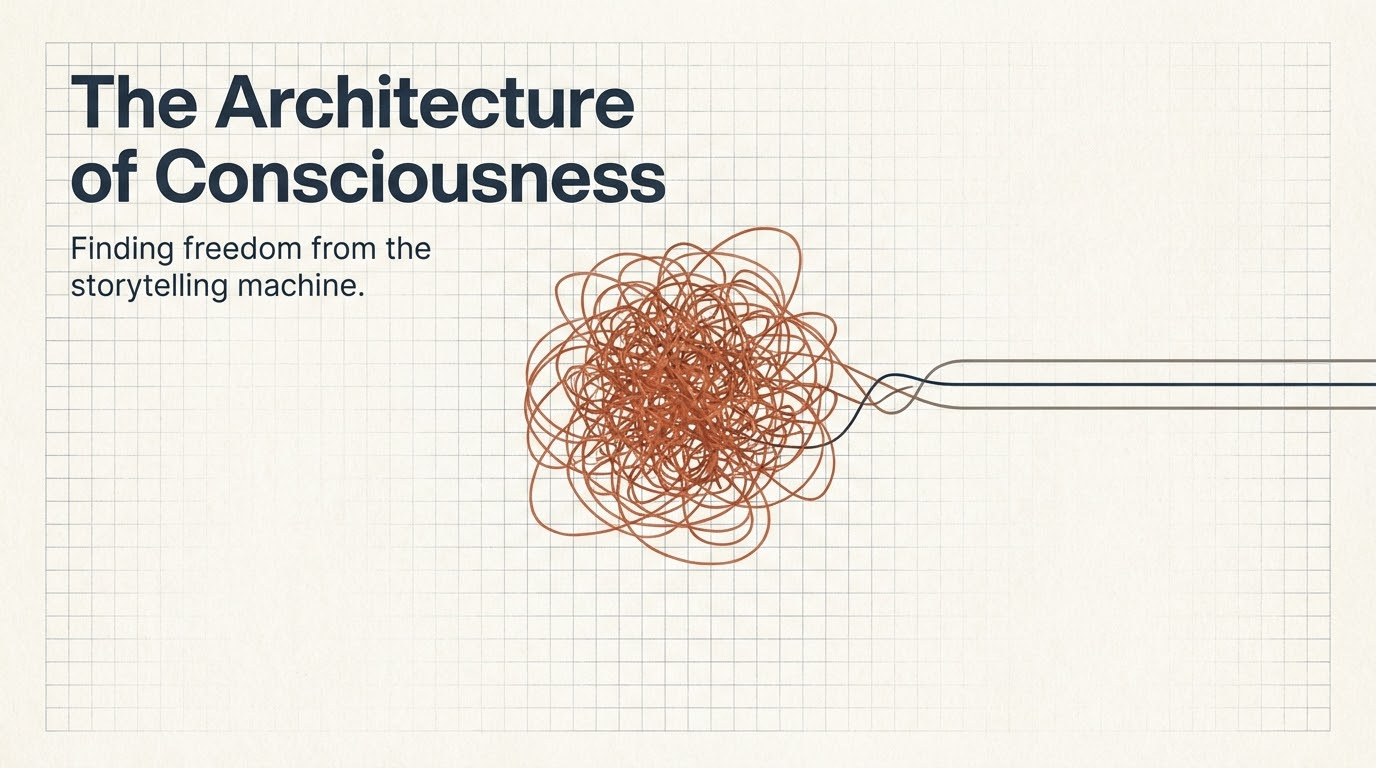
In 2007, a neuroscientist named Marcus Raichle published a paper that irritated half his field and fascinated the other half. He had discovered that the brain is never quiet. Even when a person is lying still in a scanner, doing nothing, no task, no stimulus, no problem to solve, a network of regions lights up and starts talking to itself. He called it the default mode network. Other researchers started calling it what it actually is: the storytelling machine.
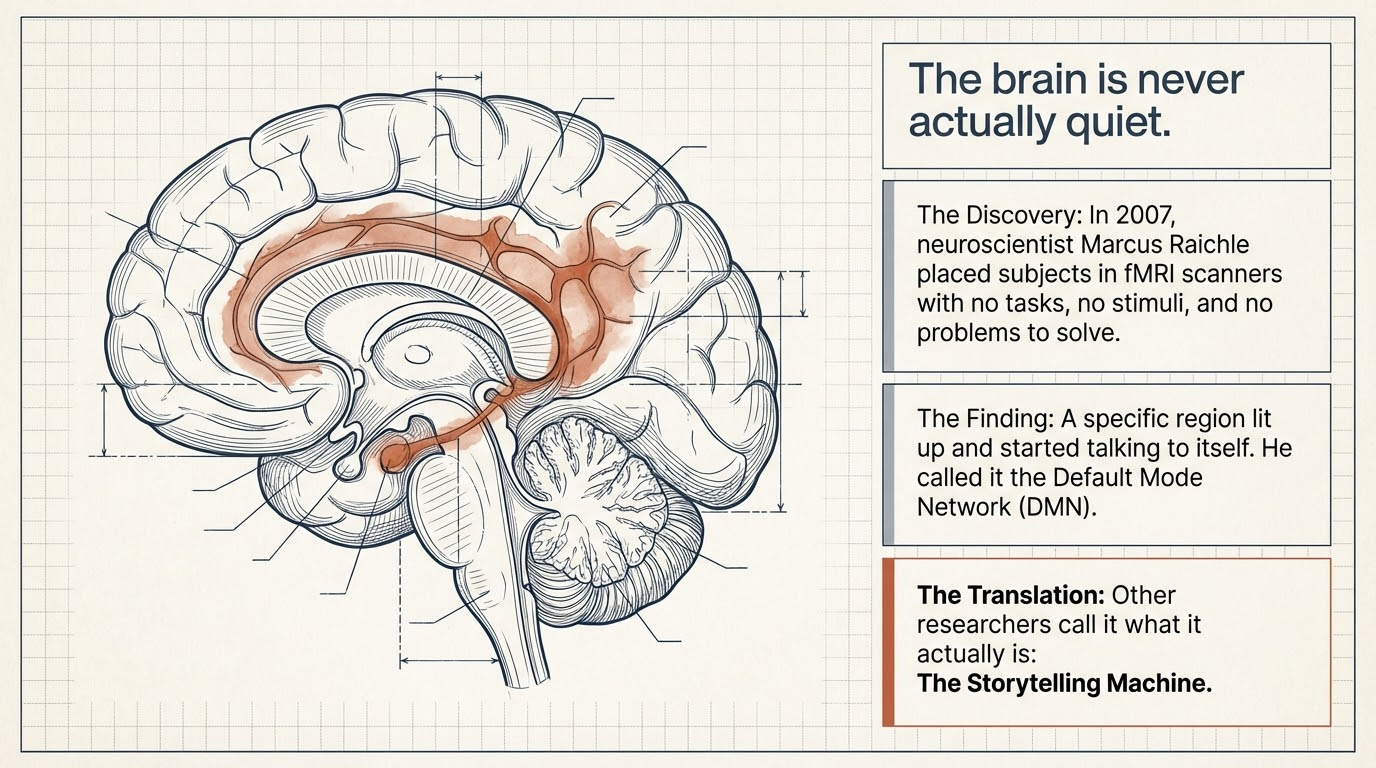
The default mode network activates when you are not paying attention to anything external. It is the part of your brain that narrates your life. It replays conversations. It rehearses future arguments. It explains other people’s motives to you with a confidence that would be impressive if it weren’t almost always wrong. It constructs a running monologue so constant, so seamless, so automatic that most people never notice it’s happening. They think the monologue is them.
That mistake , the conflation of the narrator with the self , may be the most expensive error a human being can make in a relationship.
Here’s how it plays out. You’re sitting across from someone you love. They say something, maybe it’s about the dishes, maybe it’s about a trip they want to take, maybe it’s about how they’ve been feeling lately. Before they finish the sentence, the narrator is already running. He doesn’t mean that. She’s saying that because of what happened Thursday. This is going to turn into a fight. I need to get ahead of this. I should say something now before it gets worse.
None of that is the person talking. All of it is the narrator , the default mode network running its prediction engine, pulling from old data, constructing a story about what is happening that may have nothing to do with what is actually happening.
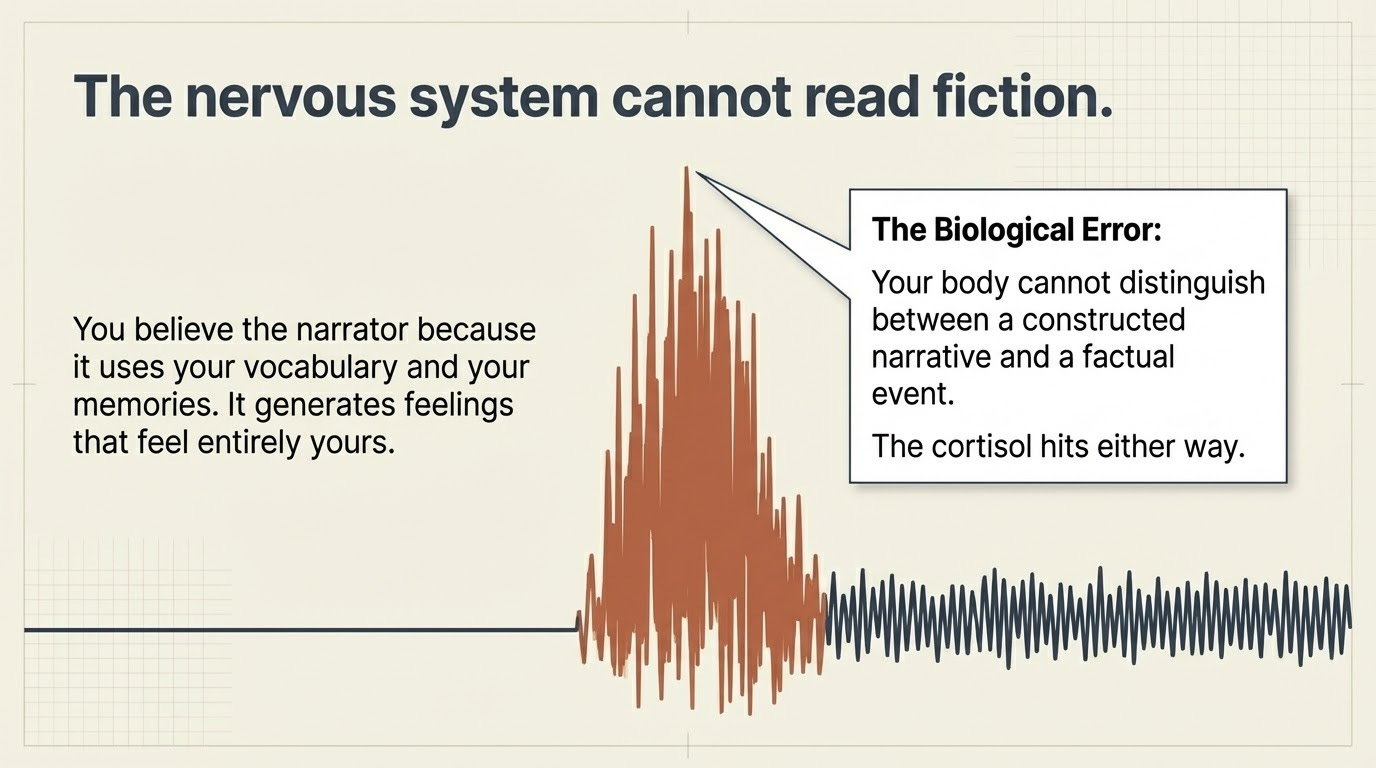
And you believe it. You believe it the way you believe your own name. Because it sounds like you. It uses your vocabulary. It has your memories. It even has your feelings , or rather, it generates feelings that feel like yours, because your nervous system responds to the narrator’s stories the way it would respond to real events. Your body cannot distinguish between a narrative and a fact. The cortisol hits either way.
Michael Singer puts it simply enough that it’s easy to miss how radical the claim actually is: you are not your thoughts. You are not your feelings. You are not your body. You are the awareness in front of which all of those things appear.
That sounds like a bumper sticker until you test it.
Notice the voice in your head right now. The one that is evaluating this sentence. The one that is deciding whether it agrees, whether it’s useful, whether it sounds too abstract. That voice is happening. You can hear it. Which means there is a you that is hearing it. The voice and the listener are not the same entity. They can’t be. Because the listener can observe the voice, which means the listener exists prior to it, outside of it, in a position from which the voice can be witnessed rather than obeyed.
This is not philosophy. It is architecture. It is the structural reality of consciousness that anyone can verify in about ten seconds of honest attention.
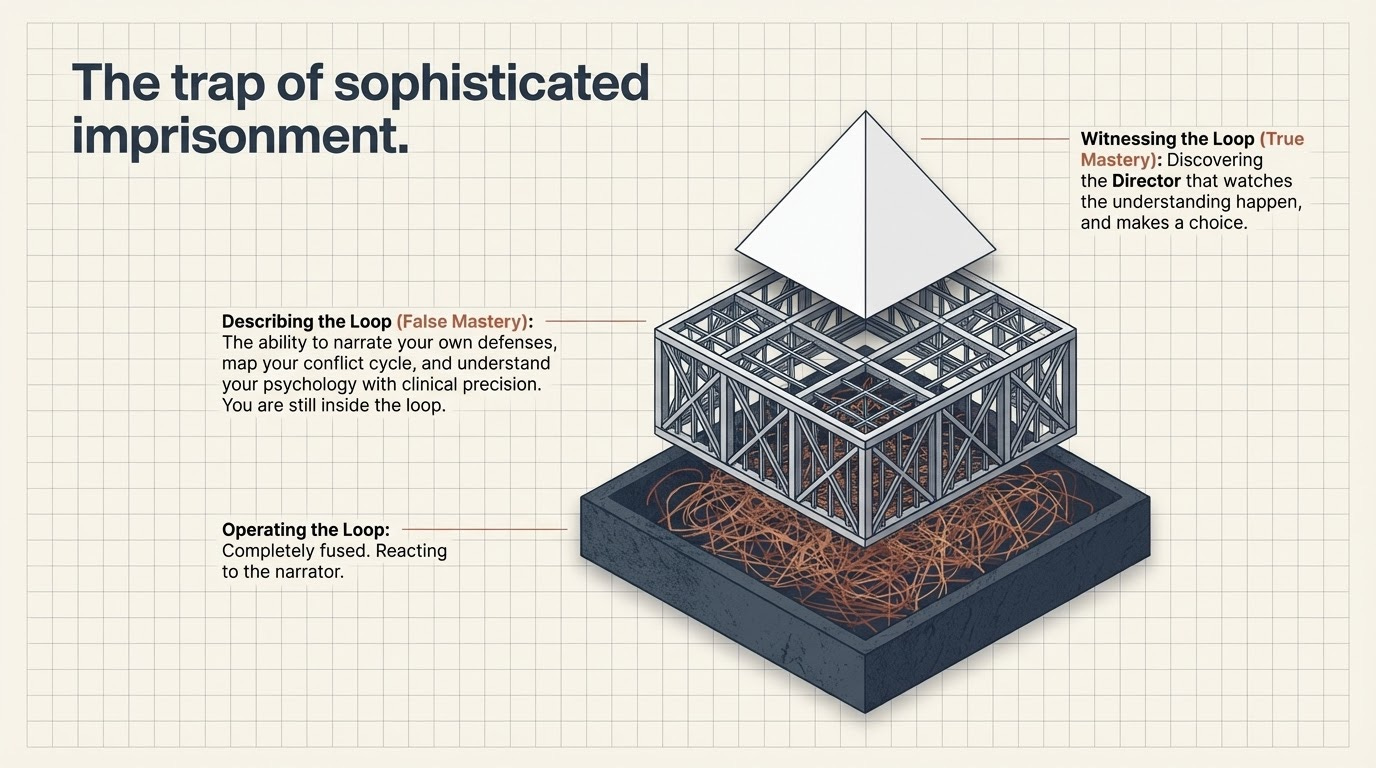
I spent years in the grip of the narrator and thought I was being insightful. The voice in my head could explain my wife’s motives, my own defenses, the entire architecture of our conflict cycle, with clinical precision. I could narrate the pattern while running the pattern. Describe the loop while living inside the loop. And I confused the narration for mastery.
It wasn’t mastery.
It was the most sophisticated form of imprisonment available to an intelligent person.
The breakthrough was not understanding the pattern better. I already understood it. The breakthrough was discovering that the part of me doing the understanding, the part that felt the rejection, named the dismissal, mapped the whole war, was not the deepest part.
It was not the true me.
There was something above the understanding, something that could watch it happen and choose.
Like a director.
The narrator would notice the well of defensiveness rise as rage. It would show me the future of my actions in vivid frames: “Get up now and move toward the door, slam it, mutter an obscenity.”
“Protect yourself, you don’t have to take this shit.”
But now, instead of obeying that instinctual protector, instead of armoring up, going cold, becoming defensive, I could notice the instruction and stay.
Breathe.
Float back.
Untether.
Detach from the avatar.
I am the one who sees.
I am aware of what is before me.
I live here.
Data.
Not direction.
Now direct.
Notice the primary emotion.
Breathe in.
He’s hurt, not angry.
Now choose.
Breathe out.
Express.
Vulnerable.
Softly.
Breathe in.
The neuroscience on this is not speculative. When researchers put experienced meditators in an fMRI scanner and ask them to observe their thoughts rather than engage with them, something measurable happens. Activity in the default mode network decreases. Activity in the prefrontal cortex, the region associated with executive function, perspective-taking, and deliberate choice, increases. The brain is doing something structurally different when you witness a thought versus when you ride it. The observer state is not a metaphor. It is a measurable neural configuration.
And it can be built. Not through years of silent retreat, though that works too, but through the repeated practice of stepping back from the narrator just enough to see that the narrator is not the whole story. You don’t have to silence the voice. You can’t silence it, actually.
That’s another map that gets mistaken for territory, the idea that peace requires a quiet mind. It doesn’t. Peace requires a self that is not fused with the noise.
But here’s the thing.
The voice in your head is not the enemy. It is a survival tool. It was built to predict threat, manage proximity, and keep you safe in a world that was genuinely dangerous when you were small. It is doing its job. The problem is not the voice. The problem is the assumption that the voice is you, that its predictions are your perceptions, that its stories are your reality, that its urgency is your truth.
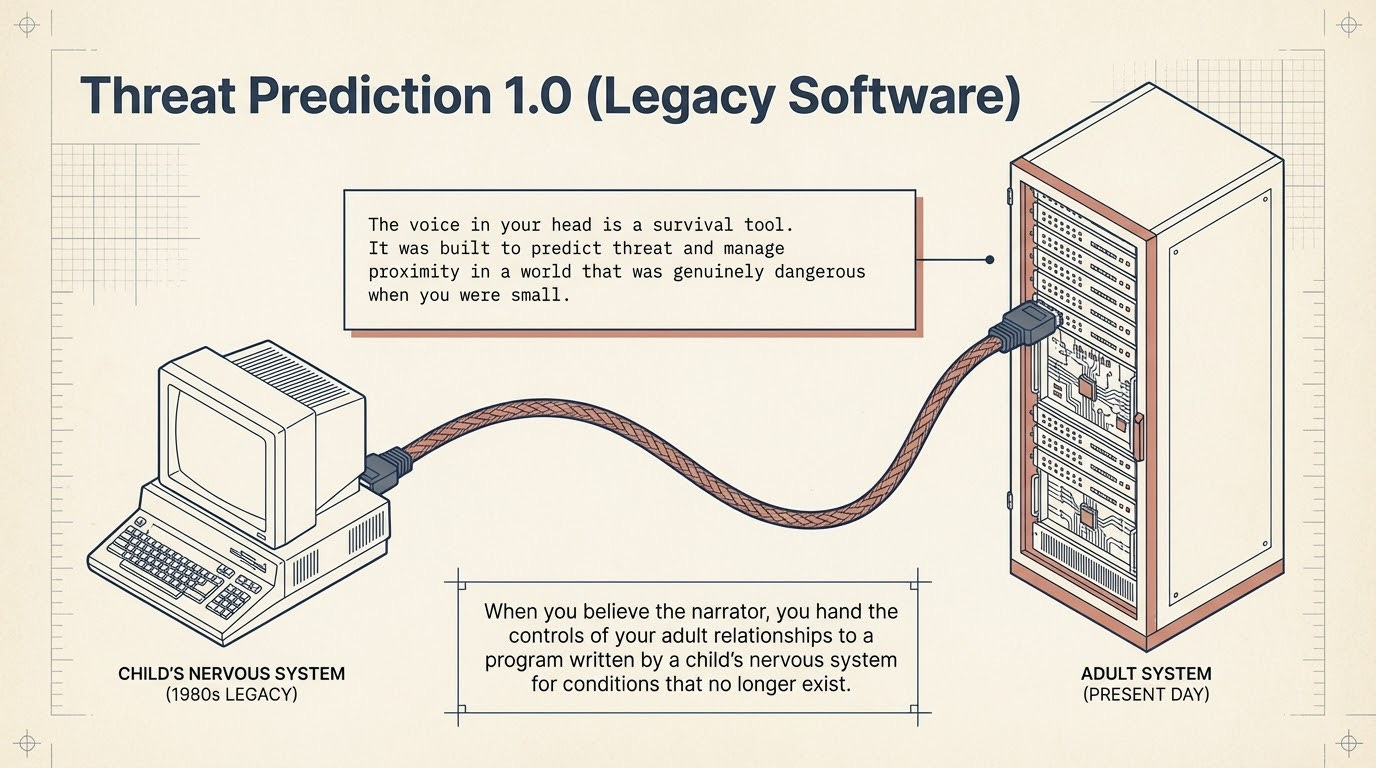
When you believe the narrator, you hand the controls of your closest relationships to a program that was written by a child’s nervous system in response to conditions that no longer exist. The narrator doesn’t know your partner. It knows the template your partner has been filed under. It doesn’t know what’s happening right now. It knows what happened before and assumes the rerun is playing.
You’ve had the experience. You know exactly what I’m describing. The moment your partner says something and you feel the story start, the whole cascade of interpretation and prediction and preemptive defense, and by the time you open your mouth, you’re not responding to what they said. You’re responding to what the narrator told you they meant.
This is one of the most important principles of the Map is Not the Territory: We are not responding to what happens. We are not responding to what is said. We are not responding to what wasn’t said or what wasn’t done.
We are responding to what it means to us.
And they can feel it.
They can feel that you’re not talking to them. You’re talking to your story about them. The loneliness that produces, on both sides, is the quiet engine of most relational decay. Not malice. Not incompatibility. Just two people talking to their narrators while the actual person sits right there, unseen.
What if you could hear the narrator start and simply observe it.
Not suppress it. Not override it with a better thought. Not positive-self-talk your way out of it. Just hear it, the way you hear the weather, this is happening, it is not me, I do not have to go where it wants to take me.
That’s not a technique.
That’s a location.
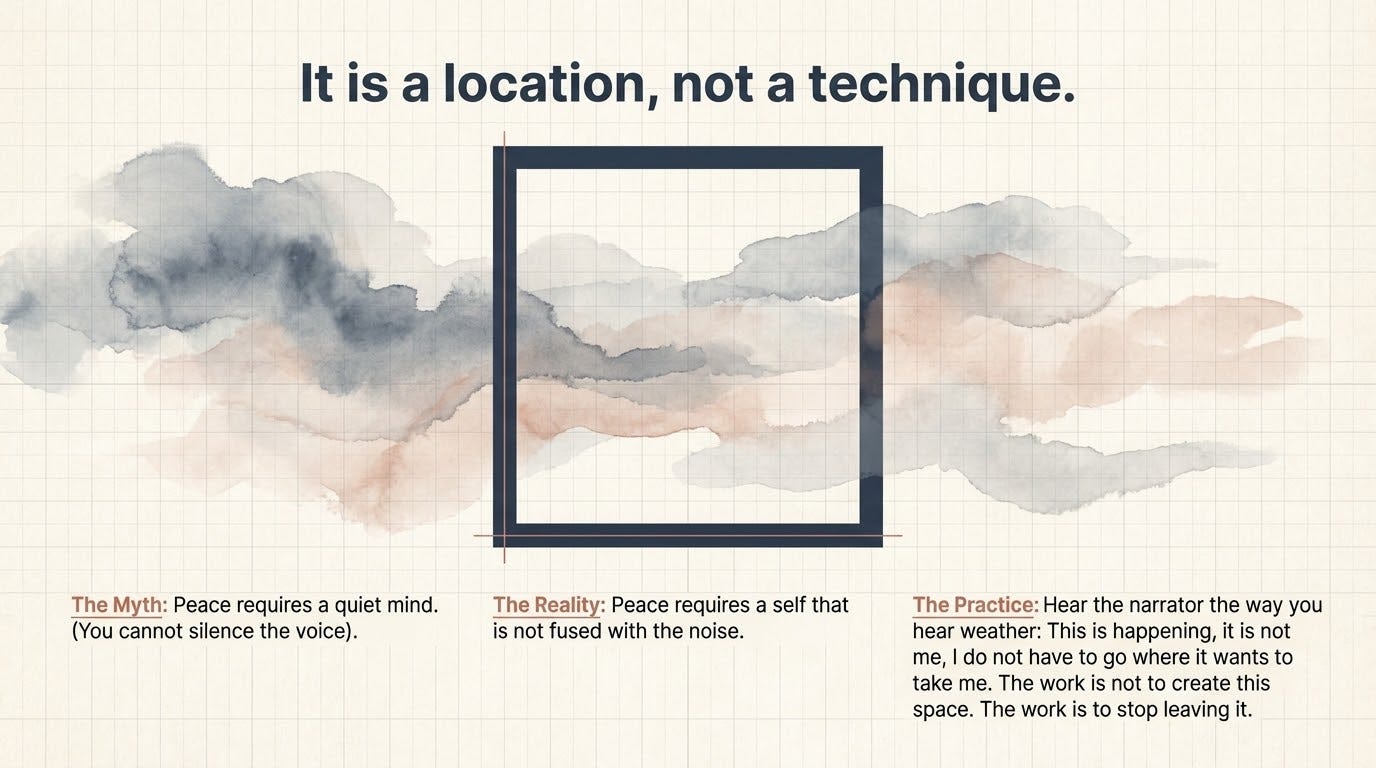
It is the place you already are when you’re not fused with the noise. You’ve been there before, in moments of genuine presence, in the seconds after laughter, in the rare conversations where you forgot to monitor and just listened. You know what it feels like. The work is not to create it. The work is to stop leaving it.
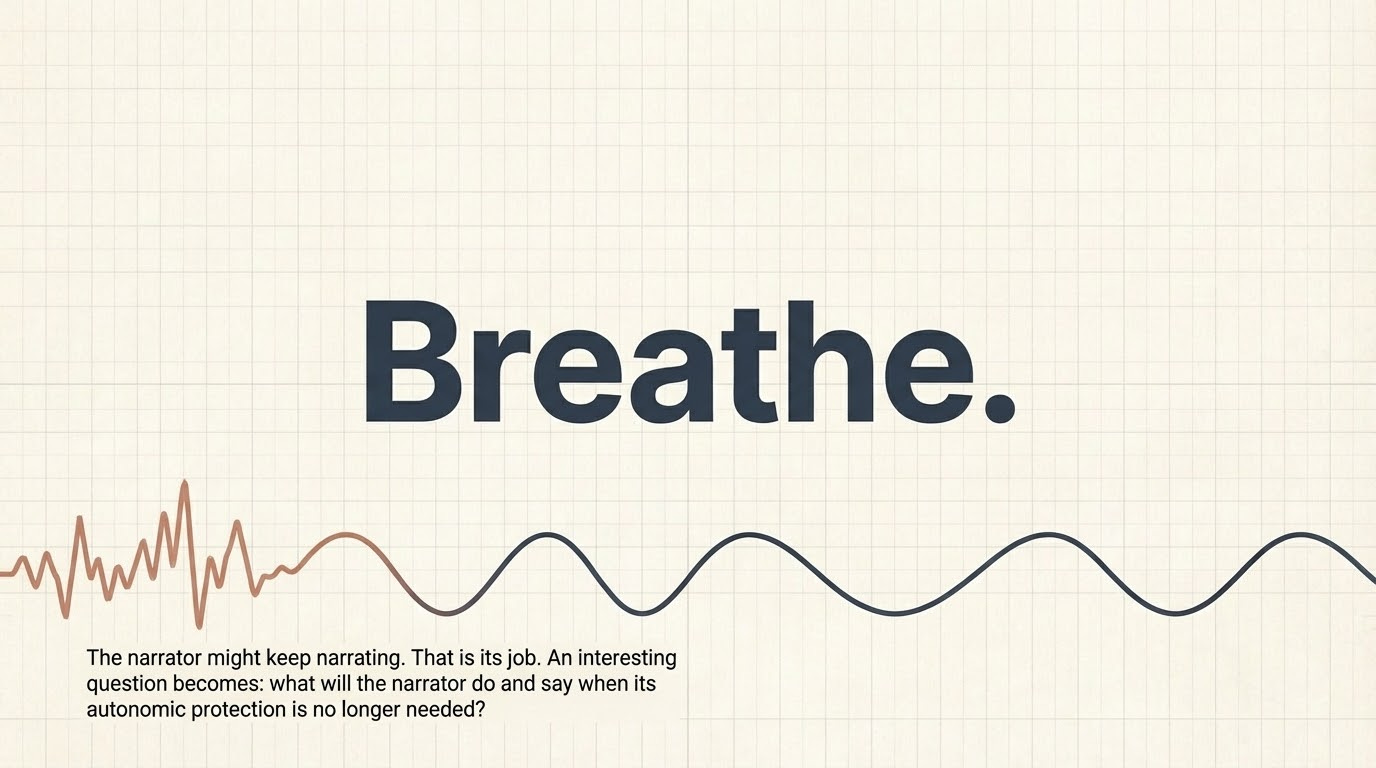
The narrator might keep narrating.
That’s its job.
An interesting question will become, what will the narrator do and say when it’s autonomic protection is not needed?
You might feel weird right now. It’s ok.
Breathe.